If you missed our recent top reads:
“You can’t unbake the omelet.”
- Jim Jarrell, CEO of Linamar, on the integration level of the North American automotive supply chain
Once an egg has been beaten, poured into a pan, and cooked into an omelet, you cannot separate it back into the yolk, the white, and the original individual ingredients.
The North American supply chain is the same.
After three decades of NAFTA and then USMCA, the U.S., Canada, and Mexico no longer operate as three separate manufacturing economies. A car, an engine, a component, or an industrial shipment may cross borders multiple times before reaching the consumer. In customs data, that is international trade. In manufacturing reality, it is a shared assembly line spanning three countries.
There are borders that exist very clearly on maps, but they almost disappear in real economic life. The border between Detroit and Windsor is one such example.
An automotive component can pass through the U.S., Canada, and Mexico multiple times before becoming part of a finished vehicle. In customs ledgers, that is international trade. But in manufacturing reality, it is like a single factory line - only divided by three flags, a few border checkpoints, and tens of thousands of pages of trade regulations.
That is why the USMCA cannot be understood simply as a tariff agreement. It is the operating system of the North American manufacturing economy. It determines where companies locate factories, how banks price risk, where workers are hired, how the CAD and peso react, and ultimately how much U.S. consumers pay for a car, a tomato, or a home appliance.
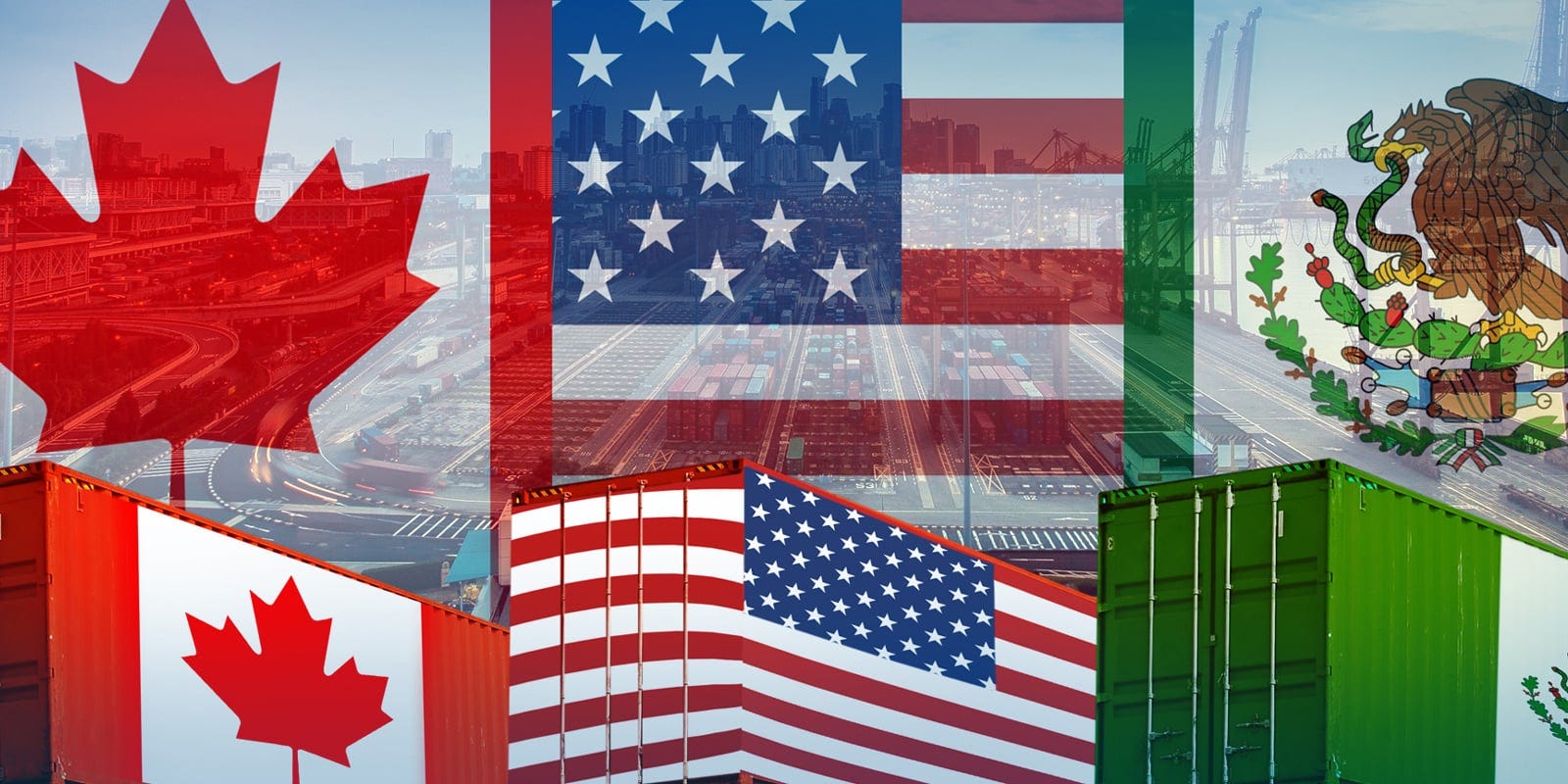
On July 1, 2026, the Trump administration declined to extend the USMCA long-term - the very agreement that Trump once called one of the most important trade deals for the U.S. But the key point is this: The U.S. did not withdraw from the USMCA. The agreement is not dead. No tariff streams immediately reverted to MFN levels. There was no “Lehman moment” shock in North American trade.
Instead, North America has entered a more dangerous state: The USMCA remains in effect, but it no longer provides what businesses need most when making long-term investment decisions - certainty.
This is the central paradox of the story.
The USMCA is not dead. But precisely because it is not dead, the risk has become harder to price.
A clear collapse gives businesses a specific date to react. A new tariff level allows a CFO to plug a number into a model. A clear policy deadline helps a factory adjust its production plan. But an agreement that still exists, is still reviewed annually, can still be changed at any time, and is still threatened by a six-month unilateral withdrawal right - that is a different kind of risk.
It does not hit the economy with a shock. It hits by making every long-term decision harder to trust.
This is the type of risk to which financial markets often react slowly, but the real economy feels very early. A stock may not have plummeted yet because no cash flow has disappeared today. But a factory project may be postponed. A supplier may open an additional facility elsewhere as a hedge. A bank may increase the spread on a manufacturing investment loan. A CFO may raise the hurdle rate for all projects related to North America.
In other words, the real risk of USMCA 2026 is not collapse. It is erosion7.2. Once lost, trust is hard to regain
It is not that North America stops trading overnight. It is that businesses stop investing as if North America will remain a stable, shared project for the next 10, 20, or 30 years.
This article will go through eight layers of analysis:
Part I - What July 1 really means: why “not extending” does not mean “termination”.
Part II - Why the USMCA is the production structure of North America, not just a trade agreement.
Part III - Canada: A G7 economy with “single-customer” risk.
Part IV - Mexico: The winner of nearshoring must prove it is not a backdoor for China.
Part V - The U.S.: Using uncertainty as leverage can create reverse costs for U.S. businesses and consumers themselves.
Part VI - Rules of origin: from “made in North America” to “made mostly in America”.
Part VII - The real price: not collapse, but erosion.
Part VIII - Three scenarios for the next 12 months.