Note: Recently, many readers have not been receiving Viet Hustler articles as the automated email system has been flagging them as Spam due to declining engagement rates. Viet Hustler and Tạp Chí Phố Wall continue to operate in parallel with no changes.
Account migration portal from Viet Hustler to Tạp Chí Phố Wall:
Enter your Viet Hustler account email
Receive a coupon via email for the unused balance from Viet Hustler
Use the coupon to register for a Tạp Chí Phố Wall account
You must manually cancel/turn off auto-renew for Viet Hustler on Substack
https://tapchiphowall.com/viethustler

If you missed our best recent articles:
The AI Token Economy, Tokenmaxxing & The AI Physical Bottleneck
6 Signals to Determine the Strength of the U.S. Economy in 2026
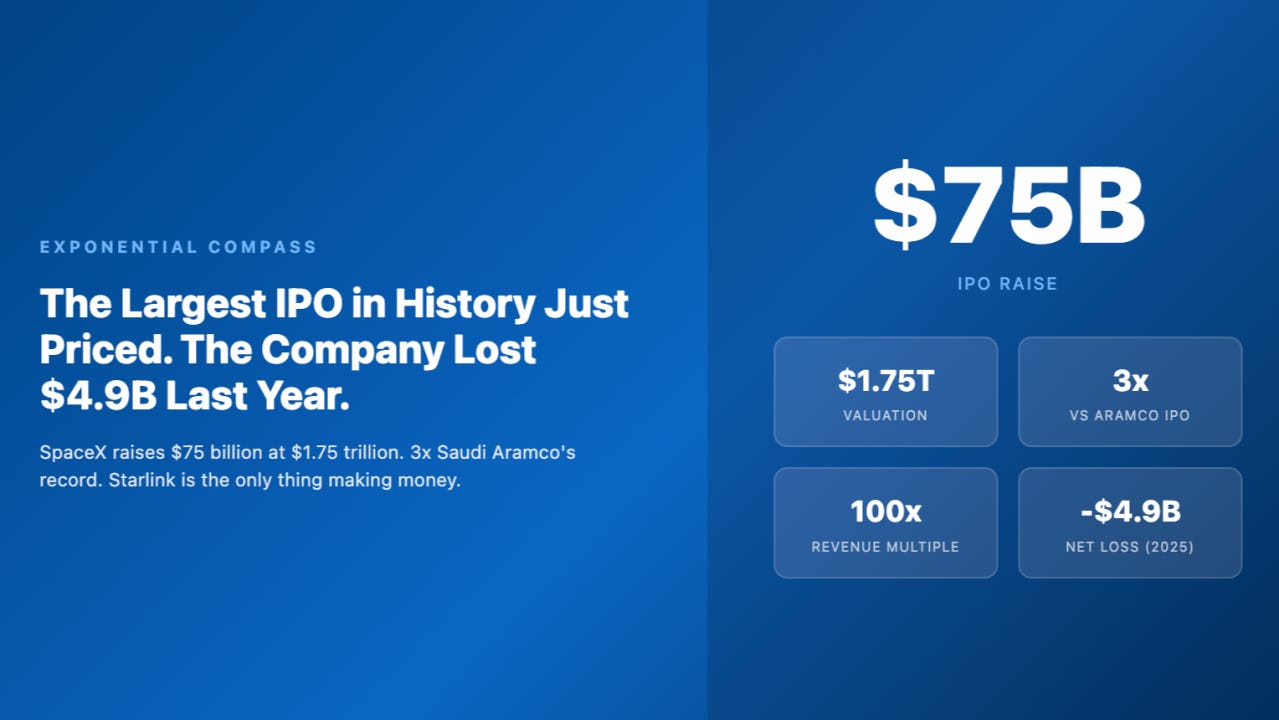
$2 trillion is the price tag for SpaceX-a company that just lost $4.9 billion last year.
The figure sounds absurd, but the most absurd part isn't the loss-it's the reason for it.
SpaceX was profitable in 2024.
Then it merged with xAI-Musk's own AI company-in February 2026, and xAI brought along a $6.4 billion operating loss, double its own revenue.
Full-year negative free cash flow: $13.9 billion.
In Q1 2026 alone, it posted a net loss of $4.28 billion-in just one quarter.
To put the $2 trillion into context:
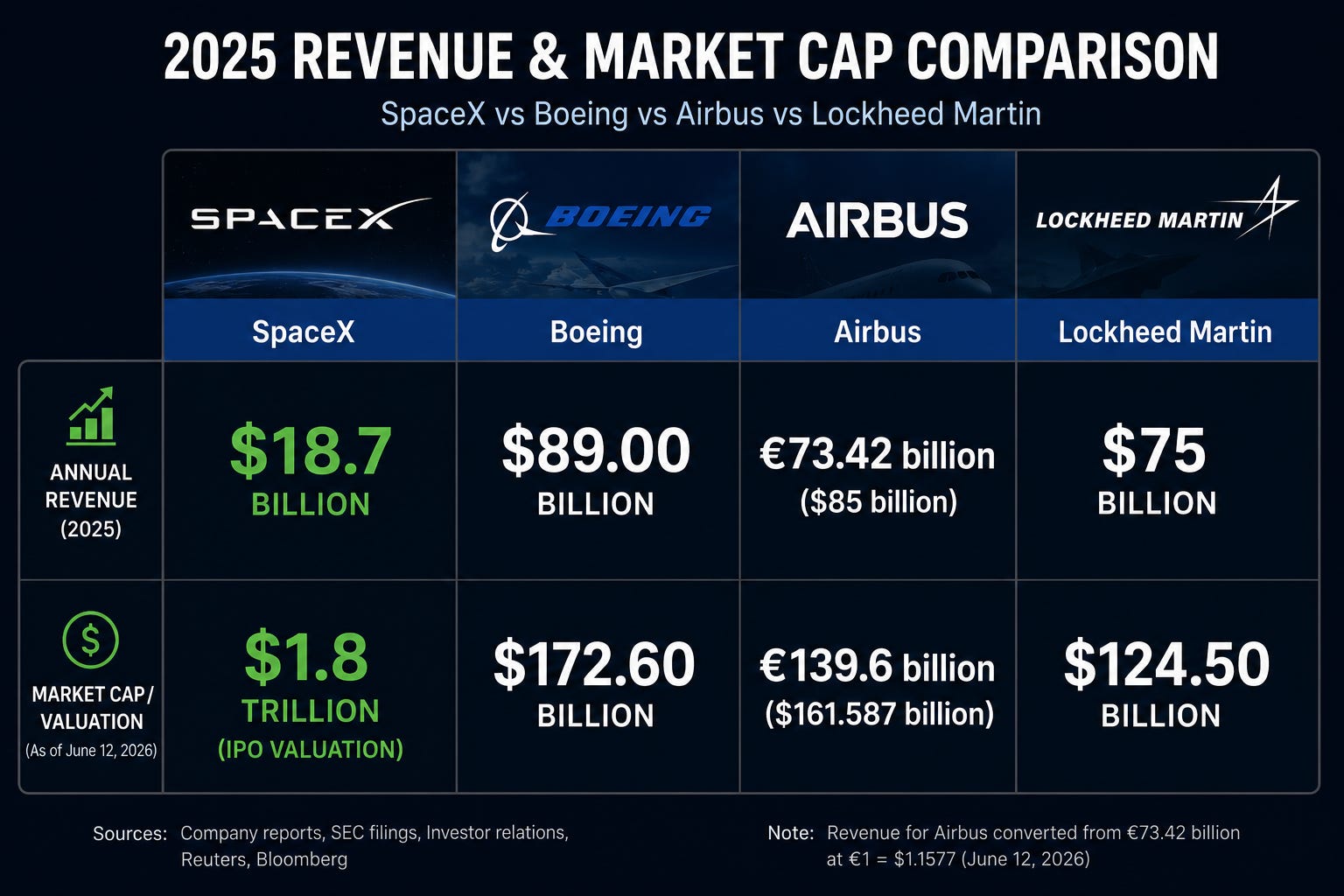
SpaceX is currently more expensive than the combined market cap of Boeing ($172.6 billion), Airbus ($161.6 billion), and Lockheed Martin ($124.5 billion).
The three aerospace/defense giants generated approximately $249 billion in combined revenue in 2025-13 times that of SpaceX-and still only account for 22% of its market value.
Valuation metrics make the story even more unusual.
EV/Revenue is around 107x. Hyperscalers typically trade around 8-15x.
Even the most expensive SaaS companies at their peak only reached about 30-40x.
Most mature industrial businesses trade at just 1-5x.
EV/EBITDA is around 310x.
Net profit shifted from profitable the previous year to a $4.9 billion loss.
But looking deeper, this is an AI business burning cash at one of the fastest rates in the world, while the Starlink satellite division must constantly generate cash flow to fund that entire ambition.
Aswath Damodaran-the finance professor dubbed the "Dean of Valuation"-calls it "an all-in bet on AI and Elon Musk" and places the fair value at $1.25–1.35 trillion, 30-35% lower than the current level.
This is also the central thesis of this week's analysis.
SpaceX is not merely a business. It is Starlink generating cash flow to feed two massive megaprojects simultaneously, while the rest of the valuation primarily reflects optionality for future scenarios.
At an equity value of around $670 billion, the intrinsic value could still be defended.
But at over $2 trillion, almost all the upside has already been priced in.
Our SOTP yields ~$1.2 trillion. The market is paying $2.04 trillion-170% of that figure.
To achieve an 8% market-equivalent return from this price over 5 years, SpaceX must grow EBITDA at ~67% per year-from $6.6 billion to nearly $86 billion.
Apple, the most profitable company on the planet, has a total EBITDA of ~$145 billion. SpaceX must reach nearly 60% of that figure in 5 years just for you to break even against the S&P index.
This price leaves no room for "very good"; it demands "unprecedented in history."
In today's article, Viet Hustler will dissect each layer of SpaceX's value with you to answer the question: at the current price, even if everything goes according to plan, does SpaceX still offer an attractive enough return for investors?
Decoding the $2 trillion-Three re-ratings in 6 months
Three businesses, three economic natures
Starlink-The cash cow carrying the empire
xAI-The most controversial part of the valuation
Starship & Billion-dollar dreams
SOTP Valuation-What is SpaceX really worth?
Investment Strategy-What price is worth buying?
Part I. Decoding the $2 trillion-Three re-ratings in 6 months
First, let's look back at SpaceX's journey to the $2 trillion mark-because the speed of its re-rating is a red flag in itself.
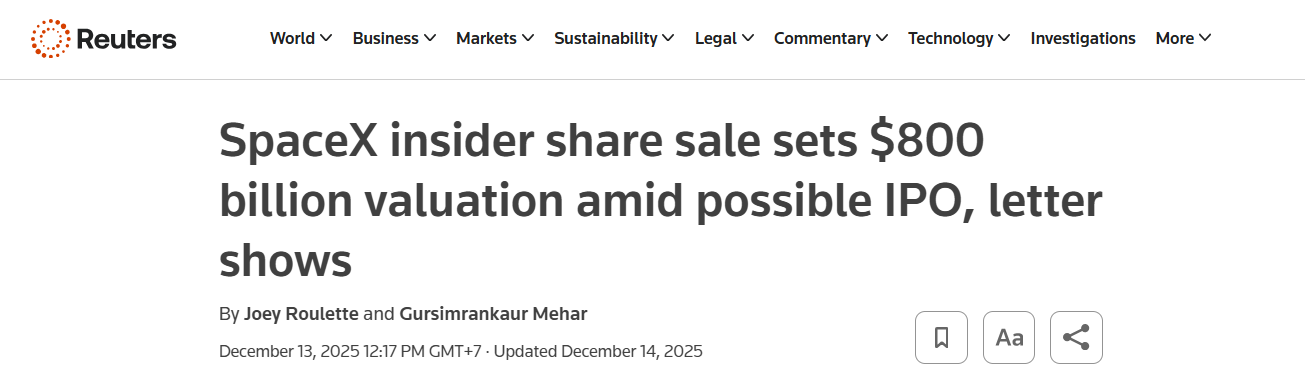
December 2025, internal transaction: ~$800 billion-reasonable for a satellite internet company growing at 50%/year with a near-monopoly in rocket launches.
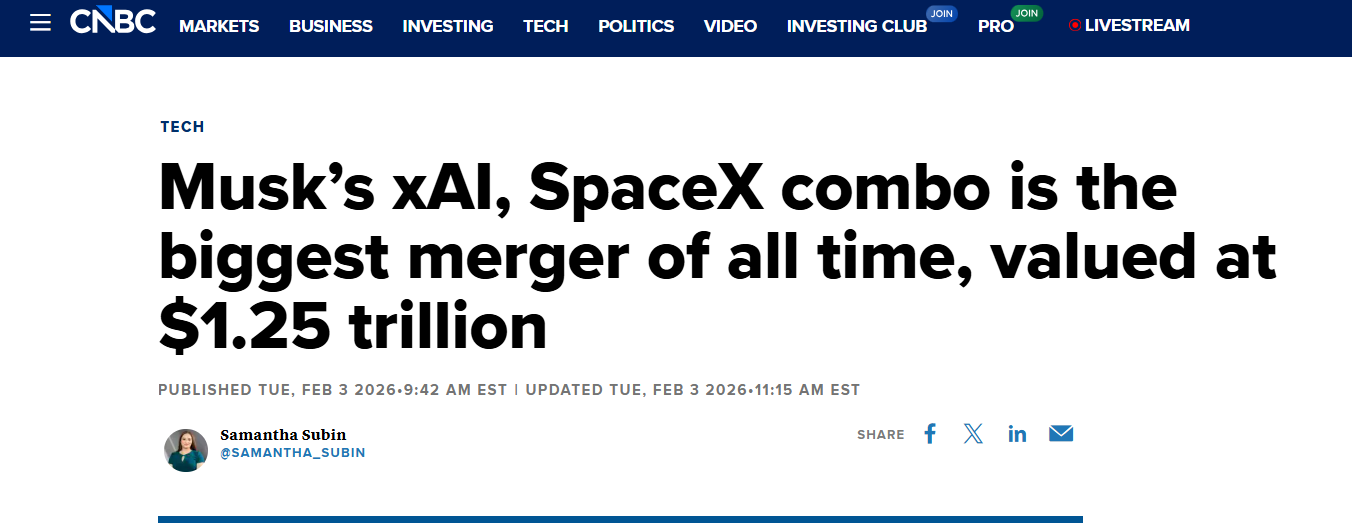
8 weeks later, February 2026, Musk merged xAI into SpaceX via a stock swap.
Musk controlled both sides of the negotiating table.
xAI was valued at $250 billion. SpaceX jumped to ~$1.25 trillion.
Then the June IPO pushed it to $1.77 trillion.
The market opened, retail investors flooded in-30% of shares allocated to individuals, 3 times the standard-and the all-time high hit $225.64 on 06/16-making Musk the first person in the world to possess a trillion-dollar fortune.
Market cap at the peak: nearly $3 trillion.
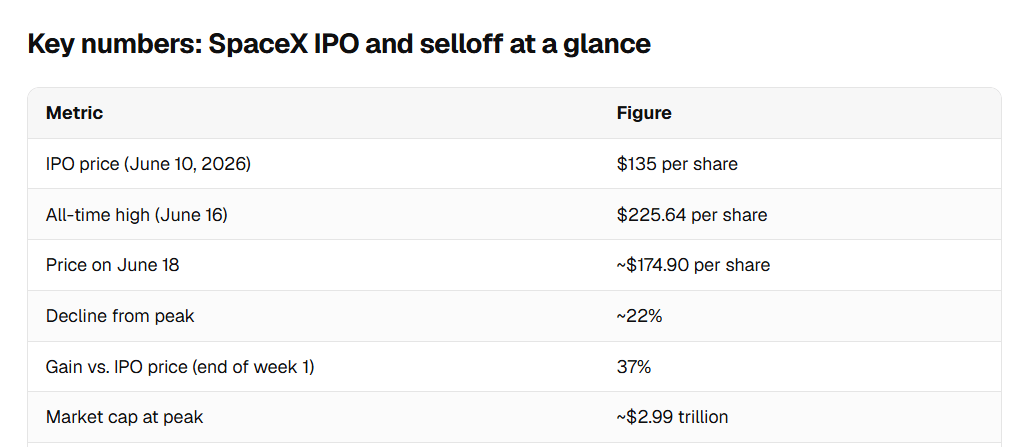
In other words: SpaceX more than tripled in 6 months. Nothing changed in the business except for the addition of a heavily loss-making AI lab.
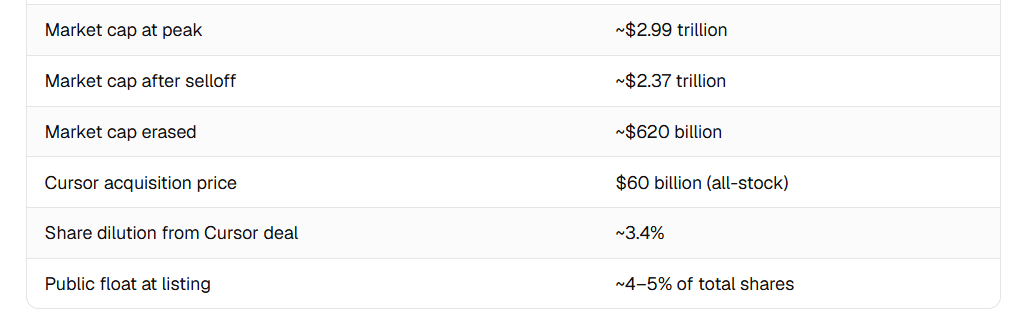
Then reality knocked. In the 8 sessions from the peak, the stock fell 31%. Three reasons:
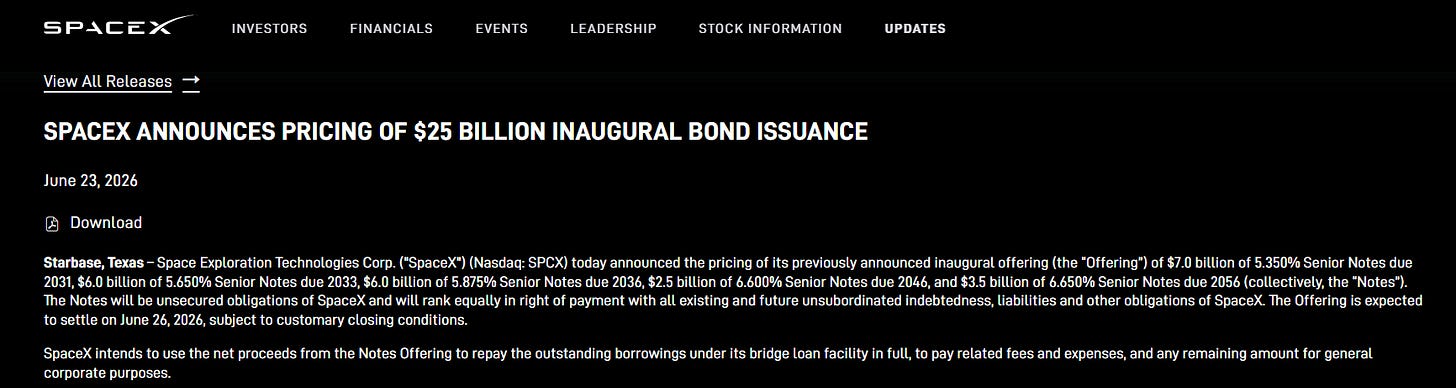
Issuance of $25 billion in bonds - 10 days after the IPO. Purpose: refinancing the bridge loan from the xAI deal. The market immediately understood that the $86 billion raised from the IPO had already been largely committed. The IPO wasn't a profit-taking event-it was fuel.
Acquisition of Cursor for $60 billion in stock - announced 4 days after the IPO-an immediate dilution. SpaceX's first move as a public company was to place another AI bet, not to pay down debt.
Thin float - only 4.2%. The low share count amplifies both the upside and the downside.
When sentiment turned, the lack of institutional liquidity meant the stock could fall as violently as it rose.
Damodaran warned before the IPO that at $1.8 trillion, SpaceX was already "too expensive for my taste." But he also reminded us of something noteworthy:
Facebook traded at half its IPO price months after listing.
Uber lost more than 50% of its market cap in its first year.
Both later became excellent stocks-but at much lower prices.
Mega-cap IPO history shows: patience is often rewarded.
The disagreement among analysts says it all.
Morningstar fair value: $780 billion ($63/share).
CFRA: Sell recommendation, $115 target.
Susquehanna: Neutral, $170.
Goldman Sachs 2030 revenue projection: $474 billion-requiring xAI revenue to grow 100x.
ARK Invest bull case: $3.1 trillion.
Ron Baron: $10-30 trillion by 2040.
The spread between the lowest and highest target: 260%. When analysts value Apple, the spread is not more than 10-15%. When the spread is 260% wide, it's no longer a disagreement-it's a sign that everyone is valuing completely different things under the same ticker.
The problem is that SpaceX is no longer a business that can be valued with a single trailing multiple. SpaceX has:
61% of revenue from Starlink-a satellite internet business.
22% from rocket launch services.
The remaining 17% is xAI-an AI company losing more than the revenue it generates.
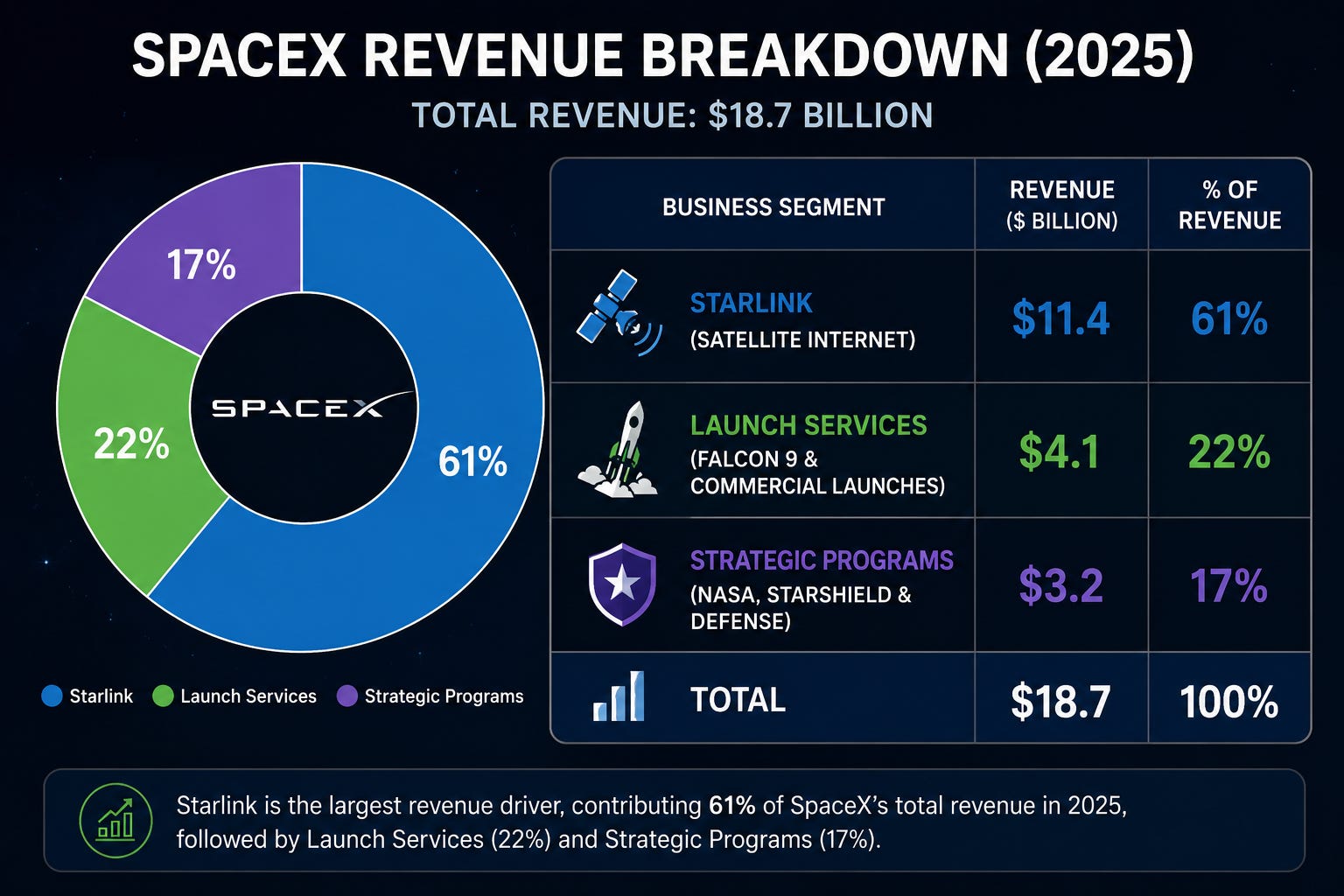
Three business segments. Three completely different economic models. Three different growth rates, margins, and risk profiles.
Therefore, metrics like EV/Revenue or EV/EBITDA for the entire company no longer hold much meaning. Trailing multiples are meaningless here.
To know what SpaceX is truly worth, the only way is to separate each segment, value them individually, and then add them up. That is also why SOTP (Sum-of-the-Parts) has become the most appropriate method to look at SpaceX at the present time.
Part II. Three businesses, three economic natures
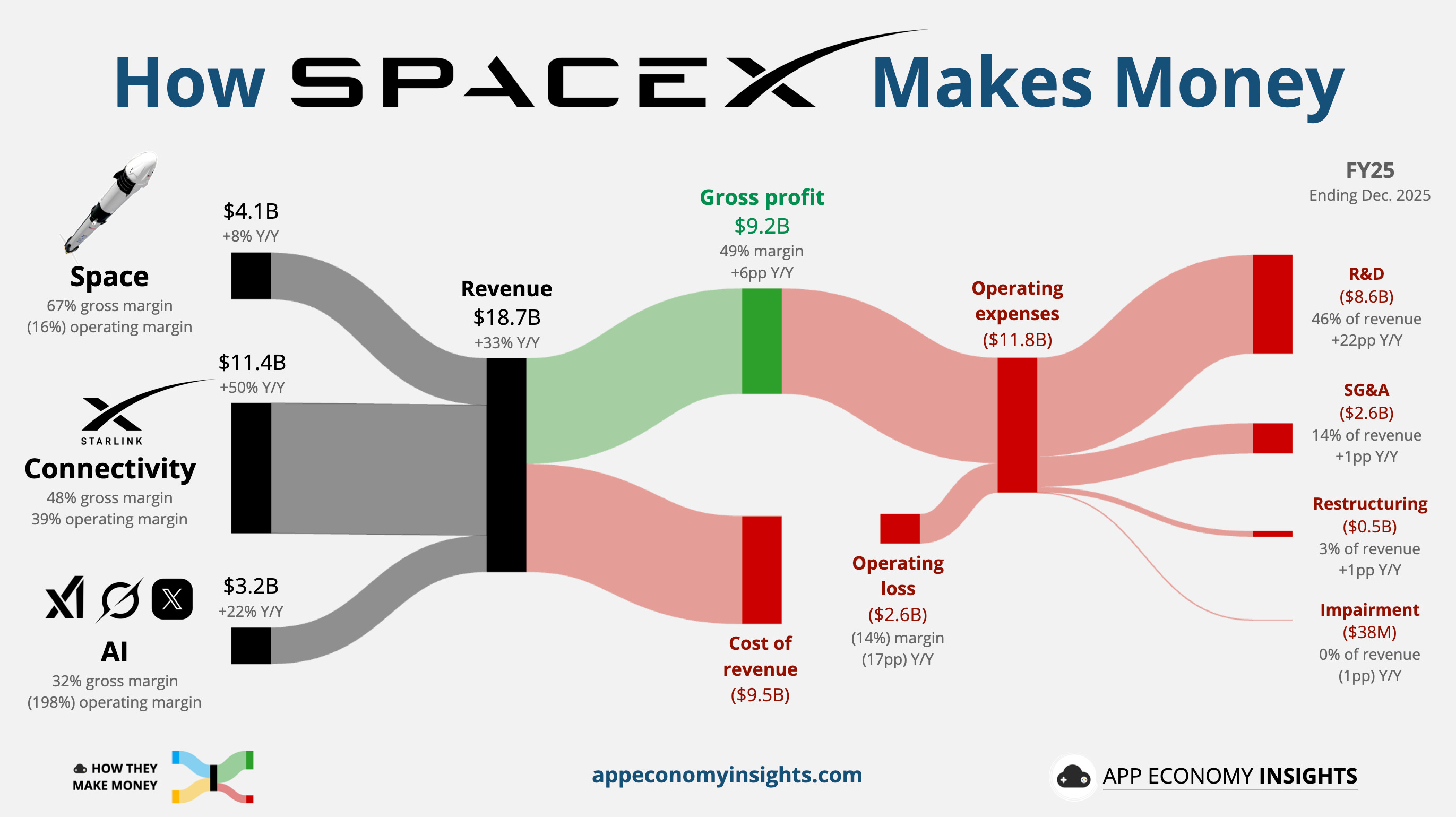
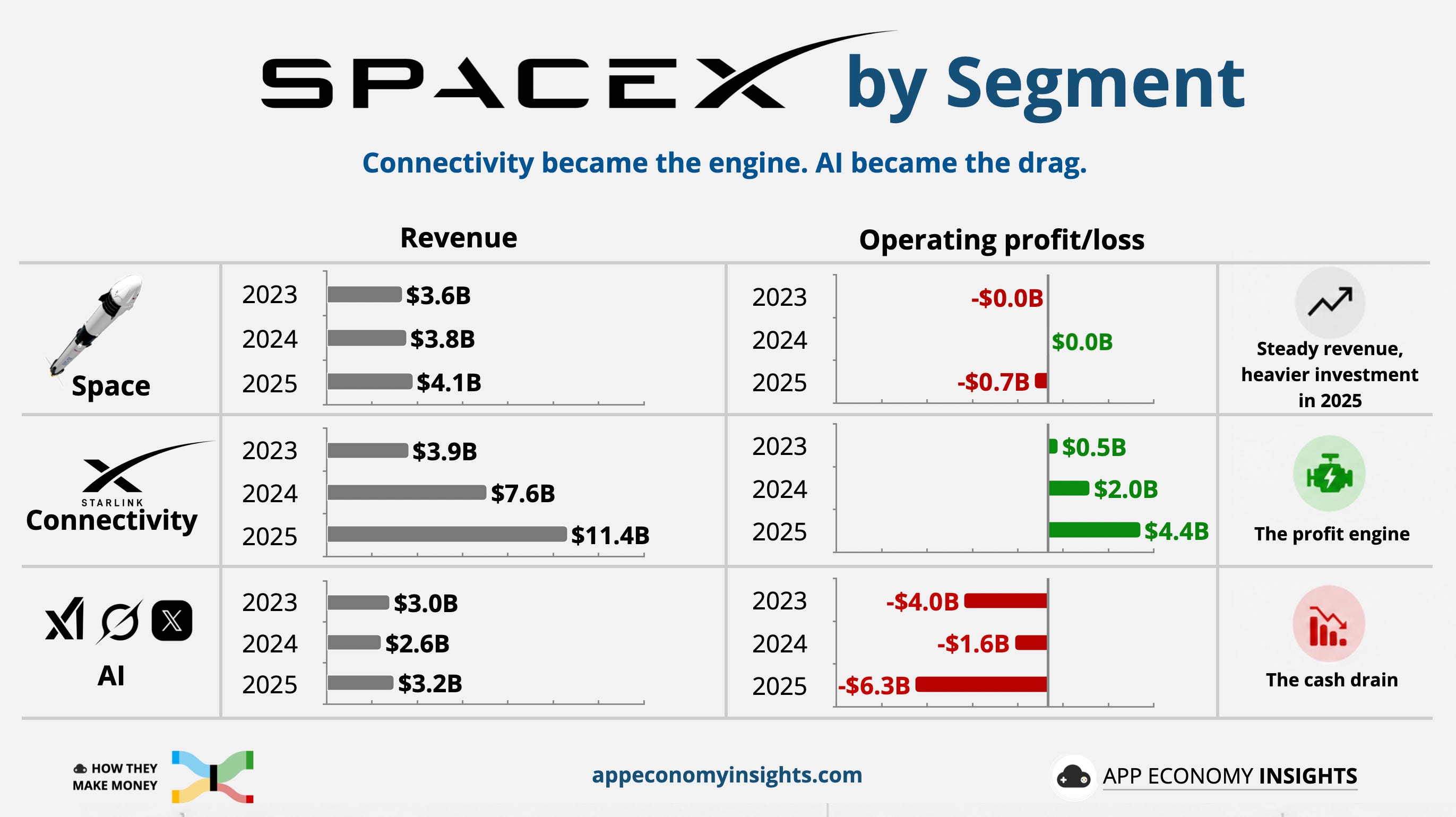
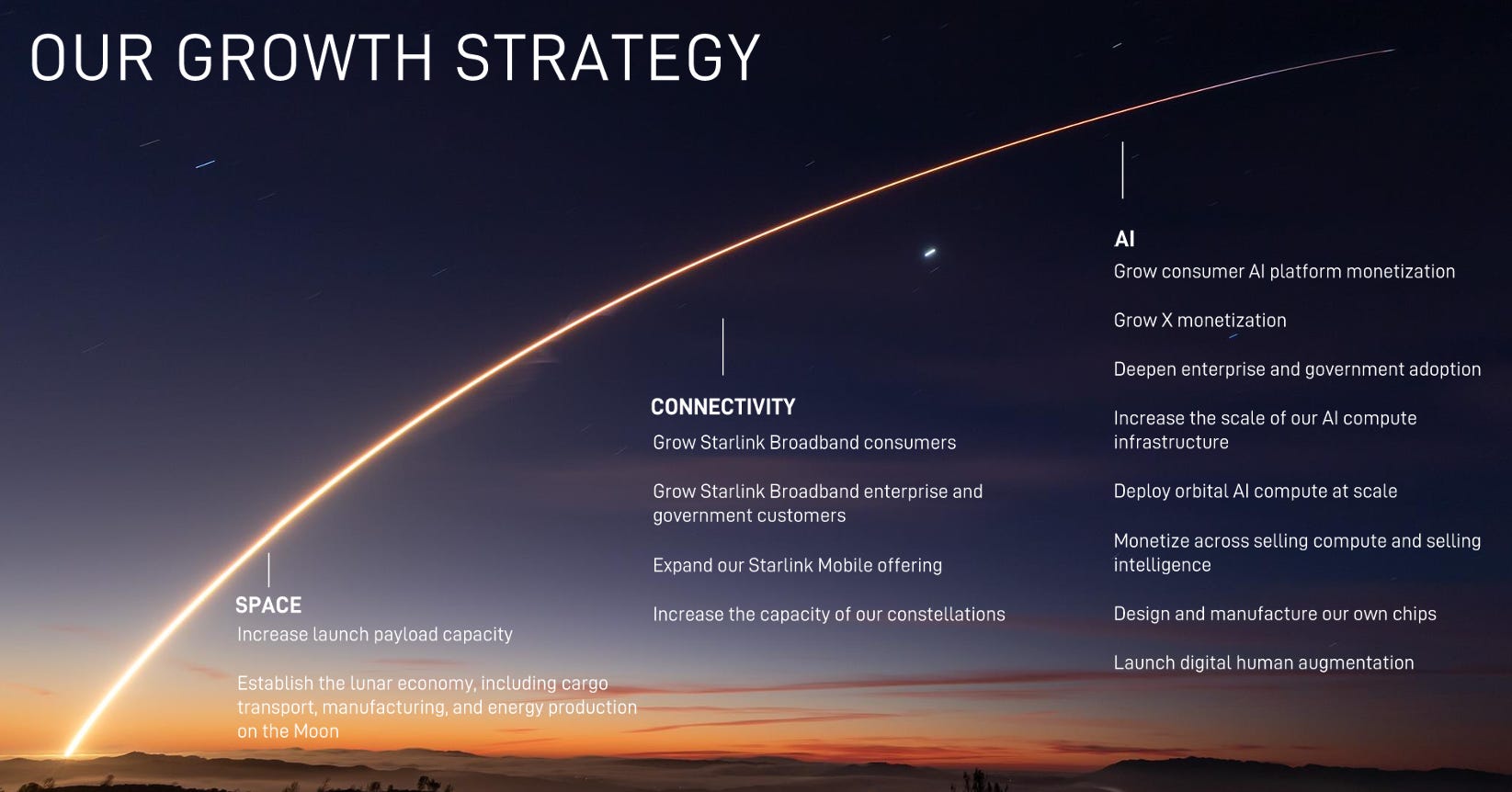
SpaceX is not a company that loses money everywhere. In essence, it is a highly profitable company in one segment, using those profits to fund the other two black holes simultaneously.
This way of framing the issue changes everything:
If you strip xAI out of the consolidated figures, SpaceX has never lost money.
Excluding Starship development costs from the Space segment, the launch business is profitable.
Looking at the 2025 segment data-consolidated figures from the S-1, with xAI + X included:
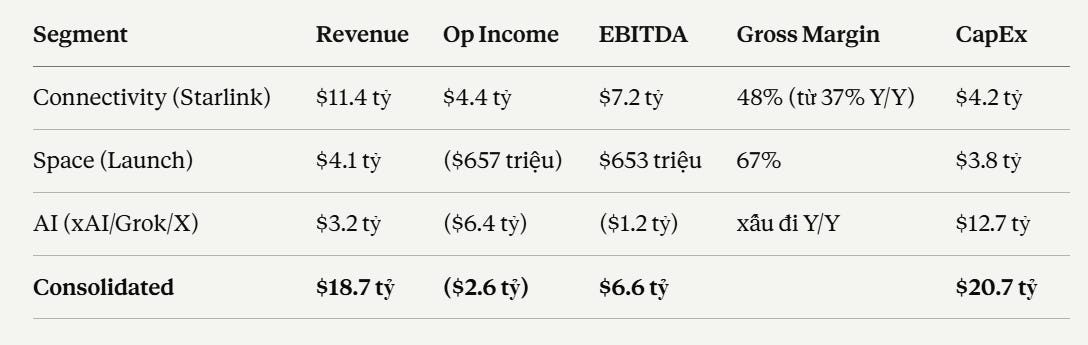
The gross margin column is noteworthy.
The Space segment has the best unit economics-a 67% gross margin reflecting the cost advantage of reusable rocket technology.
The Connectivity segment's gross margin is improving rapidly-jumping from 37% in 2024 to 48% in 2025.
But the AI segment? Not only does it have the lowest gross margin-it is deteriorating year by year.
Competitive pressure and the cost of providing AI services will likely continue to drag margins down.
It is very clear from the data:
Starlink's $7.2 billion EBITDA minus the $6.4 billion AI operating loss leaves about $800 million for everything else.
The xAI merger turned a profitable company into one with heavy losses.
A key detail hidden in the filing: of the 165 Falcon 9 flights in 2025, only 43 flights served external customers -nearly 3/4 of launches were to deploy internal Starlink satellites.
Space segment revenue ($4.1 billion) came from only 26% of total flights. The remaining 74% was a cross-subsidy for the Connectivity segment. The three segments are not just economically different-they are interdependent in ways that past financial reports did not reflect.
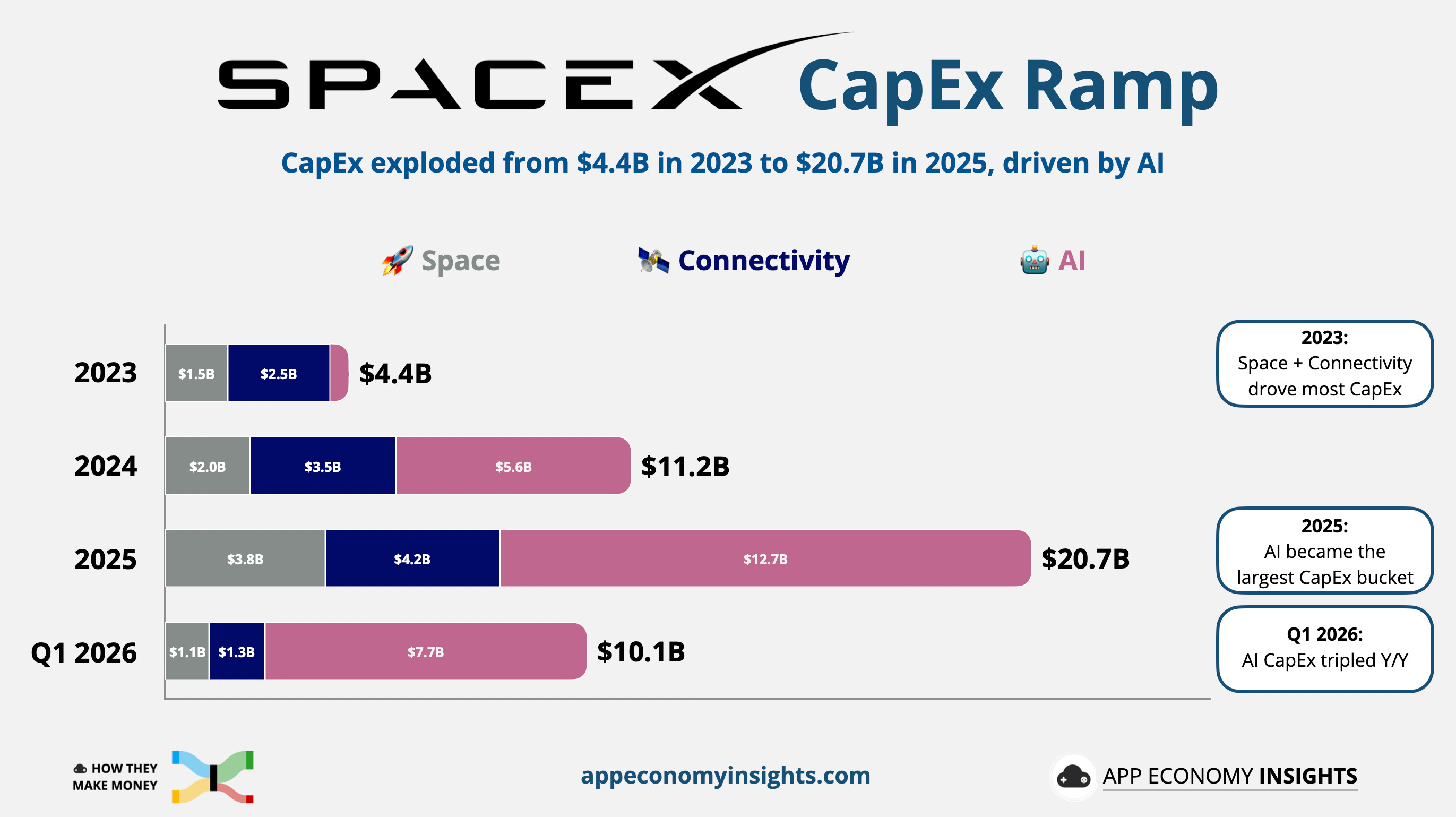
Q1 2026 tells an even clearer story.
AI CapEx: $7.7 billion in a single quarter-higher than the combined CapEx of Space and Connectivity.
AI revenue: $818 million.
AI operating loss: $2.47 billion-a loss three times the revenue.
This is the segment that analysts have called “a value-destroying threat” with “an unidentifiable economic moat.”
Part III. Starlink - The cash cow carrying the empire
If SpaceX were just Starlink, the conversation would be much simpler. This is the only profitable segment, generating 61% of total revenue, and is the foundation upon which the entire $2 trillion thesis stands.
The subscriber growth trajectory is arguably extraordinary:
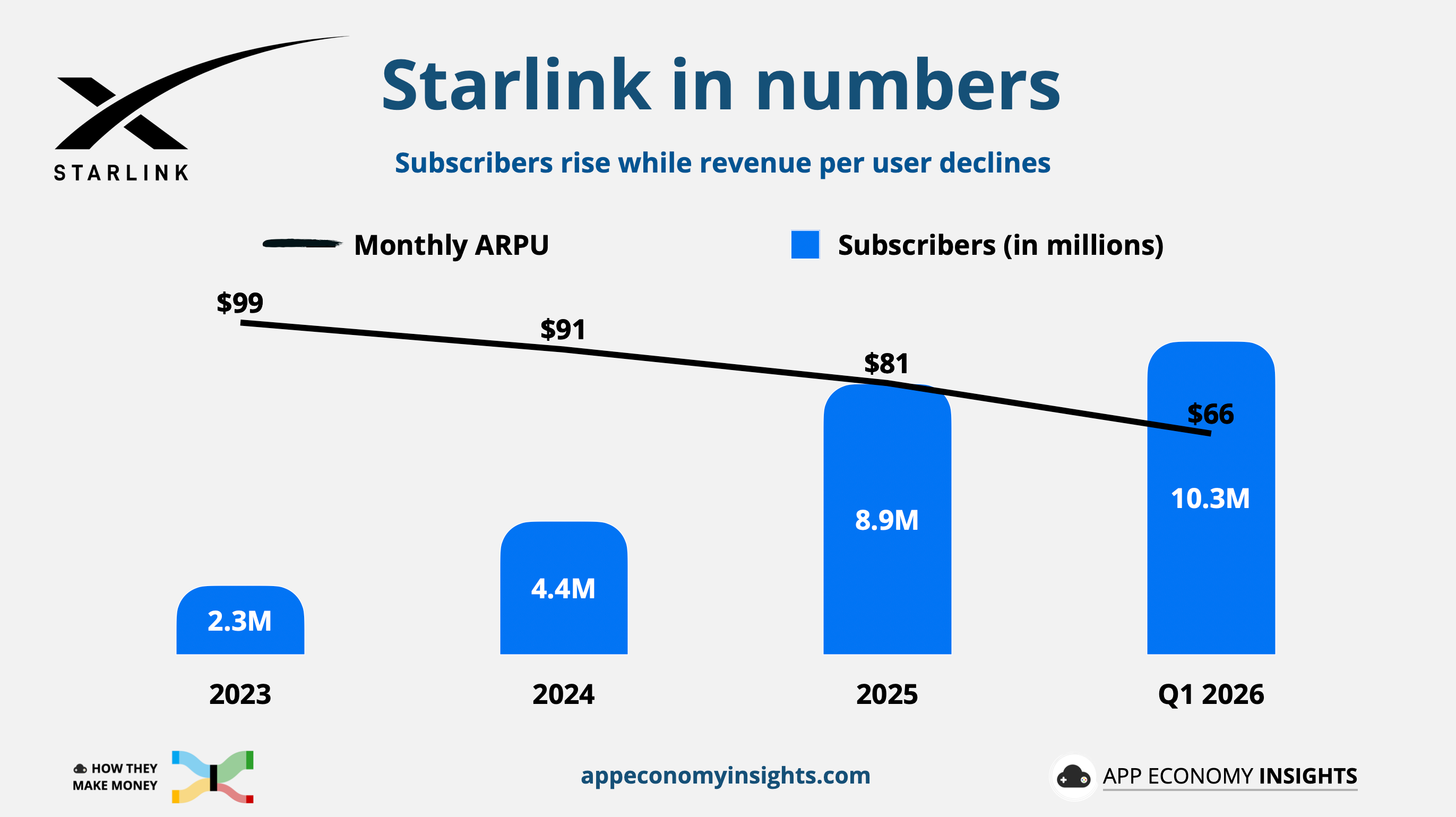
A 97% CAGR over 2 years.
Over 9,600 low-orbit satellites-accounting for 75% of all active maneuverable satellites in Earth's orbit.
Coverage in 164 countries, territories, and markets.
And this is the beauty of the model: each new subscriber adds revenue at near-zero marginal cost once the constellation is already in place.
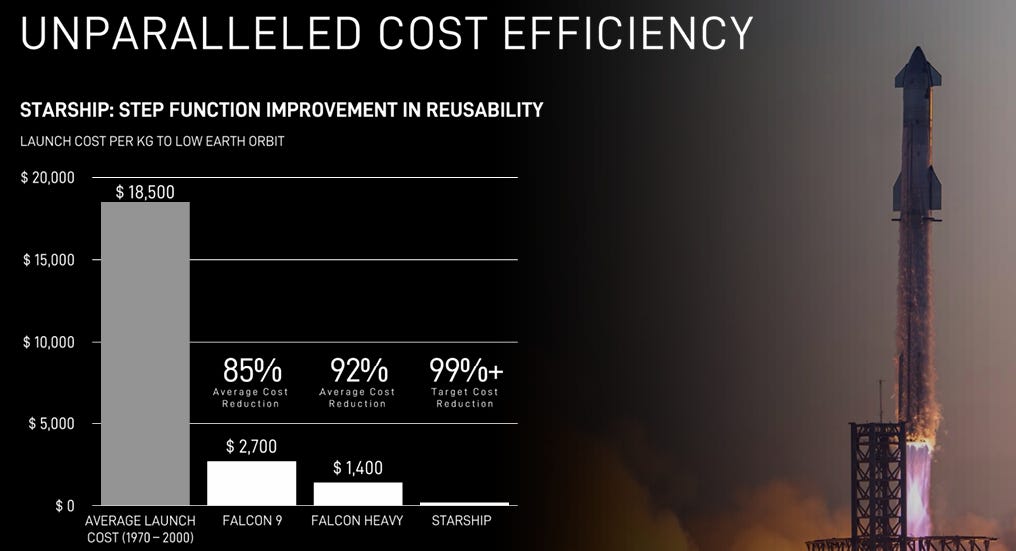
157 out of 165 Falcon 9 flights in 2025 flew on flight-proven boosters-a 95% reusability rate. Launch costs have fallen from $18,500/kg in the pre-SpaceX era to approximately $2,700/kg. No one else has a cost advantage at this scale.
But then, looking at the average revenue per subscriber-and this is the moment to pause and read carefully.
$99/month in 2023, ~$86 in Q1 2025, ~$81 in FY 2025, and only $66 in Q1 2026. A 33% decline in over two years.
Looking at the data, we see:
Subscribers nearly doubled-from 5 million to 10.3 million-but revenue per subscriber is in constant decline.
The positive: gross margin is still improving (37% to 48%) despite the decline in revenue per unit, thanks to economies of scale.
The negative: if it continues to drop below ~$55, volume growth will not be enough to compensate.
Besides, one cannot talk about Starlink without mentioning Amazon Leo.
367 production satellites launched as of June 2026.
Commercial service begins mid-2026 in the U.S.
Amazon has a balance sheet with $100 billion+ in annual CapEx and AWS integration.
But Starlink has a massive first-mover advantage: 9,600+ versus 367 satellites.
The question is not “whether Amazon Leo will compete”-but “whether it will gain enough market share to challenge Starlink.”
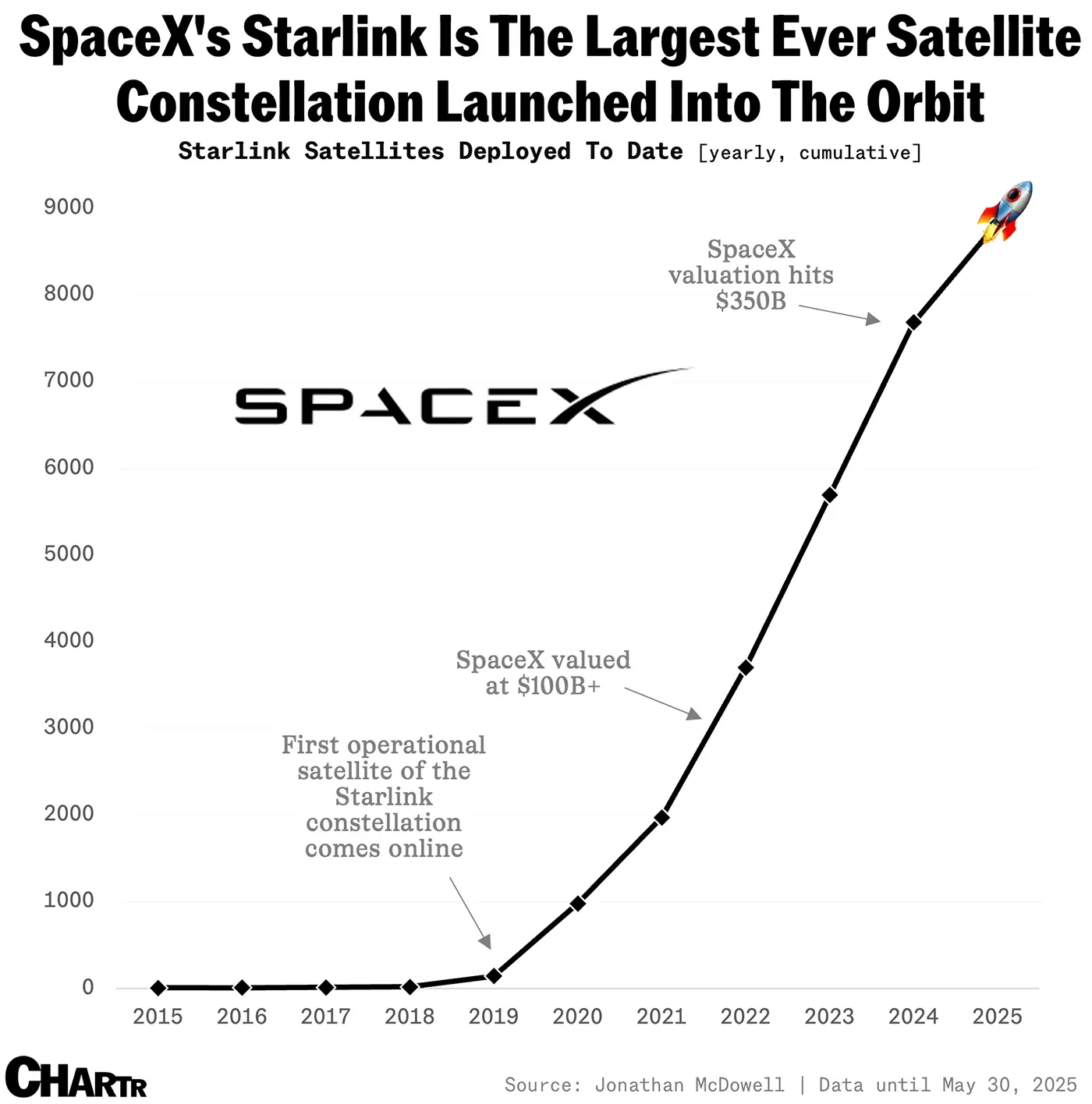
A structural risk few mention: Starlink satellites have a lifespan of only 5-7 years. This means SpaceX does not just need to launch more satellites to expand-it needs to launch thousands every year just to replace those that are expiring.
This is a perpetual capital cycle, and the entire loop depends entirely on Starship achieving a frequent, ultra-cheap launch cadence. If Starship is significantly delayed, the cost of maintaining the network with Falcon 9 will drain cash reserves.
→ Starlink Valuation:
Valuation method: Starlink is valued based on EV/EBITDA rather than revenue because it is the only segment that has generated stable profits.
With an EBITDA of approximately $7.2 billion and an EBITDA margin of up to 63%, EBITDA reflects cash flow generation power better than revenue alone.
There is no publicly traded company truly like Starlink:
Traditional telecom trades at only about 6-9x EBITDA but grows very slowly.
Infrastructure companies like Equinix or American Tower are at 18-25x.
Meanwhile, Starlink possesses the growth rate of a SaaS company, yet has the barriers to entry of a monopoly infrastructure business.
Therefore, the article uses three valuation levels: 45x for a scenario of increased competition and continued ARPU decline; 70x for a base case where Starlink maintains its leadership position; and 100x for an optimistic scenario where Starlink becomes the dominant global internet provider.
→ Correspondingly, Starlink's value ranges from approximately $325-720 billion.
Part IV. xAI - The most controversial valuation component
Looking at the most controversial valuation component:
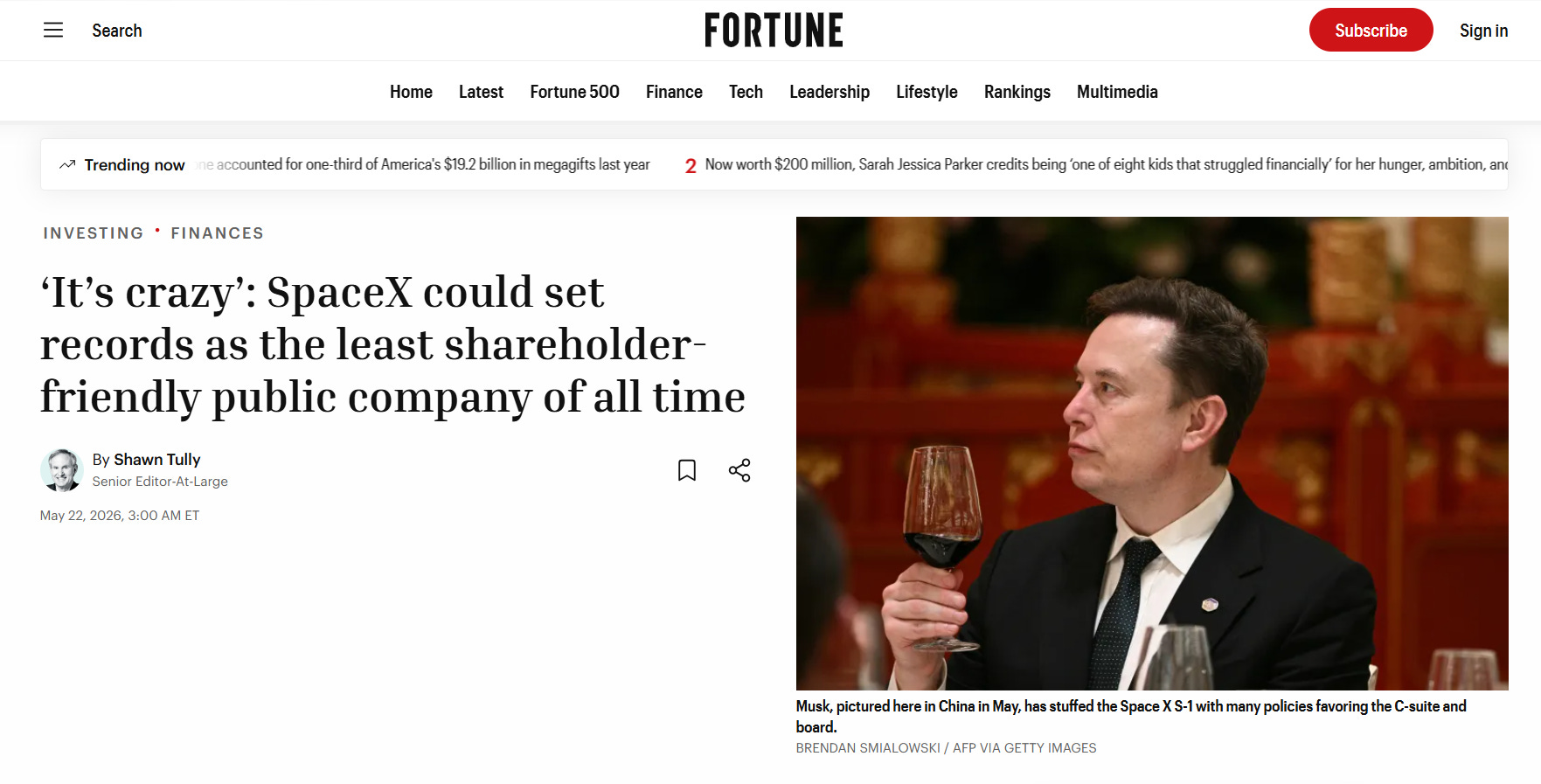
$250 billion assigned to xAI was set in a transaction between related parties-Musk controls both sides.
There was no competitive bidding.
There was no independent valuation.
And the company bylaws-a detail few read- explicitly allow Musk to own businesses that compete directly with SpaceX, with no obligation to put SpaceX first.
Investors are buying into a structure where the founder has the right to compete with the very company they own.
Putting that $250 billion against real comparisons:
Anthropic: ~$30 billion annual revenue, ~$350 billion valuation at the time of the xAI merger (Series G, February 2026), ~12x revenue
OpenAI: ~$25 billion annual revenue, ~$852 billion valuation (March 2026 funding round), ~34x revenue
xAI: $3.2 billion revenue, $250 billion per the merger, ~78x revenue
Applying the same multiple as Anthropic, xAI would be worth $35-40 billion-not $250 billion. That $200 billion+ gap is exactly what investors are accepting when buying SpaceX at over $1.2 trillion.
Looking at the Anthropic deal for comparison:
$1.25 billion/month, Anthropic leases the entire 300 MW capacity of the Colossus 1 data center, lasting until May 2029. Total ~$15 billion/year
Google jumped in at $920 million/month, total $11 billion/year
Combined: $26 billion in annual revenue-8 times xAI's entire 2025 revenue.
First, let's look at the positive side: Two of the world's most heavily funded AI companies are willing to pay real money to lease xAI's compute infrastructure. That is a signal that demand for compute infrastructure is real.
Damodaran also admits the deal with Anthropic will “kickstart revenue in the coming year” and improve profitability in the short term.
Dan Ives at Wedbush is even more optimistic: “Investors are no longer buying a capital-intensive hardware business, but are buying a vertically integrated AI and data infrastructure empire-that happens to own a network operating in the same orbit.”
Now read the negative side.
Anthropic is paying a direct competitor to run Claude on that competitor's GPUs.
Why? Because xAI cannot fill its internal capacity.
Colossus 1 was operating at 11% capacity before signing the contract.
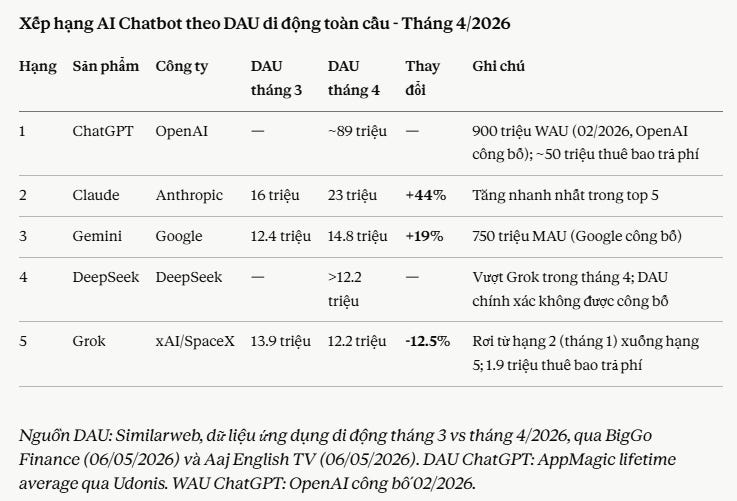
Grok's daily active users fell from 13.9 million to 12.2 million in a single month.
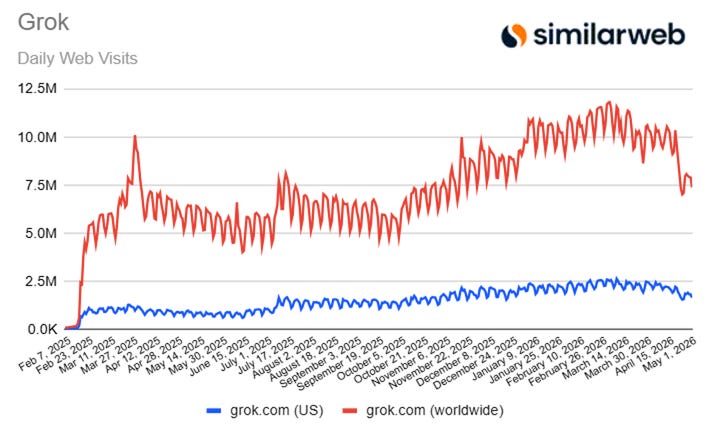
SuperGrok has 1.9 million paid subscribers; ChatGPT has ~50 million.
Grok ranks 5th in the AI assistant leaderboard.
Musk, March 2026, verbatim: xAI “wasn't built right the first time.” All 11 original co-founders have left.
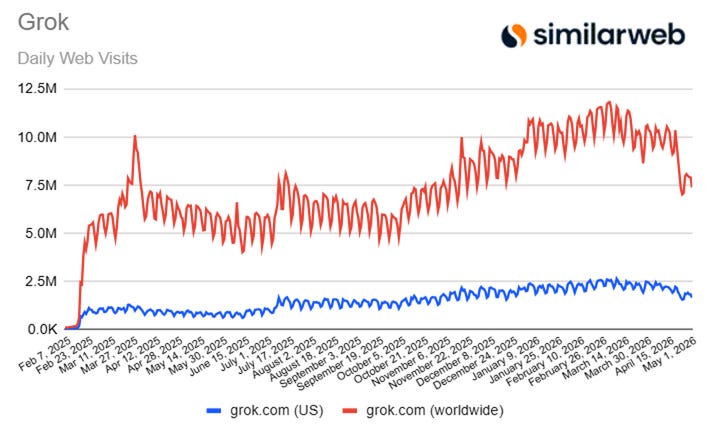
SpaceX's own filing states: “allows us to monetize unused compute capacity.”
The word “unused” - an admission that capacity is sitting idle.
xAI built Colossus for a level of demand that never materialized.
Subleasing is a contingency plan, not the original strategy.
However, looking at the landlord-tenant relationship between xAI and Anthropic, we see potential for future tension if xAI intends to compete directly with Anthropic in the AI product market.
You are letting a tenant use your space, but the tenant is also a competitor.
When they build their own capacity and leave, the landlord loses $26 billion in annual revenue.
Both contracts have a 90-day termination clause.
The most concerning part is not Starship failing or Starlink stalling - it is that SpaceX will overextend into AI, starting by overestimating its target market.
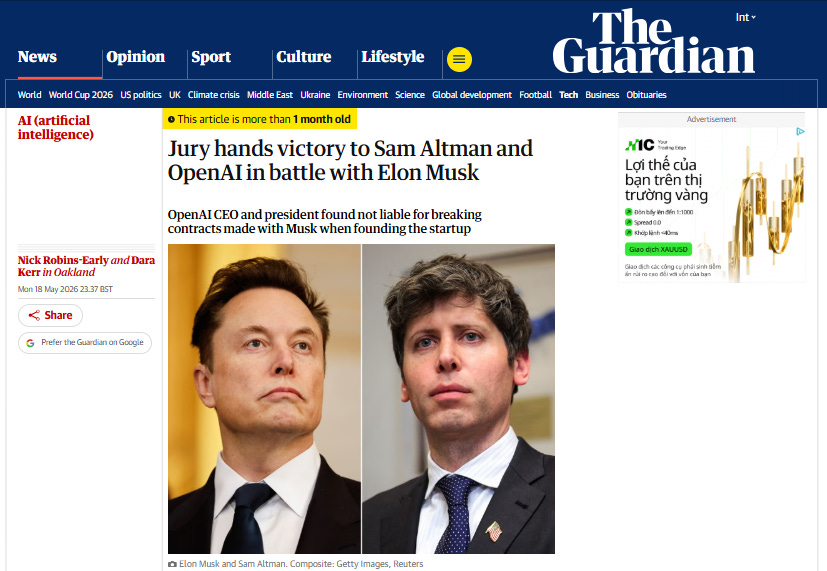
The Musk-Altman confrontation is being compared to a “UFC match between two massive egos, funded by tens of billions of dollars of shareholder money.”
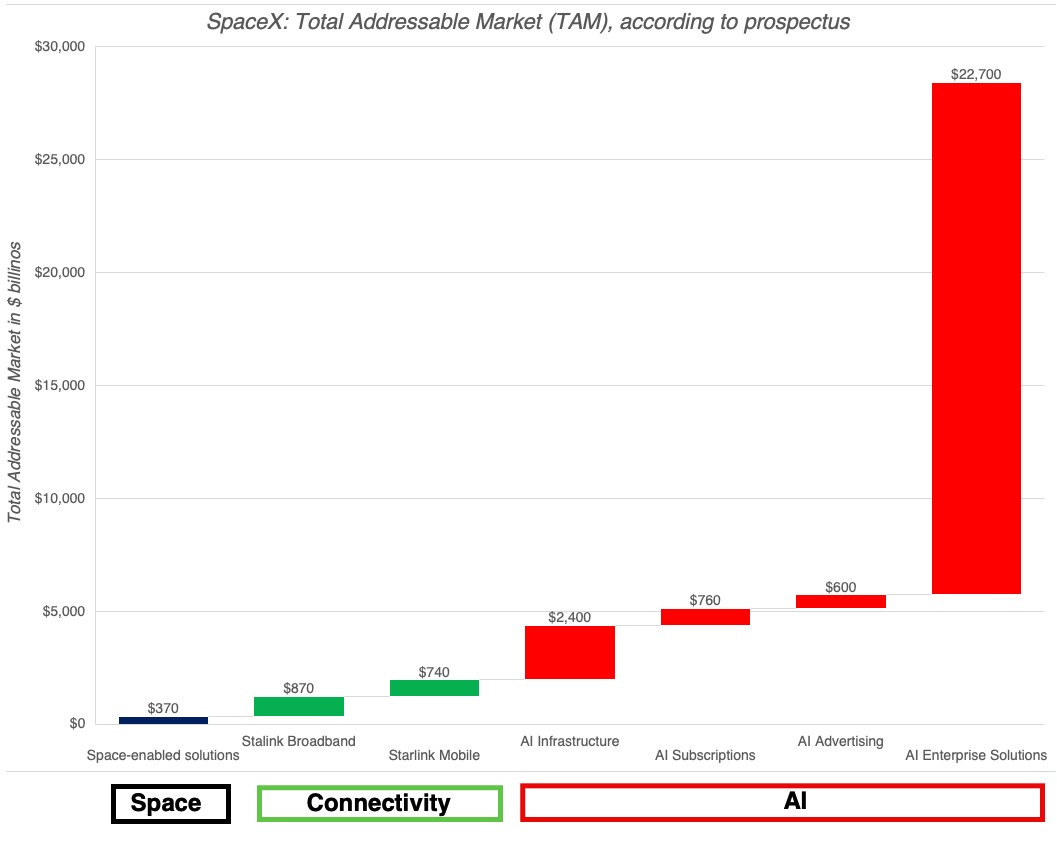
And then there is the market size story. The prospectus claims a $28.5 trillion TAM.
Of which, $26.5 trillion - or 93% - comes from AI.
The realistic market estimate for AI products/services that xAI could target is in the $3-4 trillion range - 7-8 times smaller.
The figure in this prospectus is being compared to the inflated numbers that Uber ($5.7 trillion at its 2019 IPO) and Airbnb ($3.4 trillion) once used.
Unlike Starlink, xAI is almost impossible to value using traditional methods. The company generates only about $3.2 billion in revenue but has an operating loss of $6.4 billion, making both EV/Revenue and EV/EBITDA largely meaningless.
Therefore, this article uses a valuation range instead of a single number.
$100 billion reflects the value of tangible assets such as GPU clusters, data centers, and infrastructure leasing contracts.
$250 billion is the valuation in the merger with SpaceX - also the level the market is implicitly accepting, despite the lack of an independent valuation process.
$500 billion is the optimistic scenario, in which contracts with Anthropic and Google are maintained, Grok returns to growth, and xAI becomes a large-scale AI infrastructure platform.
This wide valuation range is not because the model is inaccurate, but because xAI itself remains a business with too many variables.
Part V. Starship & Billion-Dollar Dreams
Starship does not generate much revenue today. But it creates something else: growth options.
These can be called real options - business opportunities that only exist because the enterprise already possesses a core capability.
Amazon initially built computing infrastructure to serve itself, then turned it into AWS.
Similarly, SpaceX is dominating the rocket launch market. That very position opens up opportunities like orbital data centers, lunar logistics, or further afield, Mars.
The key point about options is that they do not need to be certain to materialize to have value. But it is the combination of massive potential and very low probability of success that makes them valuable. Investors are paying for the right to enjoy the upside if that scenario occurs.
But options must still obey the laws of physics.
An orbital data center at a 100GW scale would require about 1 million tons of equipment to be launched into orbit each year.
Throughout its 24 years of operation, SpaceX has only launched about 7,400 tons.
Even at the Starship target (100-150 tons/reusable flight, daily frequency) = 18,000-27,000 flights/year - while to date, Starship has only flown 12 times.
But if you can build a data center in the Sahara Desert or mine resources in Greenland at a much lower cost, why do it in space?
These options exist, but they are still very far from reality.
Interestingly, the market seems willing to pay more for Elon Musk's options than for any other CEO's.
Orbital data centers, Optimus, or Mars are all partially reflected in SpaceX's price.
Meanwhile, Project Kuiper barely affects Amazon's valuation, and quantum computing projects have not yet made a significant difference for Google.
Musk's execution track record helps him deserve a valuation premium.
But at around $250 billion for this optionality layer alone, that premium has become very expensive.
Part VI. SOTP Valuation - What is SpaceX really worth?
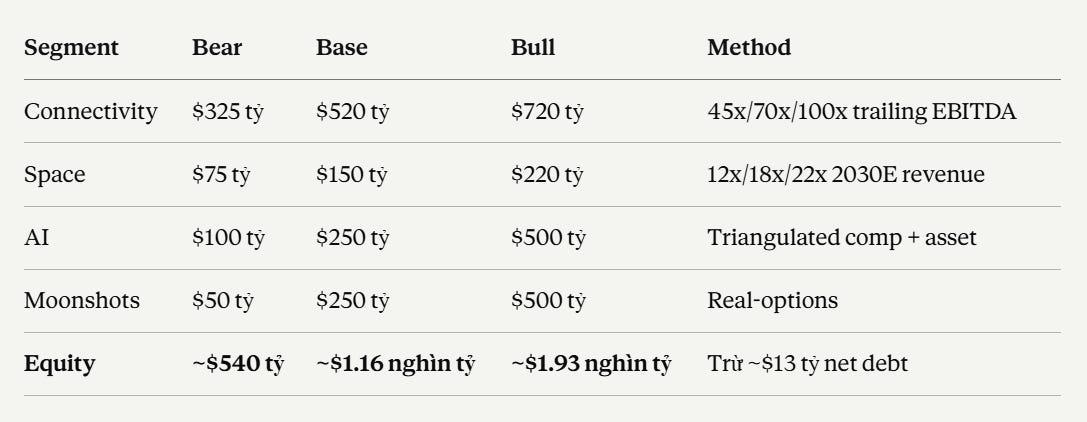
Assign 25% to the negative scenario ($540 billion), 50% to the base ($1.16 trillion), 25% to the positive ($1.93 trillion).
→ Fair value = (0.25 × 540) + (0.50 × 1,160) + (0.25 × 1,930) = $135 + $580 + $482.5 = ~$1.20 trillion.
Why 25/50/25 and not 20/60/20 or 33/34/33?
Because SpaceX is not a stable business where you assign a high probability to the average case. This is a company where the two segments accounting for more than half of its value - AI and Mega-projects - have a scenario range of 5x (from $100 billion to $500 billion each).
When variables are that wide, the distribution tails must be heavier than normal.
25% on each side reflects the real probability that xAI could become the next CoreWeave (successful GPU leasing, $500 billion) or collapse when Anthropic and Google leave ($100 billion). Both scenarios are plausible - so both need significant weighting.
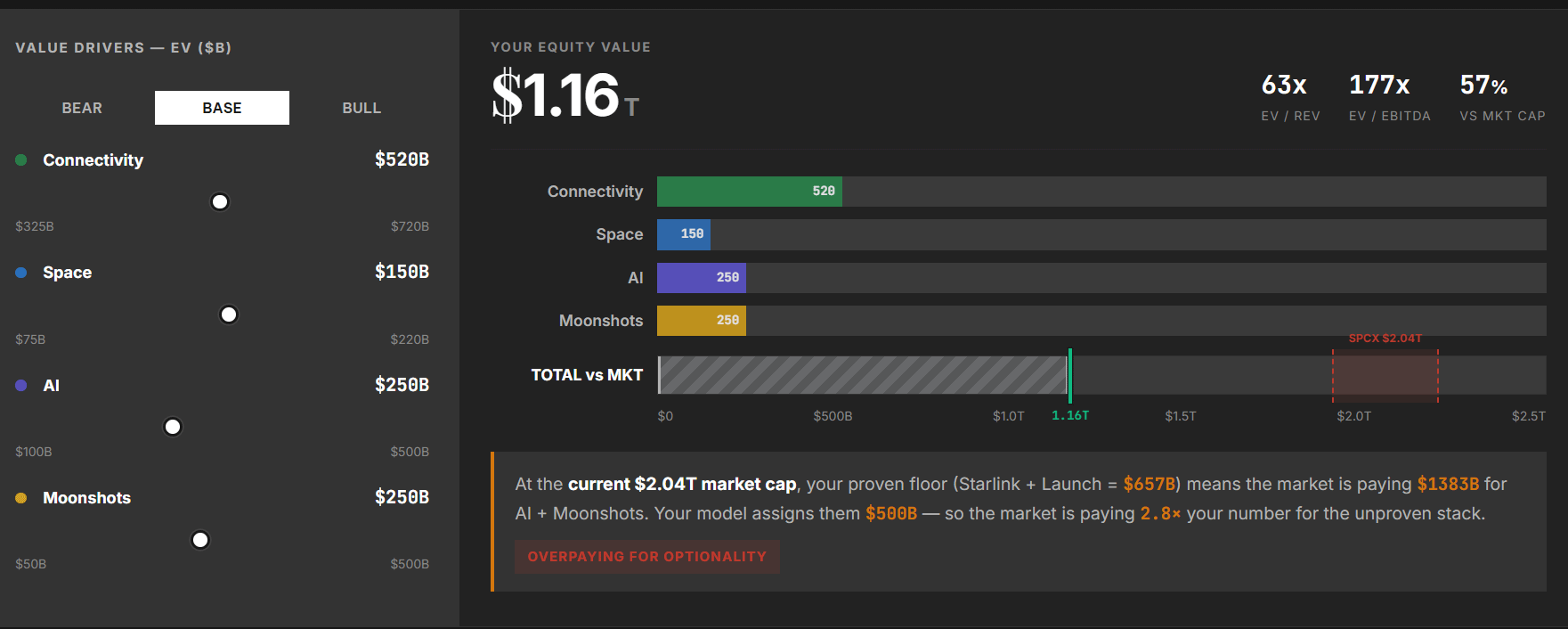
In the same range as the SOTP numbers in this article, Damodaran's DCF yields $1.25-1.35 trillion, Morningstar: $780 billion.
Three different methods, from three independent sources, all yield a mark below $1.4 trillion. Current market cap: $2.04 trillion - 170% of fair value.
In other words: the market is paying an extra $840 billion over what three independent analytical sources consider reasonable.
Delving deeper into the valuation structure, the proven business - Starlink and the launch segment - only accounts for about $657 billion in the base case. This means nearly $1.4 trillion of the current market cap is being bet on xAI and the mega-projects. Meanwhile, this article's model only values these two segments at about $500 billion.
In other words, the market is paying nearly 3 times the bottom-up analytical value for the unproven business. This is no longer just a growth premium, but a premium for the belief that everything will go almost perfectly.
However, valuation is only half the story. Capital structure and execution capability determine whether that value is realized.
After the IPO, SpaceX has about $100 billion in cash.
This number sounds very large, but the company burned $8.8 billion in the first quarter of 2026 alone, equivalent to about $35 billion per year if the pace is maintained.
At the same time, total debt has risen to about $54 billion, and accumulated losses since inception have reached $41.3 billion.
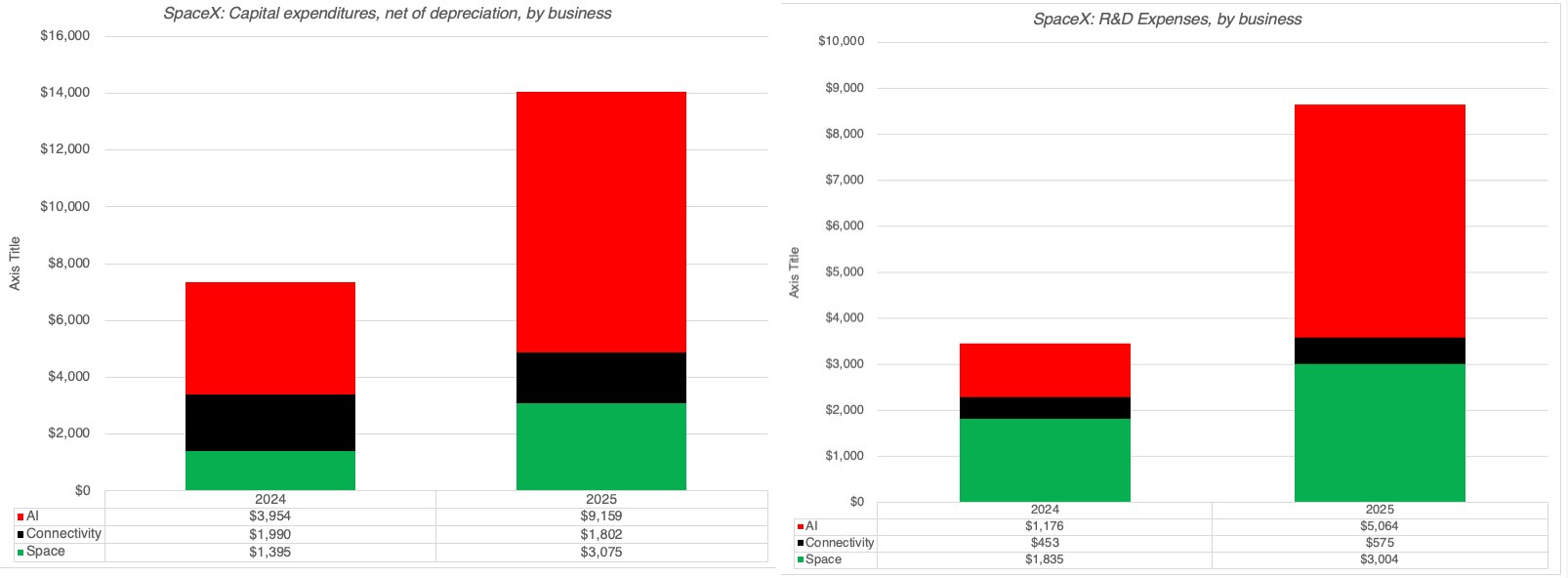
What is more notable lies ahead. Evercore ISI projects SpaceX will spend about $732 billion in CapEx through 2031, of which nearly $666 billion is for AI.
Positive free cash flow is not expected before 2030.
SpaceX's investment scale can be described as “staggering”: in 2025 alone, the company spent nearly $14 billion in CapEx and nearly $9 billion in R&D - more than its revenue for the same year.
The governance structure also increases risk. Elon Musk still controls over 82% of voting rights through super-voting shares.
This means if the company continues to aggressively increase investment or expand into AI faster than expected, shareholders have almost no ability to intervene.
The supply of shares will also change significantly after the IPO.
Currently, only about 4.2% of shares are free-floating.
About 20% of the locked-up shares will begin to unlock after the first earnings report, before the entire lock-up period ends in December 2026.
Supply pressure could be much greater than in the period immediately following the listing.
→ With a company valued at over $2 trillion, no investment bank is capable of supporting the stock price if market sentiment reverses. When the scale is this large, the stock price depends almost entirely on investor confidence.
Part VII. Investment Strategy - What price is worth buying at?
After all valuation models, the ultimate question is no longer whether SpaceX is a good business.
The question is: at the current price, how much can an investor still earn?
A reverse DCF calculation shows that to achieve a market-equivalent return (8% per year) over the next five years, SpaceX would need to grow its EBITDA from approximately $6.6 billion to nearly $86 billion-equivalent to a compound annual growth rate of about 67% (35x EV/EBITDA).
If expecting a 15% annual return, EBITDA must approach $117 billion by 2031.
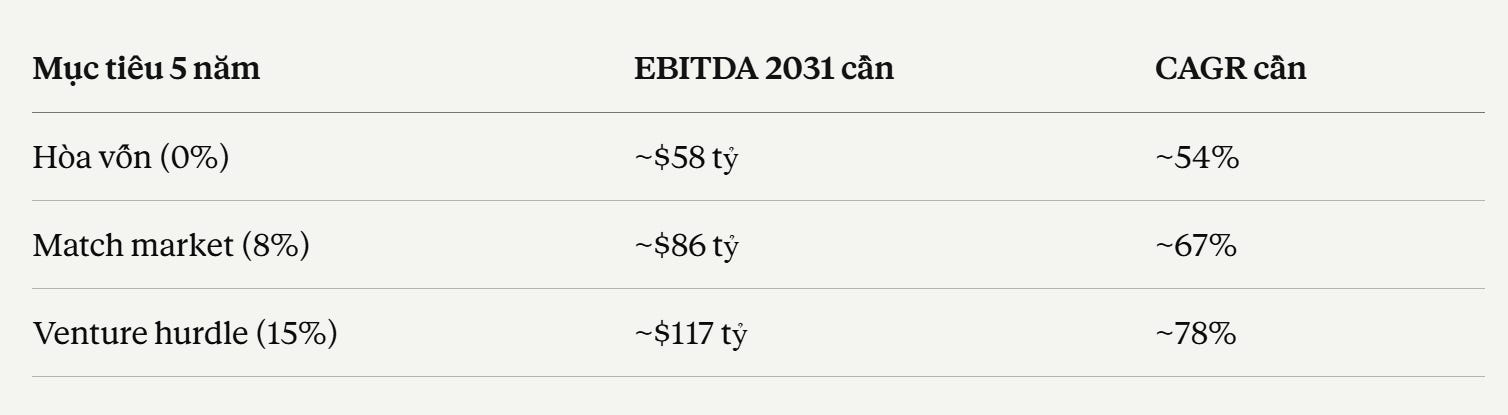
Those are extremely ambitious assumptions.
The interesting thing is that simply changing the purchase price alters the entire investment thesis.
With the same operational scenario, a purchase price of about $1.2 trillion could yield approximately 18% per year.
But at the current $2.04 trillion level, the expected return drops to only about 3% per year.
That is also why Aswath Damodaran stated he would not buy SpaceX at the current price range. According to him, only a sufficiently large correction could bring SpaceX back to a reasonable valuation range-and that would be the time to consider it.
Viet Hustler's perspective is similar. This is not a bad business. On the contrary, SpaceX may be one of the most unique companies in the world. But even an excellent business can become an unattractive investment if the price already reflects almost all the good things that could possibly happen.
In the coming time, there are four factors worth monitoring:
Second-quarter earnings report (June 8, 2026)
Average Revenue Per User (ARPU) for Starlink
The post-IPO share unlock process
The 90-day contract termination notice from Anthropic/Google - a death signal
And the schedule for allowing share sales - note that insiders may use derivatives to hedge before the deadline.
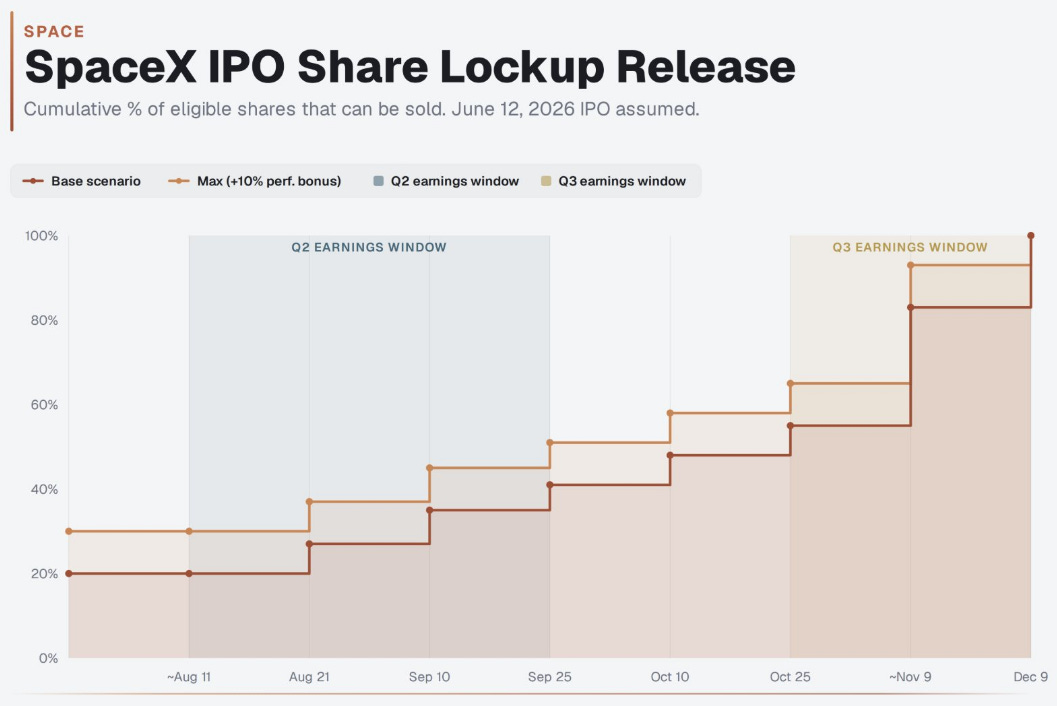
These will be the most important data points to verify whether current market expectations are on the right track.
Conclusion
Valuing SpaceX is not difficult because of a lack of data. It is difficult because this is no longer a single business.
About $670 billion of equity value comes from what the company has already proven: Starlink-the world's largest satellite internet network-and its near-absolute dominance in the rocket launch market. This is the foundation of SpaceX's value.
The second layer of value is xAI. This is the most difficult part of the entire business to value. The
deal with Anthropic and Google has proven the demand for computing infrastructure, but Grok has yet to prove its competitiveness in the AI model race.
The valuation range of $100-500 billion reflects that very uncertainty.
The final layer is Starship and growth options.
Data centers in orbit, lunar logistics, or even further, Mars, could all create entirely new markets.
But those are still options, not current cash flow.
When adding the three layers of value together, my SOTP model yields approximately $1.20 trillion. It is noteworthy that this figure is quite close to Damodaran's $1.25-1.35 trillion valuation, even though the two methods are completely different.
Meanwhile, the market is valuing SpaceX at approximately $2.04 trillion.
In other words, investors are not only paying for what SpaceX has already achieved but are also prepaying for most of what the company might do in the future.
That does not mean SpaceX will fail. On the contrary, if Starlink continues to expand, Starship achieves full reusability, xAI narrows the gap with competitors, and growth options are gradually commercialized, the company could absolutely move closer to its current valuation.
But from an investment perspective, business quality and expected return are two different stories. An excellent business is not always an attractive investment if most of its future success is already priced in.
In conclusion, SpaceX may be one of the most unique businesses in the world. But at the current valuation, the market is betting more on an unproven future rather than the values that exist today.