If you missed our top recent reads:
In the previous installment, Viet Hustler walked readers through the first 90 years of the US economy: a nation on the brink of default that learned to turn geography, credit, cotton, and people into the world's largest unified market - then paid for its slavery contradictions with roughly 700,000 lives in the Civil War.
Read Part 1 again at:
By 1865, the United States had laid the foundation. Yet a framework, no matter how solid, cannot automatically transform a nation into a superpower; to achieve that, it needed a machine large enough to exploit the market it had just created.
The next question was no longer how to build a unified market, but rather: what to build on top of it?
In 1873, Mark Twain and Charles Dudley Warner published a satirical novel titled The Gilded Age.
Notice how Mark chose the title: He did not call it the Golden Age, but rather The Gilded Age. A sparkling exterior coating masking a core made of something entirely different.
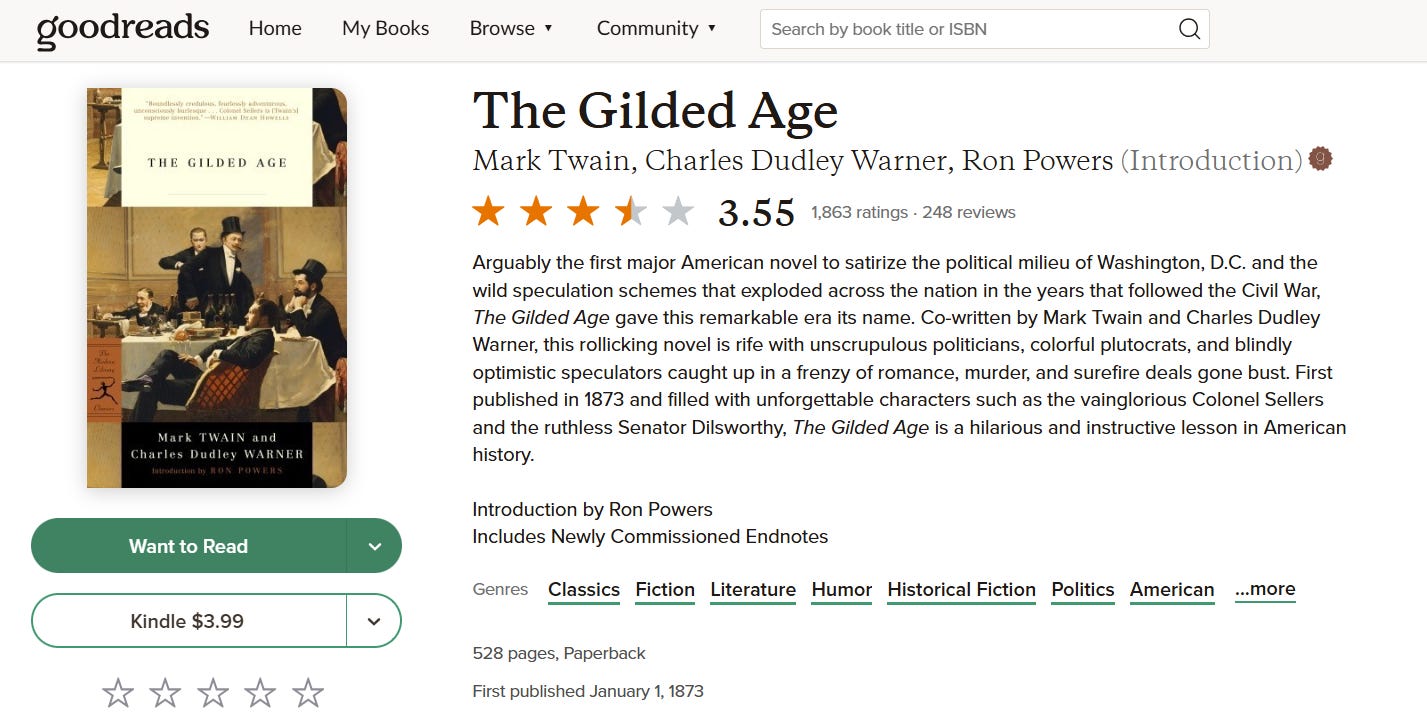
That name became synonymous with an entire era, and more than 150 years later, it remains uncomfortably accurate.
If Hamilton built the American market, the Gilded Age built the machine to exploit it. In under half a century, the United States not only produced more steel than Britain, but also invented a technology even more critical than steel: the model of the modern corporationsoftware
And from here on, every story in this article - from railways, steel, and oil to J.P. Morgan, 20 million immigrants, and three financial panics - is essentially a slice of the same revolution - the revolution of scale. Or more precisely, the revolution in how scale is organizedsoftware
To peel away that gilding, Viet Hustler will trace 6 clues:
The Day America Changed Its Time for Business
Economies of scale: The new weapon of the industrial age
Trust: The invention that changed capitalism
Morgan - The orchestrator of empires
America and the 20 million operating the industrial machine
The invoice of an era
Running through this journey is the same question that has followed us since Part 1:
America did not rise to global leadership because it had better machinery than Europe; it rose because it knew how to organize machinery, capital, and people on a scale the rest of the world could never have imagined at the time.

Part I. The Day America Changed Its Time for Business
There is a day in American history when private companies decided how the entire nation would check its clocks.
Not the government, not Congress, but railroad companies set the time framework for the United States.
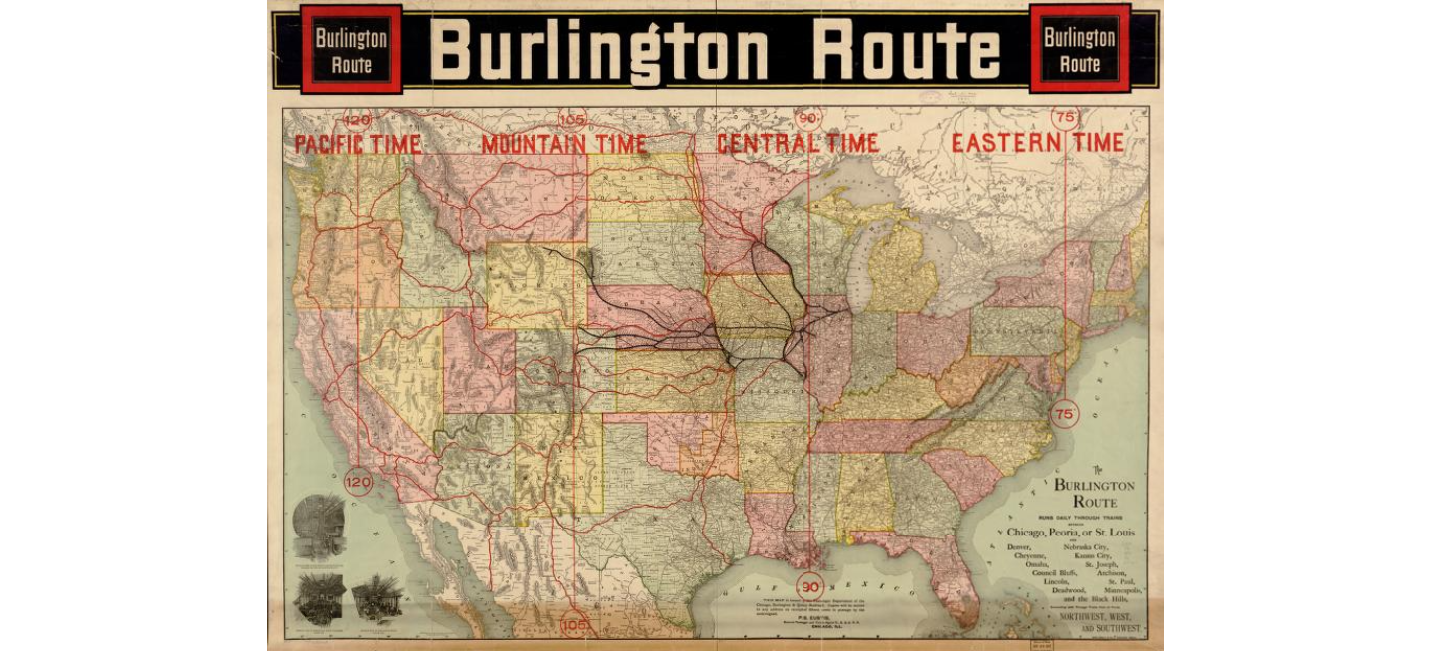
Before 1883, North America had more than 144 local time zones - with every town setting its clock by its own sun. For companies needing to run transcontinental trains on schedule, this was a pure operational nightmare. Therefore, they decided a solution was needed.
On November 18, 1883, railway companies jointly divided the continent into 4 standard time zones and synchronized their entire network to a single clock.
This caused many cities to hear church bells strike 12 twice in the same day.
That event went down in history with the rather peculiar name: "The Day of Two Noons."
The remarkable thing is not the time adjustment itself, but rather: why did a group of private enterprises have the authority to do that?
To answer this question, we must look at what the United States had just built after the Civil War.
On May 10, 1869, the final golden spike was driven at Promontory, Utah, linking the two coasts into a transcontinental railway line. But Promontory was merely a symbol. What truly transformed America was the scale of the entire network that followed.
Railways expanded from roughly 35,000 miles in 1865 to 193,000 miles in 1900, eventually peaking at nearly 254,000 miles in 1916 - the longest in the world.
By 1916, railways transported about 77% of freight and 98% of intercity passengers.
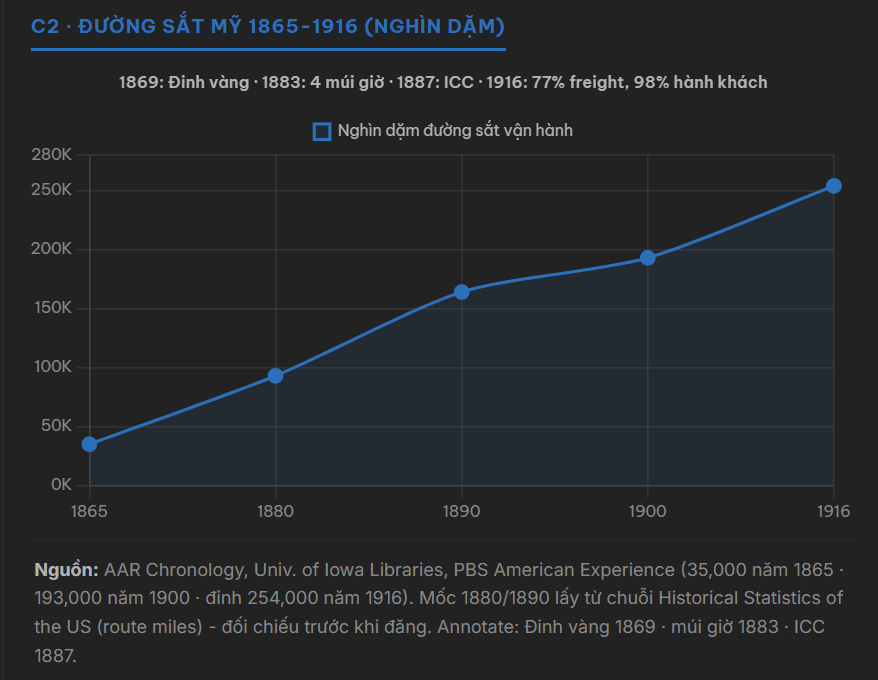
When nearly all cargo flows had to run on the same network, railways ceased to be just a business; they became the operating system of the entire US economy.
To ship steel, you had to go through the railways; to sell oil, you had to go through the railways; and to move wheat from the Midwest to the Port of New York, you also had to go through the railways.
When every industry depends on the same infrastructure, the operators of that infrastructure hold nearly the power to set the rules of the game.
-> That is why the entire United States eventually had to set its clocks by them - while Congress took another 35 years to officially legalize it through the Standard Time Act (1918).
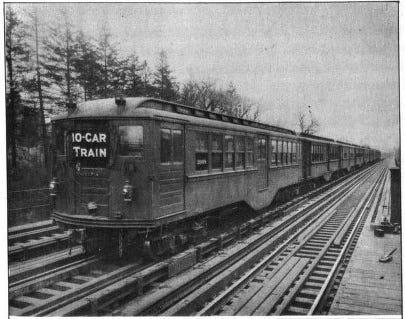
Yet the railways' greatest legacy did not even lie on the tracks.
For the first time in history, a business became too large for a single family to run on experience alone. To manage tens of thousands of employees, hundreds of stations, and tens of thousands of miles of track, they were forced to invent things that every business today takes for granted: professional management, organizational charts, cost accounting, reporting systems, and control procedures.
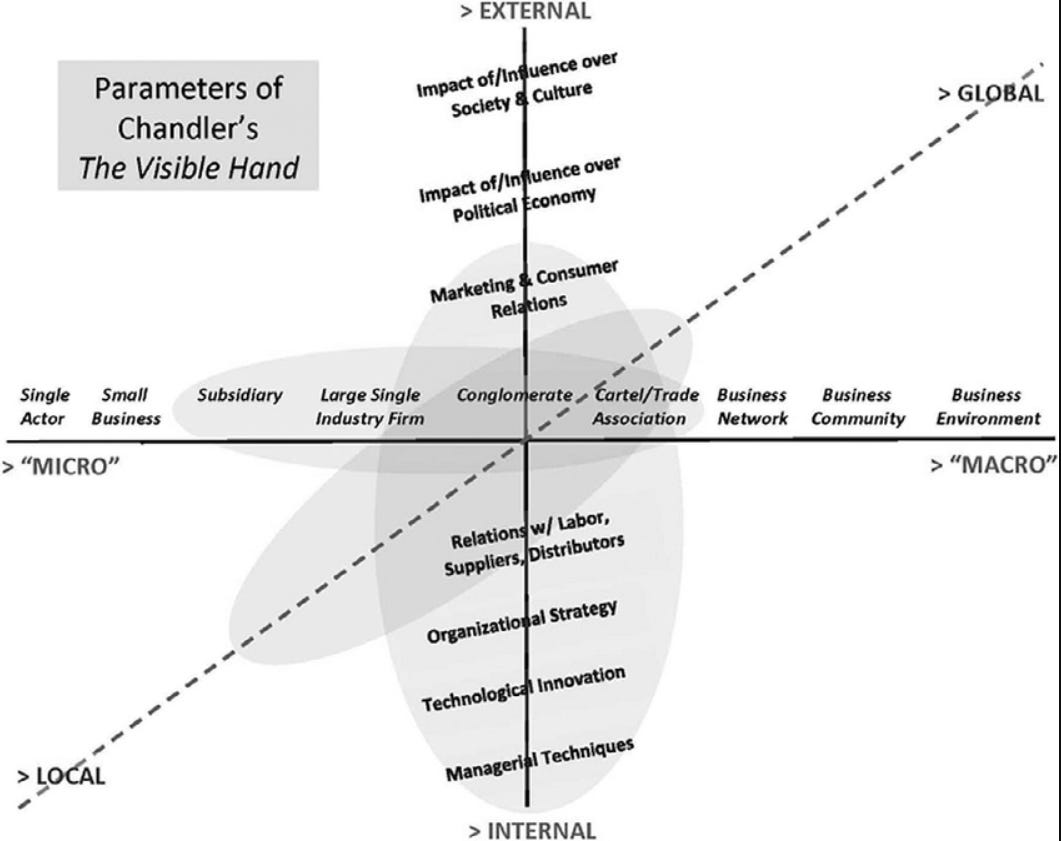
Historian Alfred Chandler, in his Pulitzer Prize-winning work The Visible Hand,called this "the visible hand" of management - where managers began to replace the market in coordinating organizations too massive to run themselves.
The most important product of the railways was not transportation, but the science of management.
Yet like every other form of power in history, railway power always came with a dark side.
Historian Richard White in Railroaded points out that many transcontinental railways were built too early, too extensively, using government land grants and scandals like Crédit Mobilier.
In 1872, the public discovered that Union Pacific executives had set up a backyard construction firm, awarded contracts to themselves, and inflated costs to siphon government subsidies while bribing numerous congressmen with stock to silence the affair.
Crédit Mobilier quickly became emblematic of the dark side of the Gilded Age: when the pace of infrastructure expansion outstripped both laws and oversight.
After every overbuilding cycle, a wave of railway companies went bankrupt, and the industry's clout was so immense that Congress had to establish the Interstate Commerce Commission in 1887 solely to oversee this sector.
And after every collapse of a major railway company, a New York banker would quietly step in:
He cut debt, replaced the management team, took a seat on the board of directors, and brought the business back to life.
Financiers of that era even coined a specific verb for it, calling it "Morganization."
→ What made the U.S. economy larger than it was yesterday?
→ What made the U.S. economy bigger than it was yesterday? Scale. Railways transformed the entire continent into a unified market, but to operate that market, the United States was forced to invent a technology even more crucial than the railways themselves: large-scale management.
Part II. Economies of scale: The new weapon of the industrial age
In the first article, we encountered the first technological deflation when cotton prices dropped by nearly 99% over seven decades.
The Gilded Age was Act 2 of that story. The only difference this time was that the stage was no longer textiles, but steel and oil - two industries that demonstrated a new law of industrial capitalism: the larger the scale, the lower the cost; the lower the cost, the easier it is for the winner to take all.
The first industry to prove the power of scale was steel.
In 1860, the entire United States produced a meager 13,000 tons of steel.
Twenty years later, that figure surged to 1.47 million tons.
By 1900, production reached over 11.2 million tons-more than the UK and Germany combined.
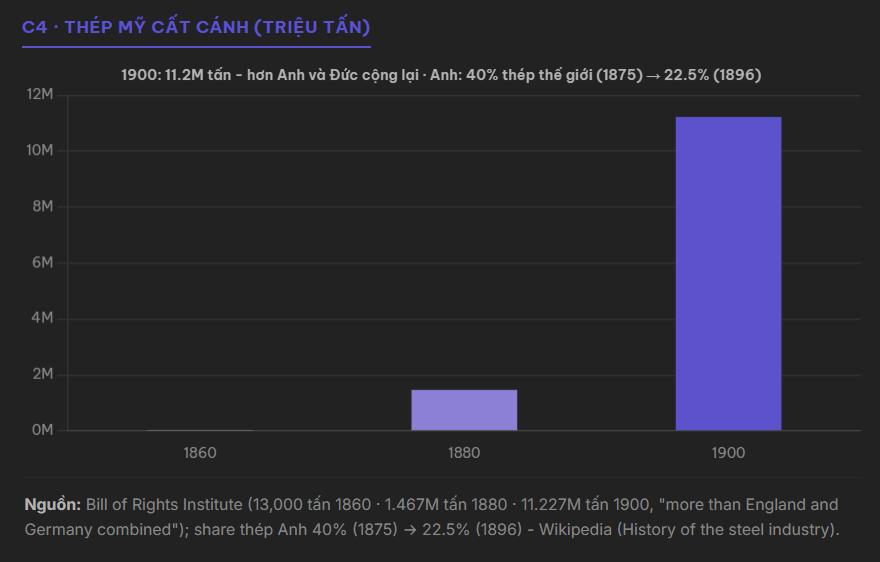
Behind that nearly 900-fold leap was the Bessemer process, a technology that made steel production much faster and cheaper by blowing air through molten pig iron to remove impurities. But technology only created opportunity-the man who turned it into an empire was Andrew Carnegie, a Scottish immigrant who built the largest steel company in America driven by an obsession with a single metric: cost per ton of steel.
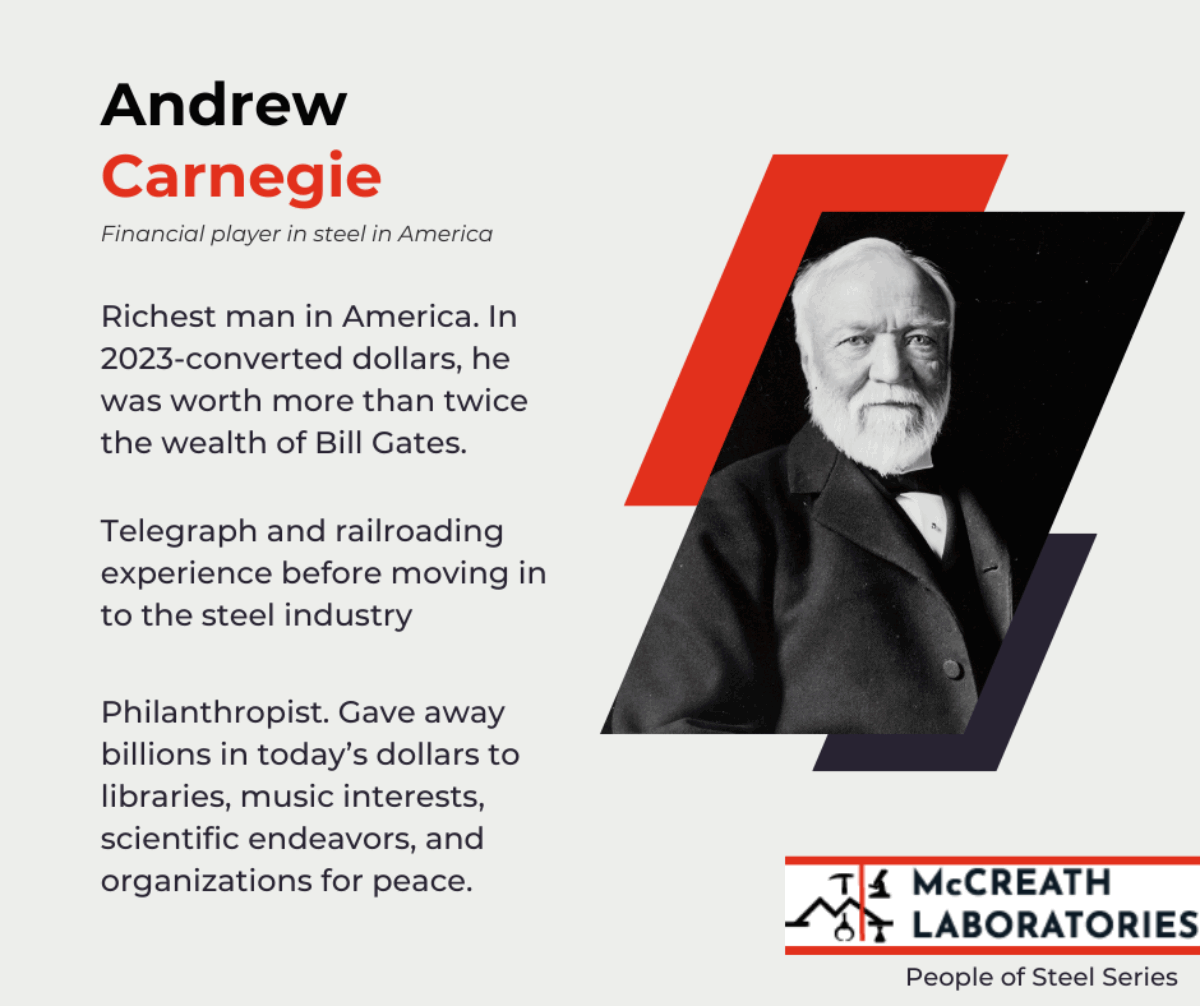
The results were starkly evident on the price tag:
The price of steel rails plunged from over $100 per ton in 1873 to about $18 per ton in the 1890s.
Carnegie Steel's production costs dropped by roughly 80%.
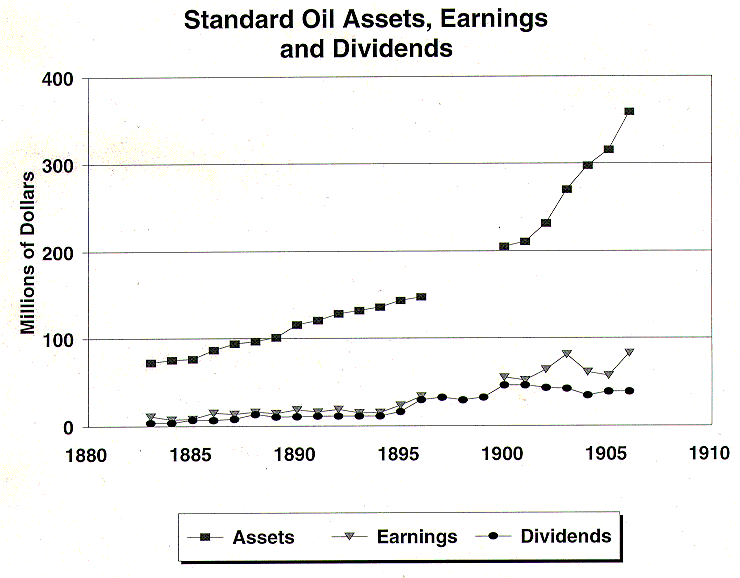
The company's net profit surged tenfold, from about $4 million in 1892 to $40 million in 1900.
Meanwhile, Britain-the "workshop of the world" for nearly a century-watched its share of global steel production shrink from about 40% to 22.5%.
Carnegie did not defeat Britain with a miraculous invention, but by producing the exact same product at a lower cost.
If Carnegie proved the power of scale with steel, Rockefeller took it to an entirely different level with petroleum. Before discussing market share or monopolies, one figure stands out:
Standard Oil's cost of refining a gallon of oil plummeted from 3 cents to just 0.45 cents within 15 years.
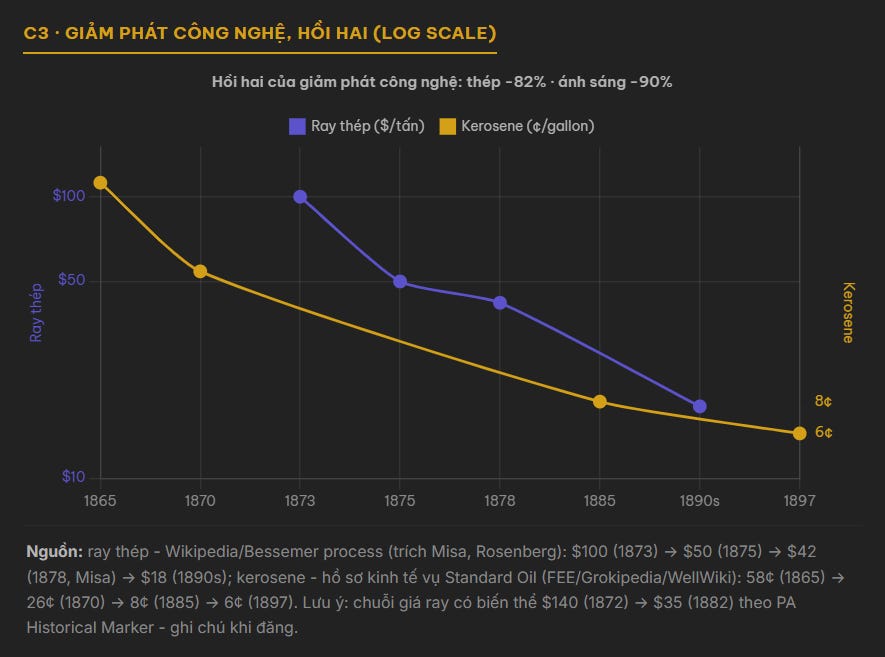
During that period, no revolutionary inventions emerged. The answer lay in scale: larger refineries, pipelines replacing wooden barrels, every byproduct utilized, and volumes large enough to negotiate freight rates lower than any competitor. Rockefeller was the first person in history to prove just how massive economies of scale could become.
The primary beneficiary of that scale was not Rockefeller, but the consumer.
The price of kerosene dropped from 58 cents a gallon in 1865 to about 6 cents by the late 19th century-a nearly 90% decline.
Artificial light at night-once a luxury of the aristocracy for most of human history-became a commodity that even factory workers could afford.
That is the true significance of the 6-cent figure. Achieving the market's lowest cost allowed Standard Oil to control approximately 90-95% of U.S. refining capacity.
However, this raises a question that historians continue to debate to this day: Did Standard Oil grow because they were that good, or because they played dirty?
One side, typified by Matthew Josephson and the concept of "Robber Barons," argues that Rockefeller built his empire through privileges unavailable to competitors: secret railroad rebates, market power, and various tactics to crush rivals.
In this view, scale stems not just from efficiency, but also from power.
The other side views the story very differently. Economist John McGee, after reading over 11,000 pages of Standard Oil records, found no clear evidence that Rockefeller used predatory pricing to destroy competitors.
What he saw was continuously falling costs accompanied by steadily declining prices.
Even renowned historian Gabriel Kolko wrote that Standard Oil "treated consumers with respect."
This article does not attempt to arbitrate right from wrong, but we must examine two simultaneous truths.
Consumers benefited as kerosene prices fell by nearly 90%.
Standard Oil's competitors were also crushed by advantages that stemmed from more than just operational efficiency.
Both are true. And that is the paradox of the Gilded Age.
By the late 1870s, oil had become king of the energy sector. Rockefeller's empire looked nearly untouchable.
Then in 1882, on a Manhattan street, a new invention lit up: Electricity.
Edison's Pearl Street station initially supplied power to just a few blocks, but anyone with foresight could see what that meant: if electricity wins, kerosene loses.
In the Gilded Age, no advantage is permanent, not even that of the market leader.
Ten years later, the banker who stepped forward to consolidate Edison's electric companies into General Electric is the very person we met at the end of Part I.
We will turn to him right after answering another question: legally speaking, how did people manage such colossal empires?
→ What made the U.S. economy larger than it was yesterday?
The answer is: Cheap inputs. Cheaper steel, cheaper lighting. But more importantly, the Gilded Age was the first time in history that economies of scale were proven to be not just the result of success- but a strategy to create success itself.
Part III. Trust: The invention that transformed capitalism
Surprisingly, the most vital invention of the Gilded Age was not forged in a workshop, but in a lawyer's office.
By the early 1880s, American businesses spanned from New York to California, yet the laws remained stuck in the previous century.
An Ohio company was not permitted to own shares in Pennsylvania.
A New York corporation likewise could not hold equity in a company in another state.
While the economy had evolved into a unified market, businesses remained partitioned by state lines.
In other words, America invented economies of scale before inventing legal scale.
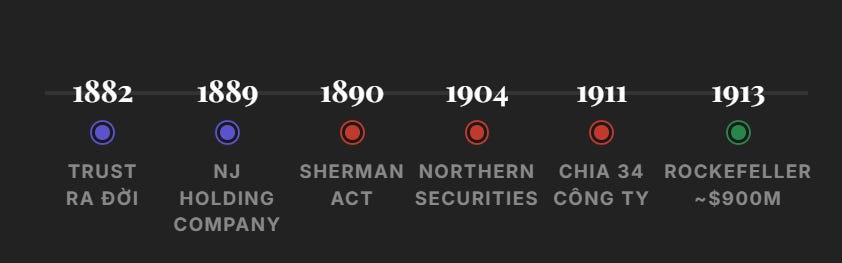
On February 1, 1882, Rockefeller's lawyers introduced a solution called a trustsoftware
Instead of letting 40 companies operate independently, shareholders transferred all their shares to nine trustees for centralized management, receiving trust certificates in return.
On paper, the 40 companies remained 40 separate entities.
In reality, they were operated as a single enterprise with a total capital of about $70 million.
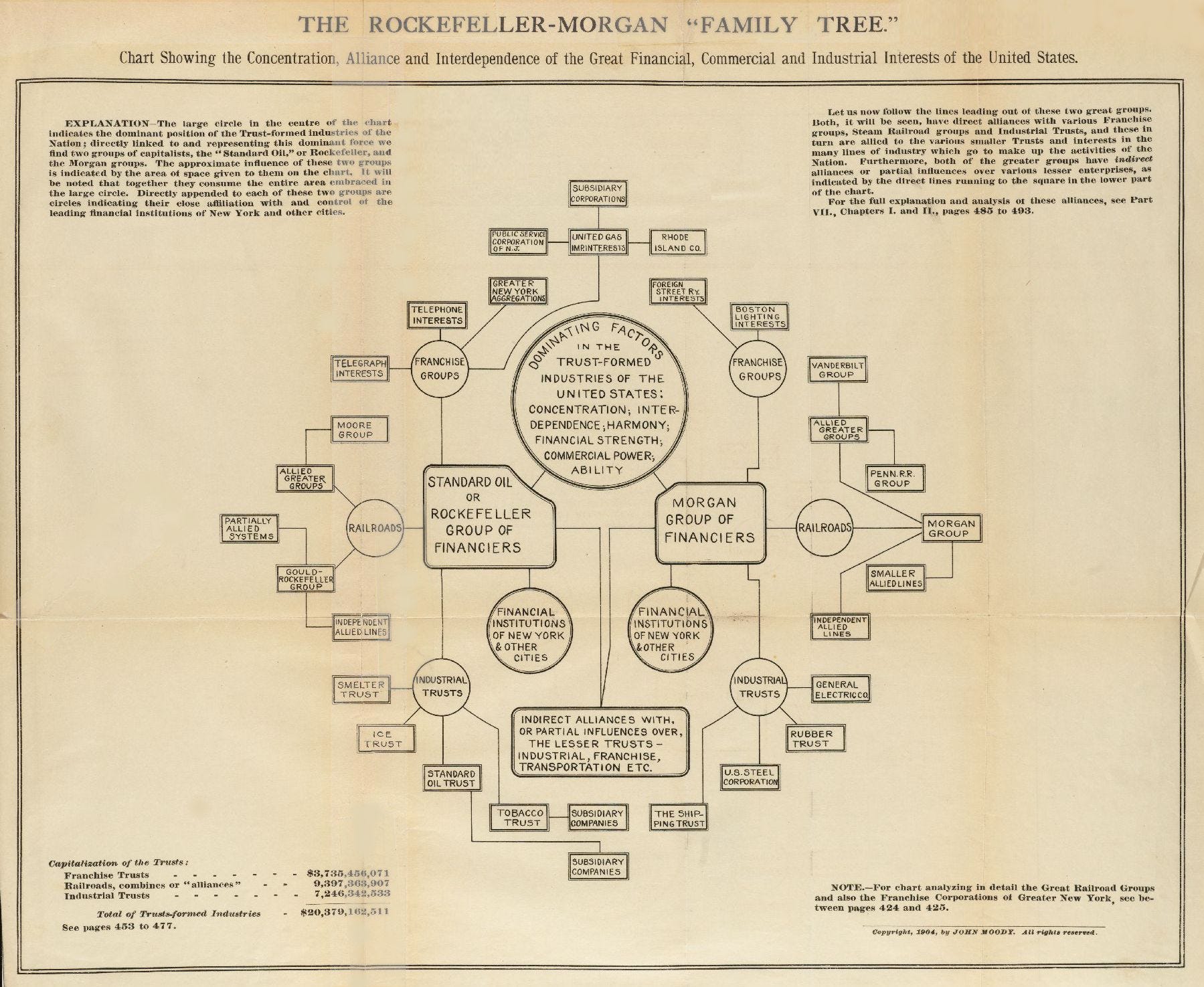
This was not merely a legal maneuver, but how America invented the modern corporationsoftware
Seven years later, New Jersey took it a step further: a new law allowed corporations to own shares in other companies, giving birth to the holding companysoftware
Trusts immediately "relocated" to New Jersey to take advantage of the new legislation.
Today we call this phenomenon regulatory arbitrage -businesses choosing to incorporate where regulations are most favorable.
As it turns out, that game already existed in the late 19th century.
Fun fact: today, almost every country has antitrust laws, but few realize that the word "trust" in antitrust originates from Rockefeller's Standard Oil Trust. In other words, America's entire antitrust legal framework is named after the very business model it was created to control.
Once this new corporate structure emerged, the next question was: what would it be used for?
There are two answers to this question, bearing the names of two entrepreneurs.
Andrew Carnegie chose vertical integration: owning iron ore mines, fleets, railways, blast furnaces, and steel rolling mills.
He controlled the entire supply chain so that no one could squeeze him on inputs.
John D. Rockefeller chose horizontal integration: acquiring rival oil refineries, scaling up until a single seller dominated most of the market.
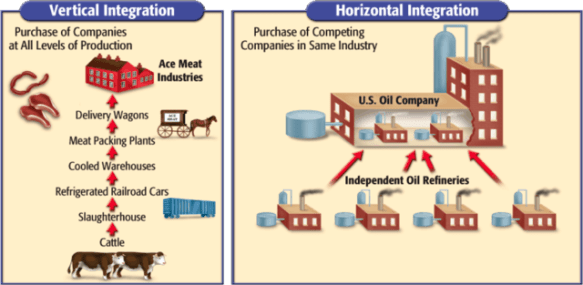
Though different, both strategies pursued the same goal: Scale.
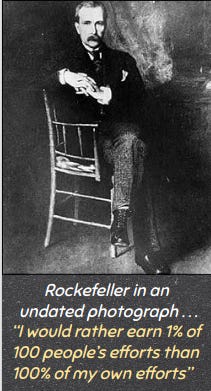
Rockefeller made no secret of this philosophy. According to historian Allan Nevins, in 1880 at age 41, he declared:
"The day of combination is here to stay. Individualism has gone, never to return."
"The day of combination is here to stay. Individualism has gone, never to return."
Yet institutions would soon push back.
Sherman Antitrust Act was passed in 1890, only to remain virtually toothless for over a decade.
It was not until the Northern Securities case in 1904, that President Theodore Roosevelt secured his first major victory against corporate trusts.
Seven years later, it was the turn of Standard Oil. In 1911, the U.S. Supreme Court ordered the breakup of Standard Oil into 34 companies.
That might sound like the death knell of an empire, but the reality proved to be quite the opposite.
Rockefeller still held about a quarter of the group's shares.
When the ruling was handed down, his net worth stood at around $300 million, but just two years later, by the end of 1913, his fortune had surpassed $900 million.
The market valued the spun-off companies-the precursors to Exxon, Mobil, and Chevron-higher than the conglomerate had been under one roof.
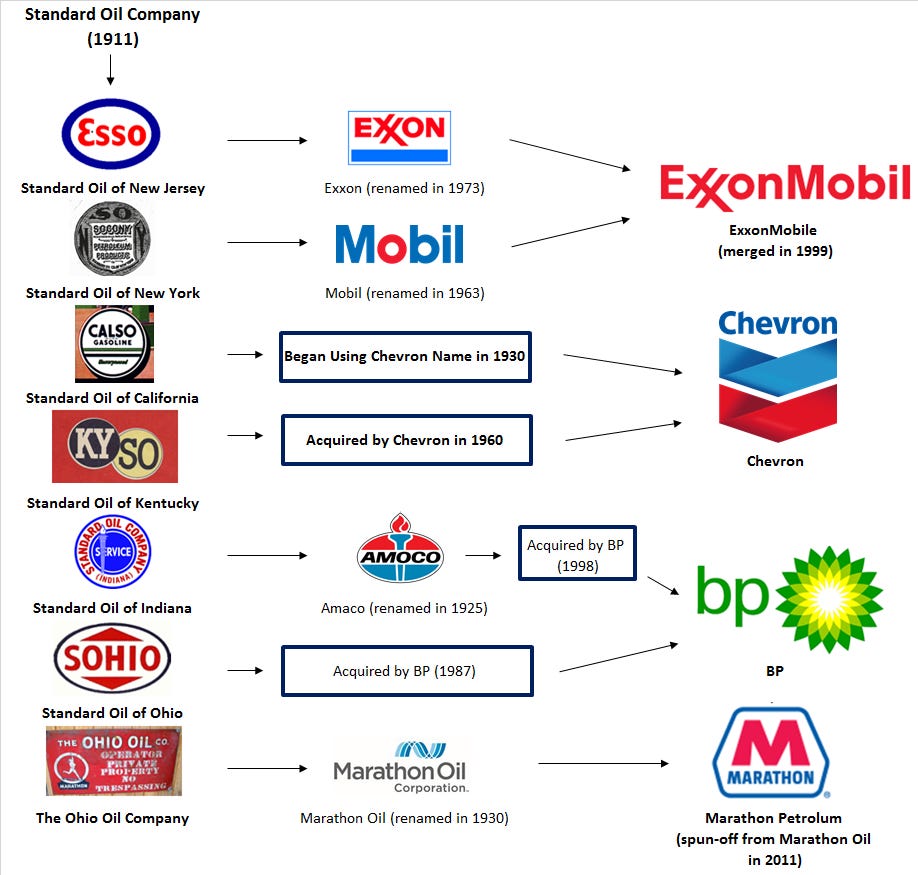
This also stands as one of the earliest spin-off lessons in financial history: sometimes the courts break up a business, but the market values the pieces higher than the whole.
Of course, it is only fair to look at the broader picture.
Upon the breakup, Standard Oil's market share dropped to 64-70% as new oil fields emerged in Texas and California, alongside rivals like Texaco, Gulf, and Shell.
Rockefeller's monopoly had already begun to crack before the court delivered its verdict.
Readers following the Big Tech antitrust lawsuits in 2026 will likely find this debate eerily familiar. Over a century ago, America was already debating whether Standard Oil grew by serving customers better, or because its market power had outgrown the limits of competition.
Today, that debate returns with Google, Apple, Meta, and Amazon. The characters change, the technology changes, but the core question remains largely the same.
The Standard Oil saga leaves investors with three questions:
Is the sum of the parts greater than the current market cap?
Would the individual segments command higher multiples from the market if they stood alone?
Are there specific catalysts or regulatory risks with a defined timeline?
In 1911, the answer to all three questions was yes-and Rockefeller "lost" the lawsuit while seeing his wealth triple in two years. In 2026, the market is applying that exact checklist to a single name: Google.
The Search case: in September 2025, the court declined to order the divestment of Chrome, opting instead for behavioral remedies (such as sharing search data). Alphabet shares surged immediately following the ruling-the market priced in "avoiding a breakup" as a windfall.
The Ad Tech case: Judge Brinkema ruled Google an illegal monopolist in April 2025; remedies-potentially including a forced divestiture of the AdX ad exchange-remain hanging in the balance as of mid-2026.
The Standard Oil paradox thus remains intact 115 years later: sometimes the worst-case scenario for shareholders is not being broken up, but never knowing whether you will be broken up at all.
→ What made the U.S. economy larger than it was yesterday?
→ What made the U.S. economy bigger than it was yesterday? Organization. Machines enabled faster production, but it was the modern corporate model that allowed America to manage machinery, capital, and labor at a scale previously unimaginable to the rest of the world.
Part IV. Morgan - The Orchestrator of Empires
By the turn of the 20th century, America already boasted colossal corporations in steel, oil, railroads, and electricity.
Yet the more giant corporations emerged, the more the economy needed someone to perform a task that no single enterprise could undertake on its own: allocate capital, broker deals, restructure businesses, and prevent the system from collapsing whenever a crisis struck.
The person who stepped up to shoulder that monumental responsibility was none other than John Pierpont Morgan (J.P. Morgan)software
If Carnegie built steel and Rockefeller built oil, Morgan was the one who stitched all those empires together into a single system.
His story also began in a very American fashion: with a crisis.
In 1873, the largest investment bank in America at the time-Jay Cooke & Co.-collapsed under the weight of too much railroad debt, igniting the Panic of 1873software
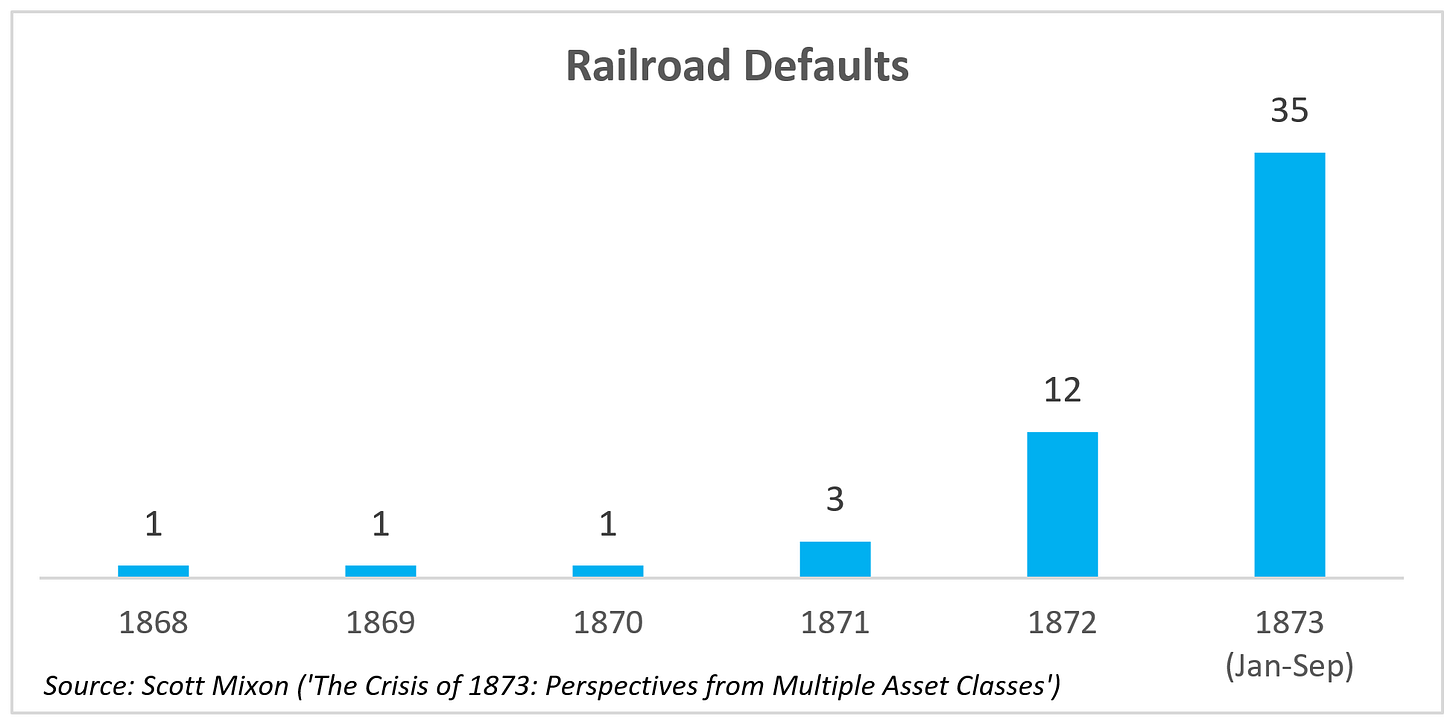
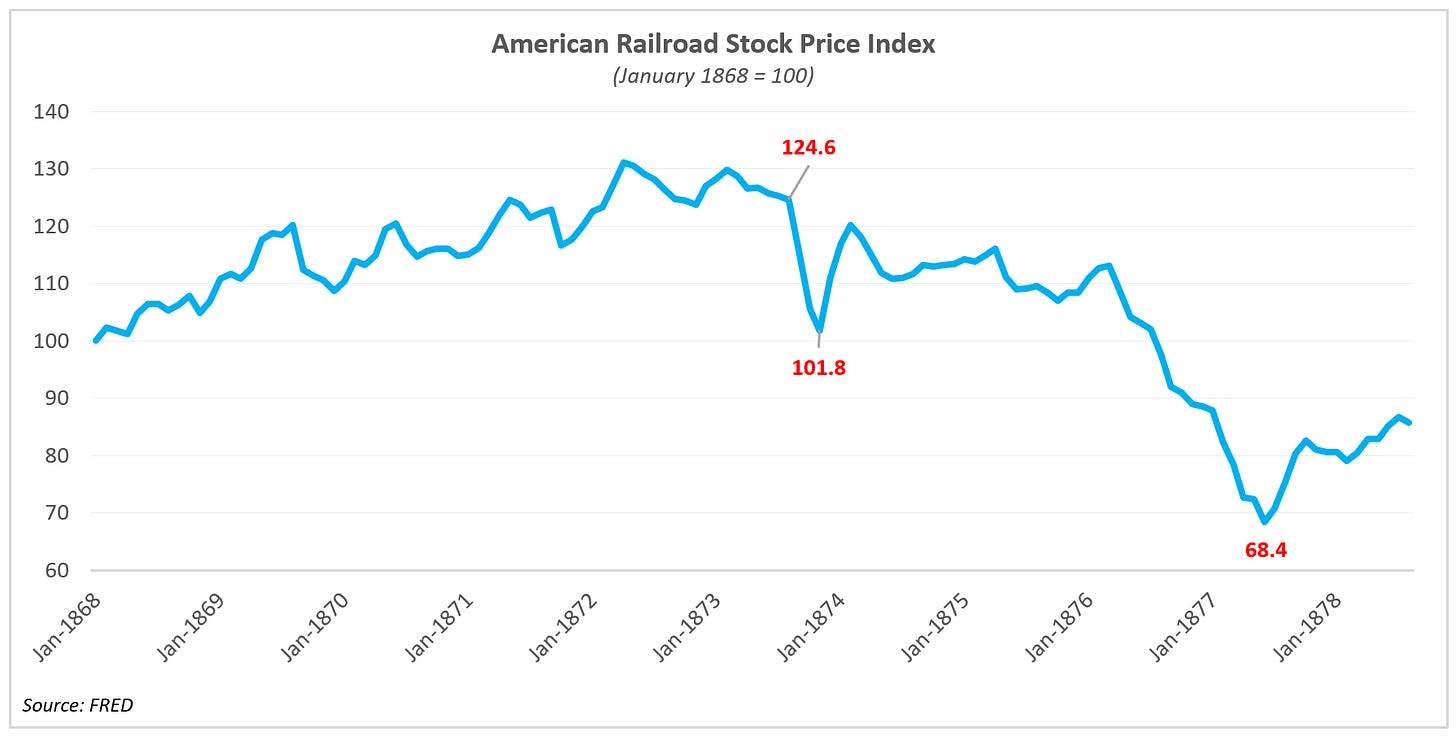
When one icon falls, another steps up. Drexel, Morgan & Co. gradually stepped into Jay Cooke's shoes to become the new epicenter of Wall Street.
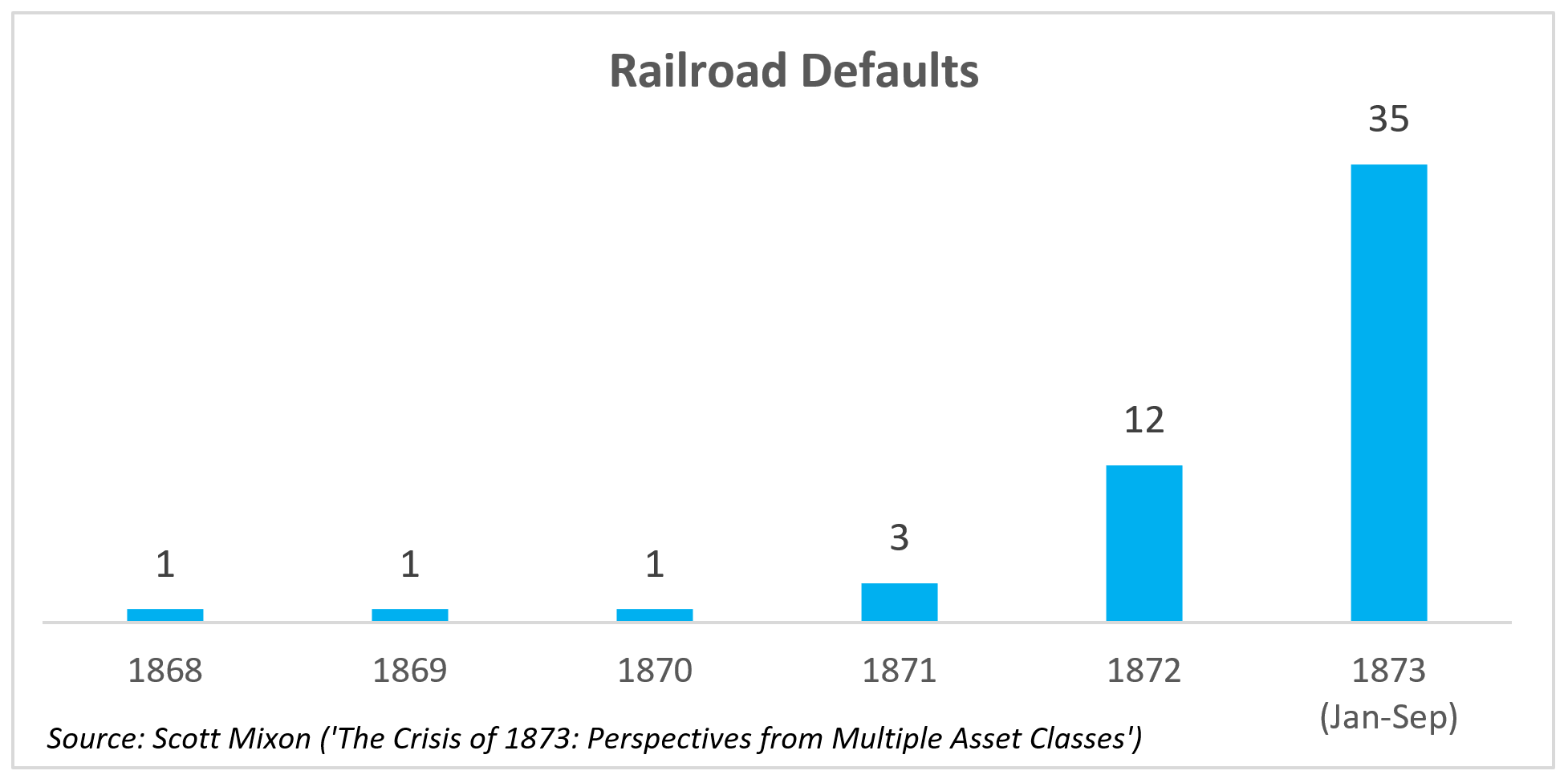
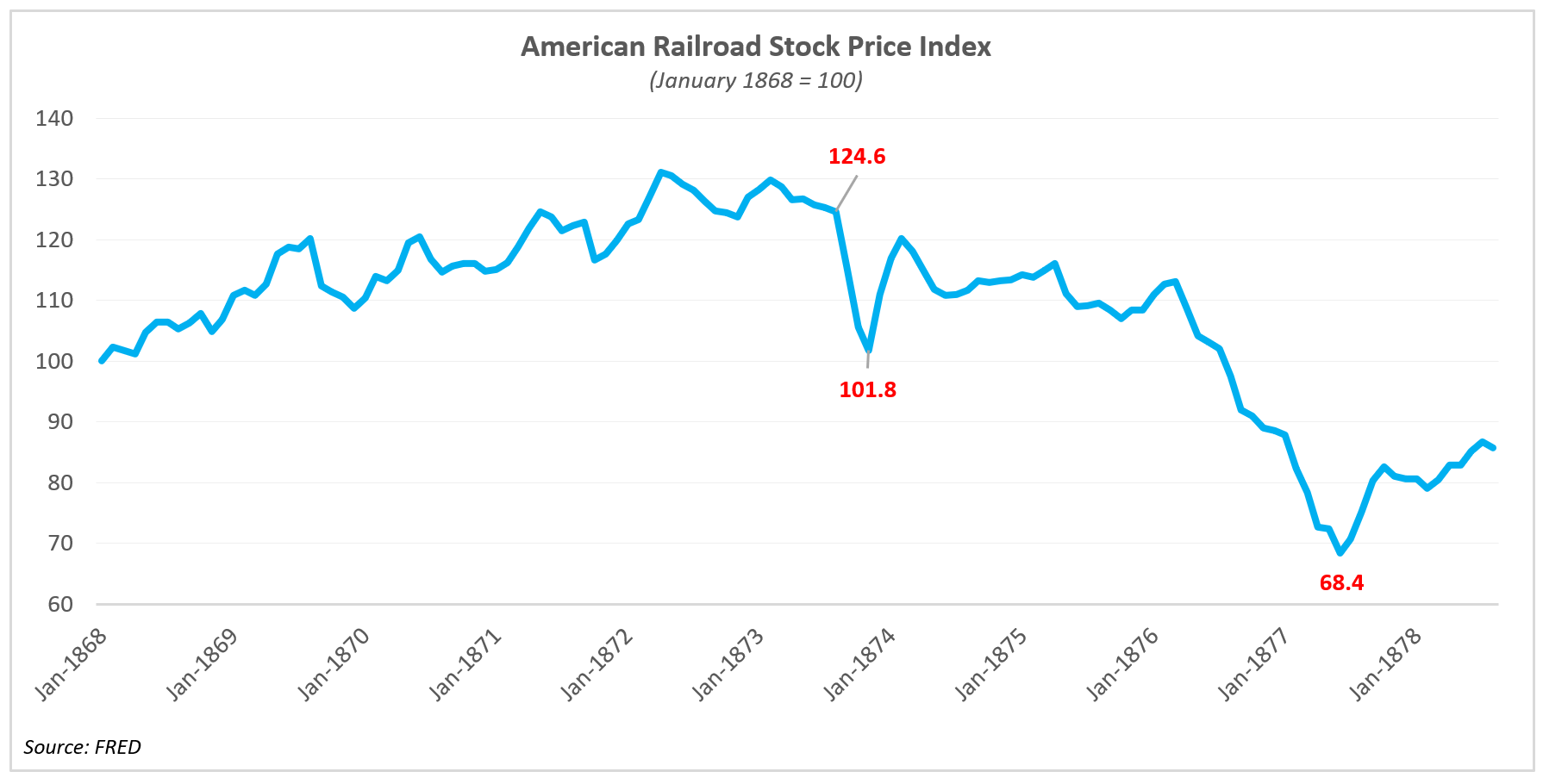
From then on, whenever the economy trembled, Morgan appeared.
His "track record" was essentially the track record of late 19th-century American capitalism:
Following each wave of railroad bankruptcies, Morgan stepped in to restructure: cutting debt, replacing management, rearranging finances, and taking a seat on the board.
At its peak around the turn of the 20th century, the Morganization wave consolidated the American railroad system into about 12 major networks-controlling over half of the country's total track mileage.
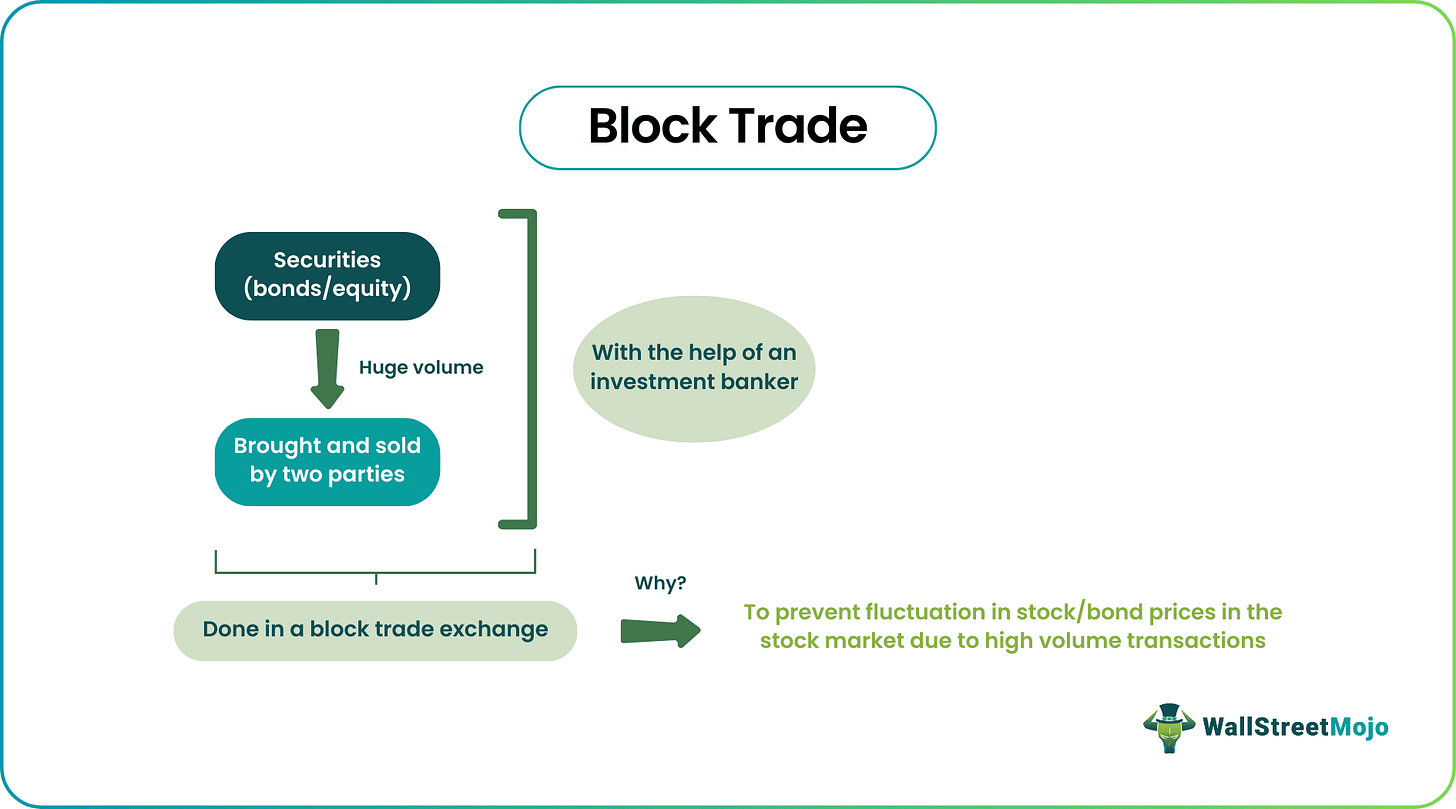
In 1879, Morgan executed the sale of 250,000 shares of the Vanderbilt family's New York Central without panicking the market- marking one of the first block trades in Wall Street history.
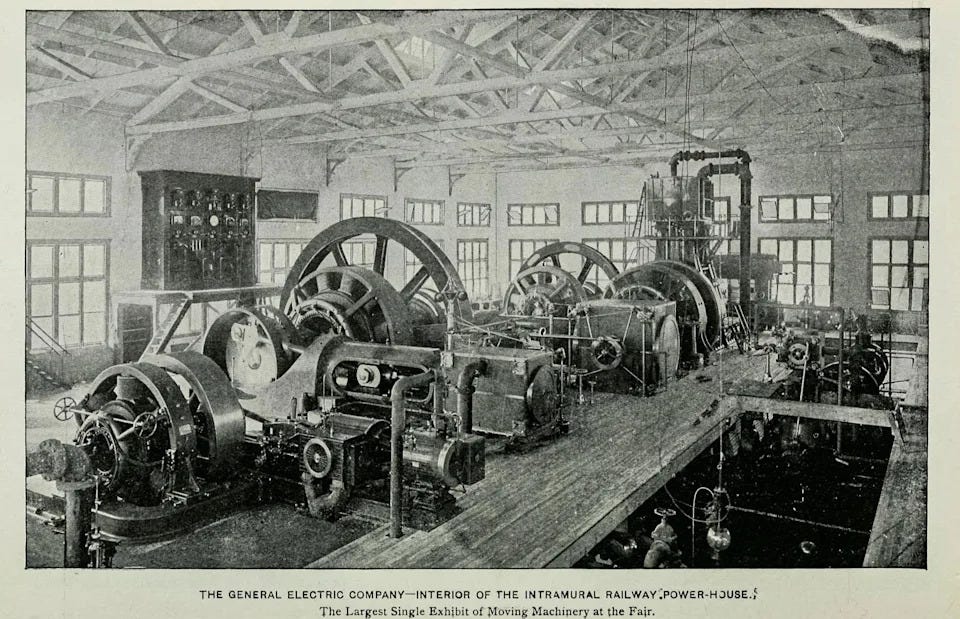
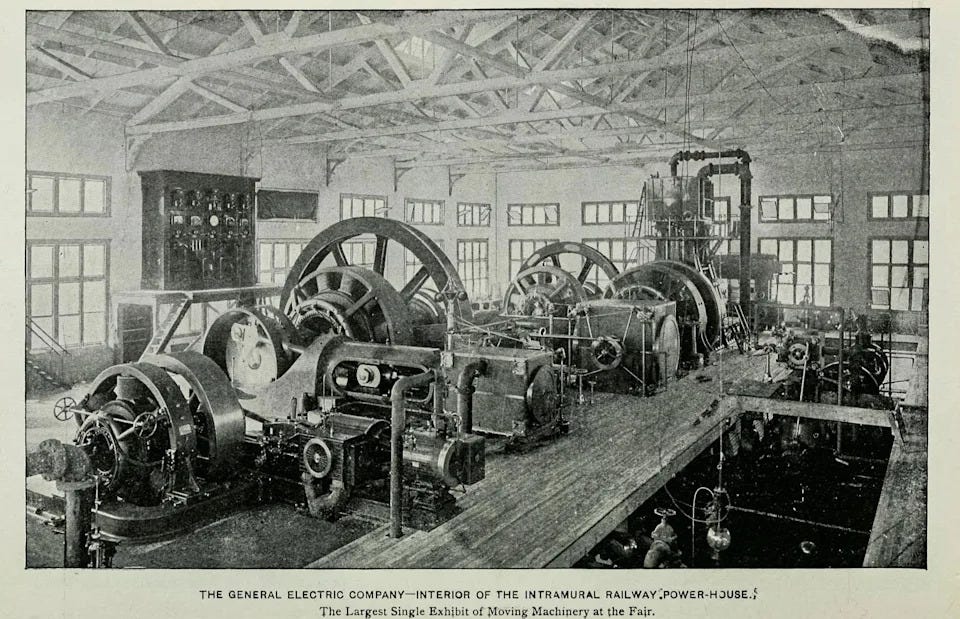
In 1892, he backed the consolidation of electrical companies to give birth to General Electric-bringing the "electricity" storyline from Part II to a close.
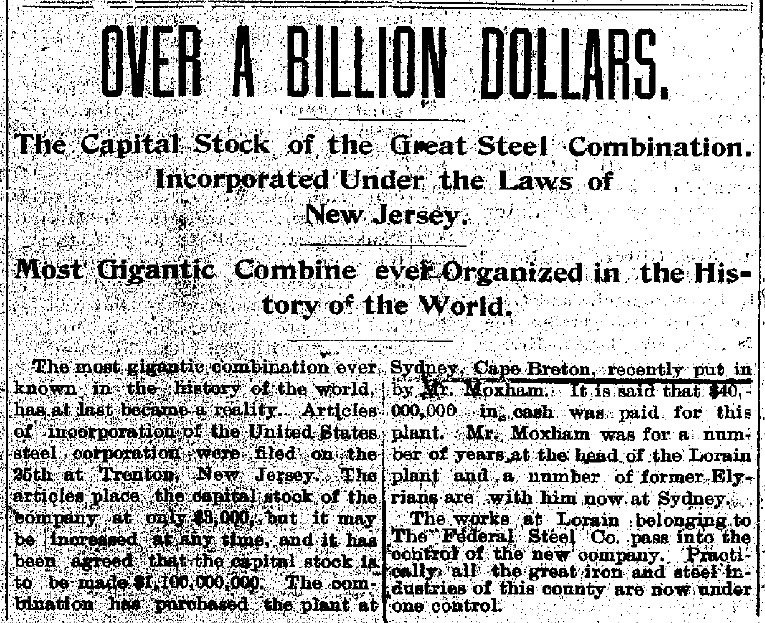
In 1901, Morgan acquired Carnegie Steel for nearly $500 million and merged it with nine other companies to form U.S. Steel-the world's first corporation with a market cap exceeding $1 billion.

In truth, Morgan did not invent steel, nor did he invent oil. What he did was take other people's inventions and turn them into even grander machines.
Morganization never truly died
In March 2008, Bear Stearns collapsed. The buyer: JPMorgan.
On January 5, 2023, First Republic Bank collapsed-the second-largest bank failure in U.S. history. The buyer-scooping it from the hands of the FDIC-was once again JPMorgan.
150 years after Jay Cooke collapsed and Drexel, Morgan & Co. stepped into the breach, the bank bearing Morgan's name still does one thing: steps in during panics, buys assets from the position of the only buyer left willing to buy, and emerges larger than before.
Returning to the Gilded Age, the moment of Morgan's ultimate authority did not stem from a corporate deal, but from a confrontation with the government.
In 1895, in the wake of the Panic of 1893, the gold reserves of the U.S. Treasury plummeted to alarming levels. Morgan walked straight into the White House to meet President Grover Cleveland and delivered a message nobody wanted to hear: without an immediate replenishment of gold, the U.S. government risked losing the market's confidence.
He then dusted off a virtually forgotten Civil War-era statute, teamed up with the Rothschild family in Europe, and sold 3.5 million ounces of gold to the U.S. Treasury.
A private banking syndicate lent the U.S. government over $60 million, enough to stabilize the system.
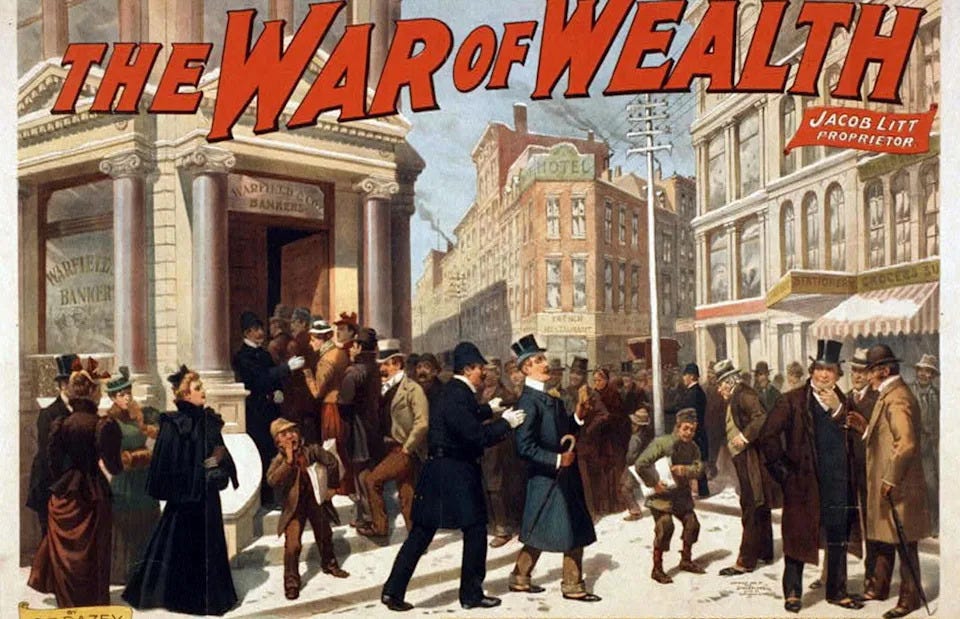
Last time, we saw Hamilton build national credit. Now, a private bank stepped in to safeguard that very credibility. That is a level of power few businessmen in history have ever wielded.
Just how vast was Morgan's reach? One need only look at the report published by the U.S. Congress in early 1913.
The Pujo Committee investigated the so-called "money trust" and revealed a figure that shocked the nation: partners of J.P. Morgan & Co. alongside the boards of First National and National City held a combined 341 directorships across 112 companies, boasting total assets and market capitalization of roughly $22.245 trillionsoftware
To put that into perspective:
That figure was equivalent to more than half of U.S. GDP in 1913.
It equaled nearly 85% of the total value of the New York Stock Exchange at the time (about $26.5 billion).
Attorney Louis Brandeis compared it to the combined asset value of all states west of the Mississippi River.
Adjusted to modern scales:
U.S. Steel's $1.4 billion market cap in 1901 was equivalent to roughly 7% of U.S. GDP-making it the equivalent of a $2 trillion company by today's standards.
Carnegie's personal payout alone (around $226 million) accounted for roughly 1% of GDP-equivalent to a fortune of some $300 billion today, putting him on par with the planet's wealthiest individuals in 2026.
The $22.245 trillion pile attributed by the Pujo Committee to the Morgan syndicate amounted to more than half of America's GDP.
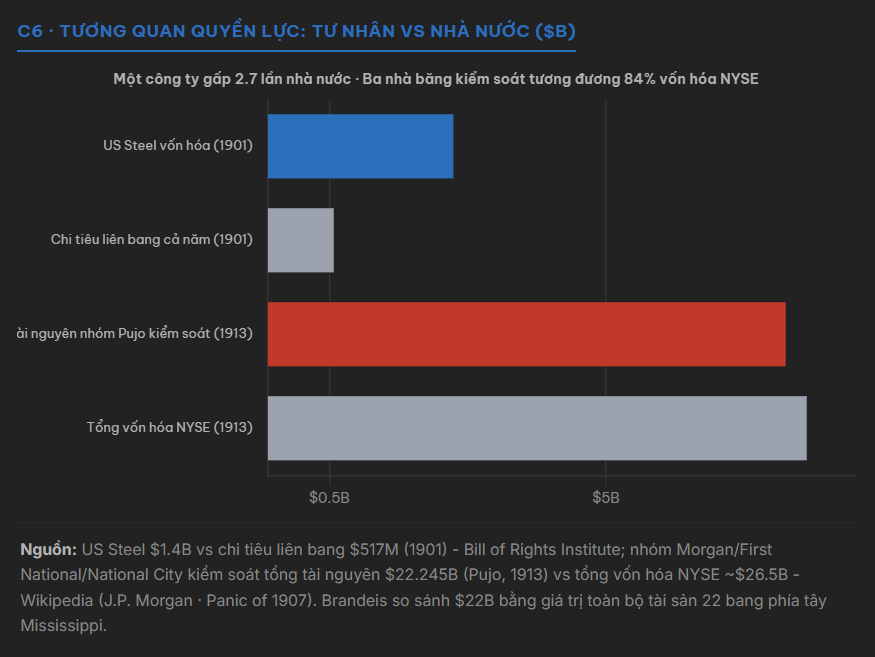
If the government had an army, Morgan had a balance sheet.
To this day, historians remain divided on how to view him.
To Louis Brandeis, Morgan was the embodiment of a "money trust"-using other people's money to control the economy and embedding conflicts of interest into the system.
To historian Ron Chernow, however, the story was different. In an America that lacked a central bank, Morganization served as the only existing mechanism of financial discipline.
Morgan did not merely lend money; he used his own reputation to keep the entire system from collapsing.
Perhaps both perspectives are valid. And precisely for that reason, America ultimately reached a definitive conclusion: the entire financial system cannot be allowed to depend on a single man.
But before that conclusion became law, the United States had to endure yet another crisis.
→ What made the U.S. economy larger than it was yesterday?
→ What made the U.S. economy bigger than it was yesterday? Capital. If Carnegie turned steel into an empire, and Rockefeller did the same with oil, Morgan connected those empires with flows of capital.
Wall Street no longer just financed industry. It began deciding which businesses would be consolidated, which restructured, and ultimately how entire industries would operate.
Part V. America and the 20 million people running the industrial machine
Steel needed furnacemen, railways needed tracklayers, factories needed machine operators. The machines of the Gilded Age may have been built of steel and powered by coal, but they still lacked the most important element: Peoplesoftware
And much like Part 1, the United States once again imported the answer.
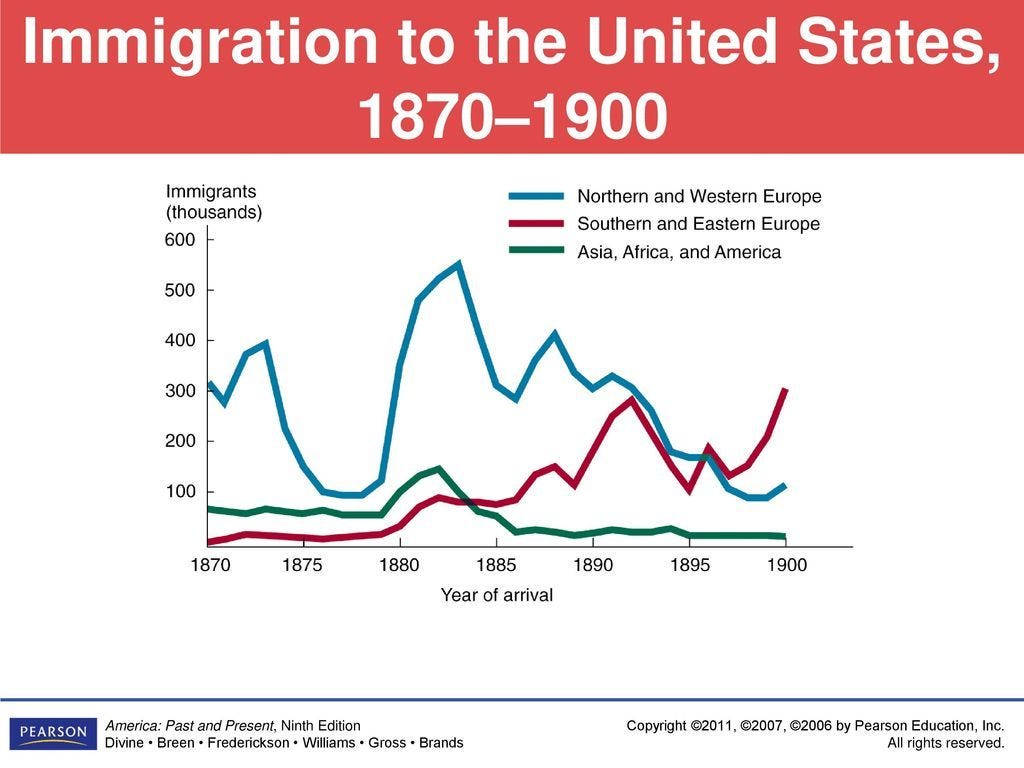
If the four decades before the Civil War saw roughly 5 million immigrants, the period from 1880 to 1920 brought a wave four times larger: over 20 million peoplesoftware
This time, however, the tide shifted. Ireland and Germany no longer accounted for the majority. Instead, they came from Southern and Eastern Europe.
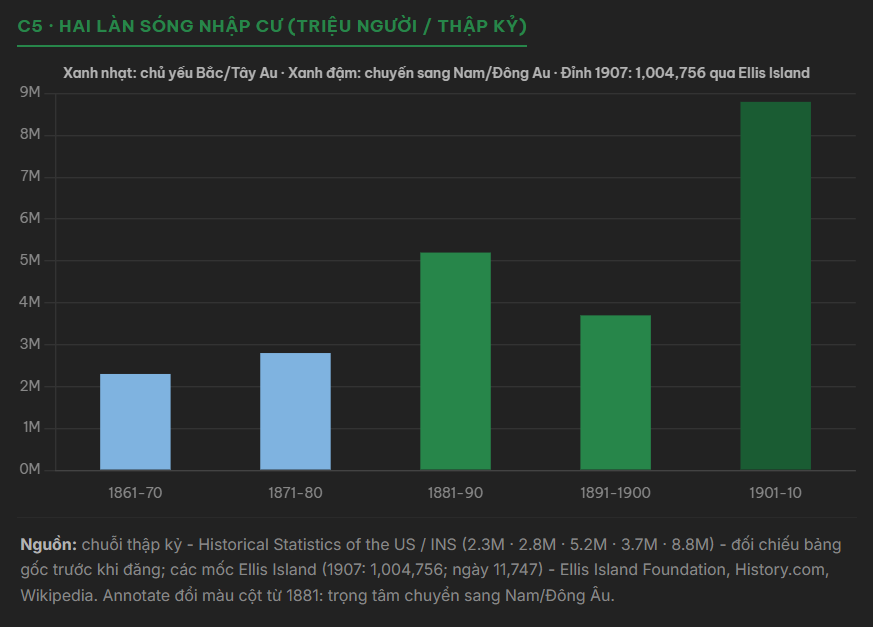
Over 4 million Italians left their homeland due to poverty and hardship.
Over 2 million Jews fled pogroms within the Russian Empire.
Millions of Poles, Hungarians, Czechs, Greeks, and Slovaks crossed the Atlantic in succession. By the dawn of the 20th century, roughly two-thirds of new immigrants came from Southern, Eastern, and Central Europe.
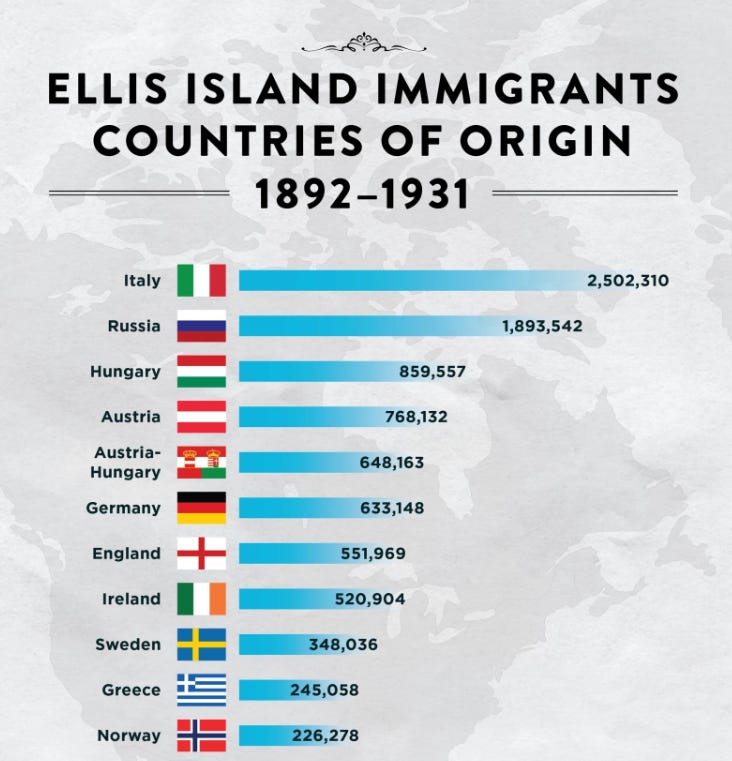
For them, America began on a small island in New York Harbor called Ellis Islandsoftware
Opened in 1892, Ellis Island became the grandest gateway to the American Dream.
Over its 62 years of operation, more than 12 million people passed through the island.
Today, roughly 40% of Americans have at least one ancestor who stood in line there.
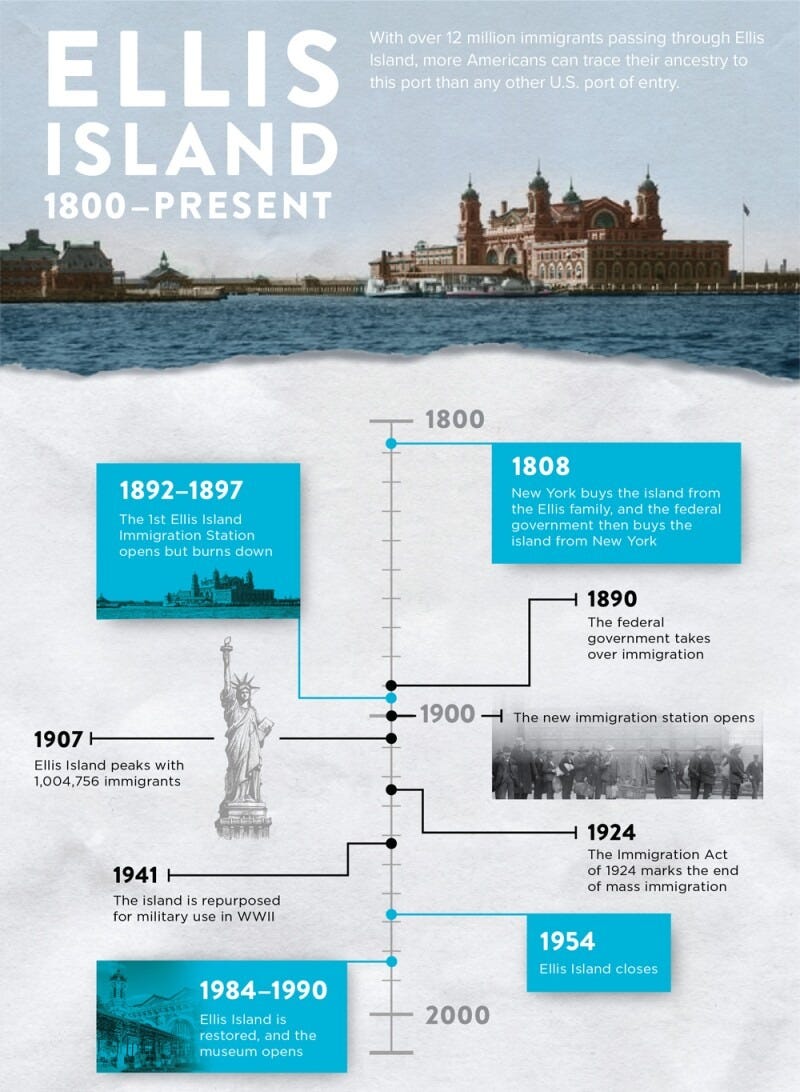
The scale of that wave is difficult to comprehend looking solely at the aggregates. But breaking it down:
Look at 1907: in a single year, more than 1 million people were processed at a single immigration station.
On April 17, 1907 alone, Ellis Island processed 11,747 people within 24 hours.
Throughout the 1905-1914 period, the U.S. welcomed an average of roughly 1 million immigrants annually.
In 1907, to enter the United States, no passport was required, no visa, nor any form of modern identification.
For most Europeans, it only took declaring information at the port of departure and purchasing a third-class ticket from Liverpool for about $10-roughly equivalent to 10 days' wages for an ordinary laborer.
Yet America did not need them to dress up population statistics; America needed them to run its industrial machine.
Evidence of this lies in the fact that roughly 85% of new immigrants stayed in cities.
They stood by Carnegie's steel furnaces, drilled Rockefeller's oil wells, sewed garments in Lower East Side workshops, and laid the remaining 200,000-plus miles of railroad tracks.
Within a few decades, America transformed from an agrarian nation into an urban powerhouse at an unprecedented pace.
Another detail is also striking: the influx of immigrants served almost as a real-time leading indicator:
When the Panic of 1893 struck, the volume of arrivals dropped from over 500,000 per year to roughly 270,000 annually, before rebounding in the 1900s.
Without needing GDP figures or employment reports, the very people preparing to sell everything they owned to cross the Atlantic sensed the U.S. economy slowing down ahead of nearly everyone else.
Naturally, that door was never open to everyone.
Also during this era, the Chinese Exclusion Act (1882) became America's first major legislation barring immigration from an entire ethnic group. While the door swung wide open for most of Europe, it slammed shut against the Chinese.
It is evident that since the late 19th century, America carried two parallel trends within itself: needing immigration to drive economic growth, and endlessly debating just how open the door should be.
140 years later, that debate is still not over.
→ What made the U.S. economy larger than it was yesterday?
→ What made the U.S. economy bigger than it was yesterday? People. Steel, oil, and capital built the machinery of the Gilded Age. But those 20 million new immigrants were the fuel that kept the machine running for nearly half a century.
Part VI. The bill of an era
By this point, the gold plating was thick enough-now it is time to look at the core.
The Gilded Age generated more wealth than any prior period in American history, but like every economic boom, it left behind a massive bill.
1. The first bill was named labor
.
The industrial machine of the Gilded Age ran on steel, oil, and more than 20 million immigrants. Yet the larger its scale of operation, the greater the friction between business owners and workers grew. While productivity and profits surged at unprecedented rates, working conditions, wages, and workers' bargaining power became the new battleground of the U.S. economy.
Consequently, strikes grew increasingly frequent. 1877:
The first nationwide railroad strike was crushed by federal troops. 1894:
The Pullman Strike ended in a similar fashion. Yet the defining symbol of the entire era was Homestead in 1892
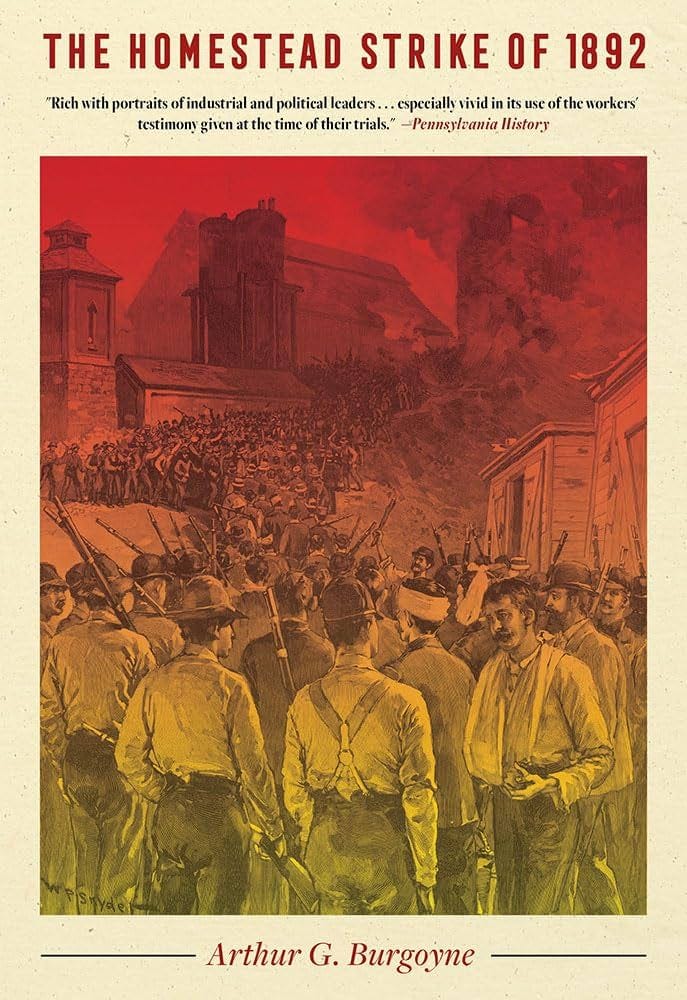
The Homestead Strike of 1892: Burgoyne, Arthur: 9780822953104: Books - Amazon.ca
What made Homestead the symbol of the era was not merely the casualty count. Three years prior, Andrew Carnegie had published an essay titledThe Gospel of Wealth
. In it, he argued that the wealthy had a responsibility to use their fortune to serve society, leaving behind a famous phrase:
“The man who dies thus rich dies disgraced.”
“The man who dies thus rich dies disgraced.”
The bloody strike of 1892 did not take place at just any random factory. It happened right at the enterprise owned by Carnegie himself-the very man who wrote those lines. 2. The second bill was namedsoftware
.
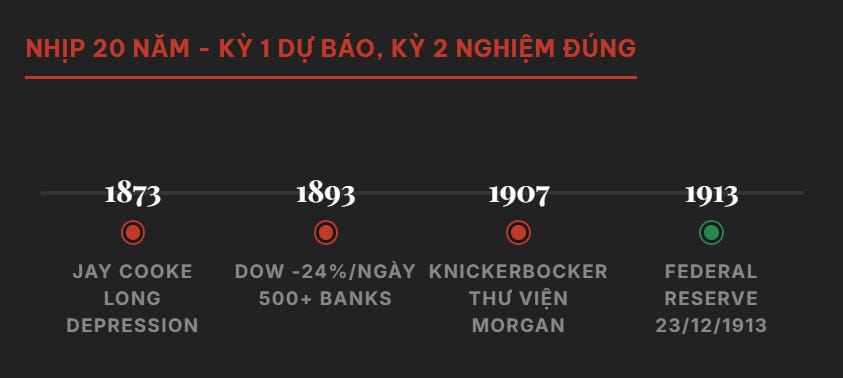
Right from Part 1, we witnessed the consequences of Andrew Jackson abolishing the central bank. The U.S. financial system entered a repeating cycle: overexpansion, collapse, and expansion once more.
During the Gilded Age, that cycle ran almost right on schedule. 1873:
Jay Cooke & Co. collapsed, the New York market froze, kicking off the Long Depression. 1893:
the most severe panic of the 19th century. Over 500 banks and roughly 15,000 to 16,000 businesses went bankrupt; nearly one-third of the railroad network plunged into bankruptcy. Unemployment hovered between 17% and 25% depending on estimation methods, peaking at 43% in Michigan alone.
Agricultural prices steadily declined while farmers' debts remained frozen. For urban consumers, deflation was welcome news. For borrowers, it was a death sentence.
In 1896, William Jennings Bryan stood before the Democratic National Convention and crystallized all of America's anger into a historic quote:
“You shall not crucify mankind upon a cross of gold.”
“You shall not crucify mankind upon a cross of gold.”
Bryan believed the root of the problem lay in the gold standard. He wanted to loosen monetary policy by minting more silver to ease the debt burden on farmers and workers. That debate failed in the 1896 election, but it left behind a much longer-lasting legacy: the ancestor of all debates betweenhard money and soft money
, stretching from the 19th century all the way to the Fed and Bitcoin today. Yet whether siding with the gold camp or the silver camp, neither resolved a greater issue:
America still lacked a central bank.
And then in 1907, the system crashed once again.
The New York stock market lost nearly half its value from its peak the previous year.
Knickerbocker Trust-the city's third-largest trust institution-collapsed, pushing the entire financial system to the brink of the abyss.
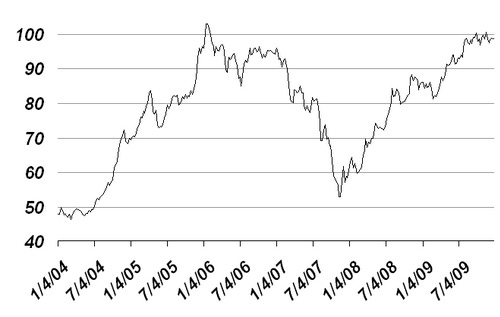
1904–1910. The low of 53 was recorded on 11/15/1907 So a man decided:
if no one else would step up to act as a central bank, he would do it himself.
J.P. Morgan's private library on Madison Avenue instantly became the command center of the entire U.S. financial system. New York bankers filed in and out for days. Morgan-then 70 years old-personally audited the books of the Trust Company of America deep into the night. The next morning, he uttered just a single sentence:
"This is the place to stop the trouble, then."
"This is the place to stop the trouble, then."
In the days that followed, Morgan locked the library doors, keeping the bankers trapped inside until they agreed to sign commitments to pump cash into the rescue of the system.
Treasury Secretary George Cortelyou injected $35 million in federal funds into New York banks.
The acquisition of Tennessee Coal & Iron by U.S. Steel to rescue a brokerage firm was also approved by President Theodore Roosevelt himself.
Morgan himself reportedly put up more than $20 million of his own money into the bailouts.
Throughout those harrowing weeks, J.P. Morgan was not just the most powerful banker in America. He was doing the job that a central bank should have done.
A 70-year-old man, relying purely on his personal clout, single-handedly shouldered the functions of a central bank.
That very moment made America realize two things at once: a modern economy needs a lender of last resort, and that role cannot be left dependent on the lifespan of a single mortal.
Six years later, the U.S. officially corrected its mistake. In1913
, three seemingly unrelated events converged in a single year: February:
The 16th Amendment was ratified, establishing the federal income tax. December 23: The Federal Reserve Act was signed into law. Seventy-seven years after Andrew Jackson dismantled the central bank,
America finally had the Fed. And right between those two milestones,on March 31
, J.P. Morgan passed away in Rome.
It is hard to find a more symbolic coincidence.
The man who spent years performing the duties of a central bank passed away the exact year an institutional central bank was born. After nearly eight decades, Morgan's role finally found a successor.
Months before his death, in his final appearance before the Pujo Committee, Morgan was asked whether commercial credit should be built first upon money and property. He replied:
"No, sir. The first thing is character... Before money or anything else. Money cannot buy it."
"No, sir. The first thing is character... Before money or anything else. Money cannot buy it."
Readers who remember Part 1 will instantly recognize the profound meaning behind that answer. "Character" in Morgan's reply is precisely the "creditworthiness" that Hamilton laid as the first brick of America's financial system more than a century prior.
After 122 years, that idea returned, this time voiced by the most powerful man on Wall Street-acting like a final testament closing out an entire era.
→ What made the U.S. economy bigger than it was yesterday? The answer is: Institutions.
During the first era (1776–1865), it took America only a few years to tear down its central bank. In this era, it took nearly 80 years, 3 panics, and a J.P. Morgan to rebuild it. That was the heaviest price tag of the Gilded Age.
Conclusion
If Part 1 told the story of America building a unified market, Part 2 is the tale of how it learned to harness that market on an unprecedented scale.
Railroads unified the continent.
Steel and oil made every input cheaper.
Trusts and holding companies allowed enterprises to outgrow outdated laws.
Wall Street learned to consolidate an entire industrial sector.
Over 20 million immigrants became the fuel for that machine.
And after 3 panics, America finally rebuilt its central bank.
Looking at the broader picture, this is also the second puzzle piece of the 250-year journey. Hamilton inventedsoftware
. The Gilded Age inventedsoftware
. Ford was about to inventsoftware
. And a century later, Silicon Valley would inventsoftware
.
Every era has had a technology that shaped America. But the most crucial technology of the 1865–1913 period was not steel, oil, or electricity-it was the ability to organize capital, machinery, and people on a scale the rest of the world had never attempted.
Yet the picture still lacked one final piece. No matter how perfectly organized a machine is, it only generates wealth when there are buyers willing to purchase what it produces.
And right as the Gilded Age drew to a close, an engineer in Detroit set out to solve that exact problem.
On January 4, 1913, at the Highland Park plant, Henry Ford rolled out the world's first moving assembly line.
Ford did not invent the automobile. He invented a way to build cars so fast and cheaply that an ordinary factory worker could afford the very vehicle they helped assemble. This was not merely a manufacturing upgrade, but the genesis of an entirely new growth model:
instead of building wealth solely through production expansion, America would begin generating wealth through the expansion of mass consumption. In the upcoming installment, Viet Hustler will take readers into the Era of Mass Consumption (1913–1945)