Account migration portal from Viet Hustler to Tạp Chí Phố Wall:
Enter your Viet Hustler account email
Receive a coupon via email for your unused Viet Hustler balance
Use the coupon to register for a Tạp Chí Phố Wall account
https://tapchiphowall.com/viethustler

If you missed our best recent articles:
On June 11, the opening match of the 2026 World Cup will take place at Estadio Azteca in Mexico City. For the first time in history, the tournament is being hosted by three countries simultaneously.
48 teams. 104 matches. 16 cities. 39 days.
FIFA forecasts revenue for the 2023–2026 cycle to reach $13 billion - a 72% increase compared to the Qatar 2022 cycle.
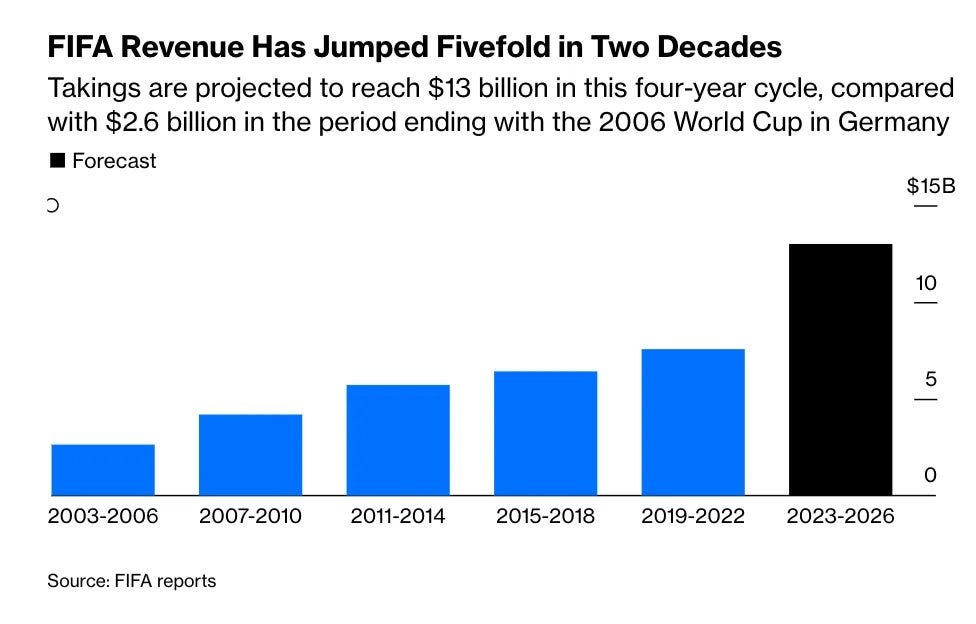
These are massive numbers. But the economic history of the World Cup tells a different story.
12 out of the 14 World Cups since 1966 have resulted in near-losses for the host nations.
The total costs incurred by host nations in the last four tournaments exceed $250 billion.
FIFA's revenue over the same period: Nearly $23 billion.
The World Cup is a wealth transfer machine - from the host nation's taxpayers to FIFA's pockets.
At a glance, 2026 seems different:
No new stadiums to build
Three countries sharing the burden
Existing infrastructure
But upon closer inspection, the commercial structure of this World Cup is more asymmetric than ever.
In today's article, Viet Hustler will dissect the entire World Cup economic machine with you - from the history of host selection to the 2026 tri-nation model and the question: who really wins?
The Bidding Game: The Price of Being Chosen
The Cost Spiral: From $500 million to $220 billion in 28 years
Infrastructure, Demand, and Planning: 5 Lessons from the U.S., Germany, Brazil, and Qatar
The Mega-Event Trap: Why the Olympics and World Cup often fail
World Cup 2026: Three host nations, three economic models
Who really wins? The $13 billion redistribution machine