If you missed our best recent reads:
“Having a reserve currency typically sows the seeds of a country ceasing to be a reserve currency country. That is because it allows the country to borrow more than it could otherwise afford to borrow, and the creation of lots of money and credit to service the debt debases the value of the currency and causes the loss of its status as a reserve currency.”
- Ray Dalio, economist and investor, on the nature and cost of the global reserve currency.
In the prolonged periods of instability throughout economic history, one question keeps resurfacing in various forms: has the current order reached its end?
In today's global monetary system, that question boils down to the most contentious proposition: is the US dollar heading toward the fate of previous reserve currencies?
Familiar historical comparisons quickly emerge. Portugal, the Netherlands, the UK - all once held the central currency, all eventually lost that status. From this, an apparently obvious conclusion is drawn: the dollar will follow the same path.But as Dornbusch emphasized when discussing economic cycles, major systems don't collapse due to 'age.' They weaken only when internal imbalances accumulate long and deep enough.
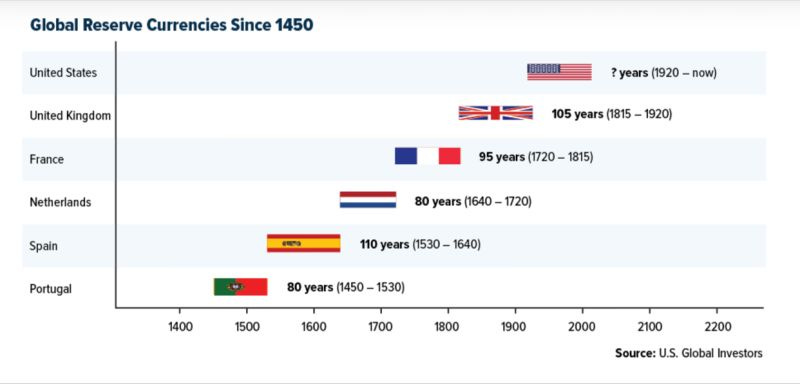
Monetary history reveals one consistent truth: no reserve currency collapses because it's 'overthrown' in a decisive moment. They don't vanish due to a treaty, a political declaration, or a single external shock. Such events - if they occur - are mere surface symptoms, not root causes.
In reality, reserve currencies decline in a far more subtle manner. They erode from within, through persistent deficits, through financialization, through treating currency privilege as the default state. This process typically unfolds over decades, masked by nominal growth, buoyant asset markets, and an illusion of stability - until the system's structure has shifted irreversibly.
That's why the right question isn't:
“Will the US dollar collapse?”
But rather:
How is the dollar's central role evolving within the historical cycle of reserve currencies - and where do the real structural risks lie?
To answer that seriously, we must step away from sensational headlines and return to historical-economic logic. This article doesn't aim to predict the dollar's 'end date,' but to clarify the operating cycle of monetary power, the USD's current position in that cycle, and why any shift - if it happens - will be slower, more distorted, and multi-layered than past precedents.
In this piece, Viet Hustler breaks it down into six key sections:
Part I – What is a reserve currency, and why it's the most powerful weapon in the global economic order
Part II – Historical template of reserve currencies: seven repeating phases
Part III – US Dollar: From post-WWII production peak to financialized economy
Part IV – The Triffin Dilemma, money printing, and the true cost of currency privilege
Part V – De-dollarization: Reality or illusion?
Part VI – How this cycle is different: Why the dollar isn't immortal, but isn't dying yet
From there, the article builds to a core conclusion: the dollar isn't exempt from historical laws, but the current cycle isn't following a simple collapse script. The biggest challenge isn't predicting 'when USD ends,' but understanding how the system is shifting - and preparing for a world where monetary power reallocates gradually, rather than overnight.