If You Missed the Best Recent Articles:
“Our task today is to decide only whether the power to ‘regulate … importation,’ as granted to the president in IEEPA, embraces the power to impose tariffs. It does not.”
The court today did not debate the economic merits of tariffs. It answered only one constitutional question: does that power exist?
- Chief Justice John Roberts
Some Supreme Court decisions don't alter tariff rates immediately, but reshape the allocation of power. And in the world's largest economy, shifts in power often matter more than changes in numbers.
In February 2026, the US Supreme Court blocked the use of IEEPA for broad tariffs. On the surface, the story is straightforward: a legal tool has been curtailed. Tariffs still exist. Goods are still taxed. Businesses are still recalibrating supply chains. Markets haven't collapsed.
But the underlying structure has shifted.
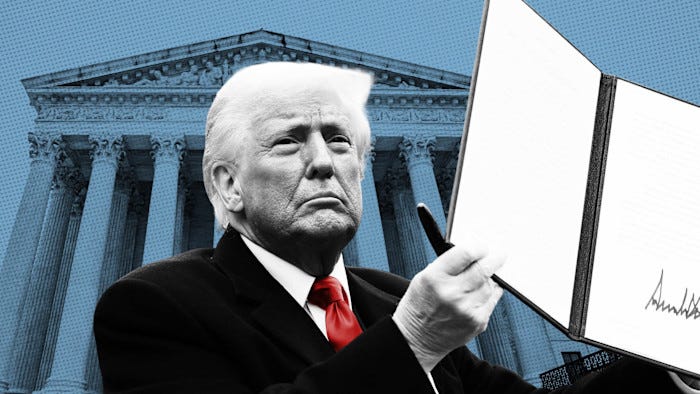
Tariffs in recent years were more than trade policy. They were negotiating leverage with China and the EU. Pressure tools against Canada and Mexico. A fast-growing fiscal revenue source amid high deficits. And crucially, a mechanism allowing the executive branch to act swiftly without Congress.
This ruling doesn't eliminate tariffs. It weakens the mechanism that made them a nearly limitless flexible tool.
In traditional policy models, tariffs are viewed as a trade variable: raise for protection, cut for stimulus. But in the current setup, tariffs have become part of the power and fiscal structure. When the tariff-imposition mechanism changes, the impact doesn't stop at the trade balance. It ripples into budgets, bonds, and policy risk pricing.
At first glance, this may seem like a technical dispute over jurisdiction. But that view misses a core element: this isn't a story about tariff levels. It's a story about constraining power in a post-globalization cycle where trade, fiscal policy, and geopolitics have merged.
When tariffs generate hundreds of billions in revenue; when they're used as diplomatic tools; and when they concentrate executive power through 'emergency' mechanisms-the system operates on new logic. The court's ruling doesn't break the system. But it forces a rebalancing. In that state, risks don't come from tariffs rising or falling a few percentage points. Risks come from markets repricing the structure: are tariffs still a stable revenue source? How will Congress respond? How extensively will alternatives like Section 122, 232, or 301 be deployed? And if $200 billion in collected tariffs becomes a legal variable, how will the fiscal trajectory shift? This article doesn't approach the issue in a binary 'high or low tariffs' lens. The goal is to analyze the new structure of US trade power: which mechanisms have been limited, which tools remain, their fiscal and economic impacts, and how markets will react to the changed machinery.
In today's article, Viethustler breaks it down in seven parts:
Part I –
Tariffs as an Implicit Fiscal Pillar
Part II – The Ruling and Executive Limits
Part III – Alternative Tools: Section 122, 232, and 301
Part IV – Canada, China - Winners and Losers from the Ruling
Part V – $200 Billion Refund Risk and Fiscal Perils
Part VI – Macro Impacts: Bonds, Inflation, and Sentiment
Part VII – Three Forward Scenarios and Outlook
The article's conclusion highlights a simple but vital rule: when a tool that generates revenue, geopolitical leverage, and concentrated power is curtailed, the system doesn't collapse immediately-but how markets price risk changes. And every time the machinery shifts, asset structures shift too. PART I – TARIFFS: FROM TRADE TOOL TO POWER PILLAR
Tariffs sound simple: a tax on imported goods.