90% OFF APEX ENDS TONIGHT
If you missed the best recent articles:
“You can order the big guns to stop firing, but you can't order interest rates to stop creeping up.”
- Robert Rubin, Former US Treasury Secretary
The Red Ticking on Fifth Avenue
If Times Square is the heart of New York, then National Debt Clock – the blinking LED sign midway on 44th Street – is America's fiscal heartbeat. 08:42 AM on January 20, 2025, when Donald J. Trump placed his wide-open hand on the Bible for the second time, the number on the clock surged past 36 000 000 000 000 USD, then 36 100 000 000 000, so fast that tourists standing below had to squint like staring at headlights in Manhattan fog. In fact, each American heartbeat pumps over 50 000 USD of new debt into the system – a speed surpassed only by… the velocity of tweets from this country's own President.

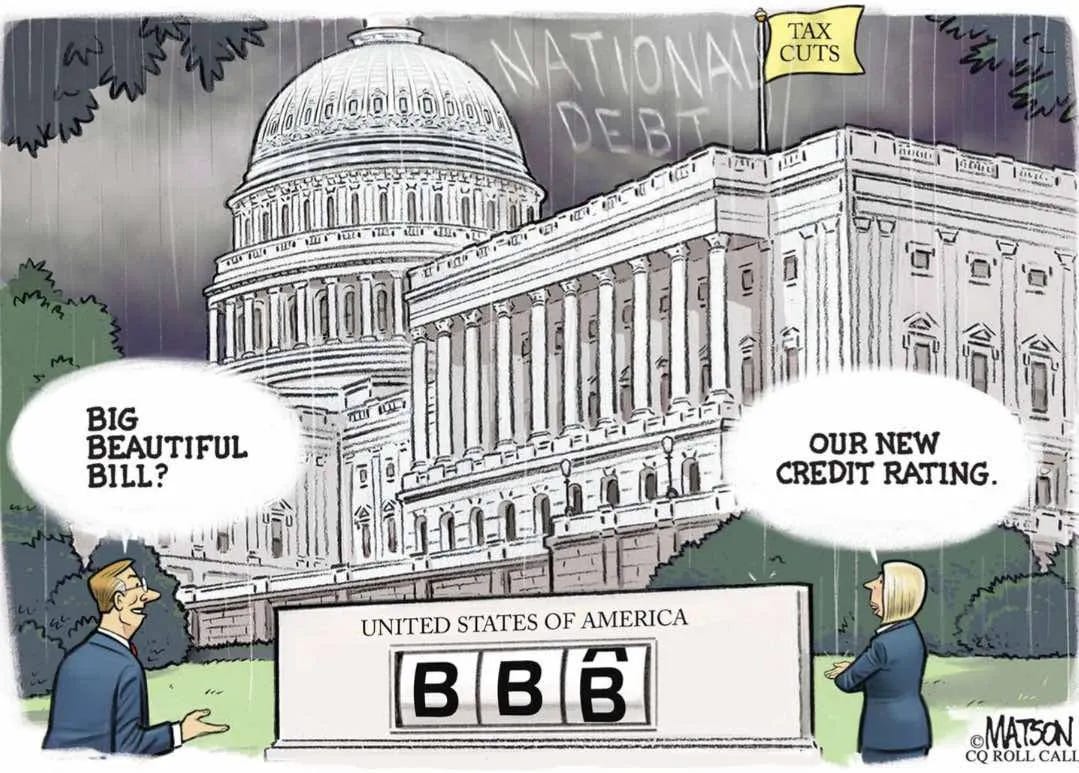
36 trillion dollars – 120 % GDP – not just a peacetime record; it's the milestone marking the moment America exits the “creditworthiness stratosphere”. Moody’s downgrades the Stars and Stripes to AA1, stripping away the last remaining “AAA almighty” star. At that point, even outlets like Wall Street Journal compared Treasury bonds – once the symbol of absolute safety – to an asset needing “discounting”: not due to default fears, but fear that... no one can control America's wallet anymore.
Tracing the money trail, the Treasury is hauling to Capitol Hill a bloated budget package named “One Big Beautiful Bill”: whirlwind tax cuts, sandstorm spending increases, with endless appendices on the border wall, tip incentives, overtime tax exemptions, and “Made-in-USA” tax gifts. White House rhetoric calls it a double punch of “making America great” and “paying it all back in the future”, while analysts just sigh: “the future” is the global bond market – where debt traders are asking: Beautiful for whom, and Bill ultimately delivered to which address?
Ironically, at the same time the International Trade Court blocks most 10-100 % tariffs Trump honed throughout the campaign, stripping revenue the White House counted as “External Revenue Service” – an IRS version collecting foreign money instead of natives'. And in another corner of the story, Elon Musk – meme master with the DOGE crew – exits the “Government Efficiency Department” advisory role with an echoing tweet: “Trimming the budget doesn't mean you get to pile more debt cake on the table.”
The picture instantly splits into three shades: red of the debt clock, gray of dumped bonds, green of growth expectations painted by tax cuts. At that crossroads, this article will play the role of pathology scope, dissecting four cracks in the US fiscal ship – from concrete-and-steel spending structures, to sharp yield pivots; from deficit-export ambitions via tariffs to the political traps of welfare promises.
In this week's article, Viethustle will dive deep with you into each layer of the US fiscal system:
The budget cake is inflating: “One Big Beautiful Bill” – from election gift to vertigo for rating agencies;
Bond market strikes back: When investors no longer believe the “tax cuts pay for themselves” story;
Spending structure locked: When 70% of the budget is beyond control, and the flexible portion is the easiest to cut;
Fed dragged into the fiscal battlefield: When monetary policy must choose between price stability and rescuing the Treasury.
Then, we'll place the US equation into three reflecting mirrors: Japan of “printing money to survive”, Italy of “yield punishment”, and China of “stability through control”.
The question is no longer “Will America pay its debt?” – but: America will pay with dollars of how much purchasing power.