SUNDAY POLITICS: WHY IS JPM SUCCESSFUL? - JAMIE DIMON
If you missed the best recent articles:
“If you torture the data long enough, it will confess to anything.”
- Ronald Coase, Nobel Prize in Economics, 1991
If the Fed is the conductor directing the symphony of the US economy, then BLS is the drummer keeping the beat - not creating the melody, but each strike decides whether the entire orchestra is in rhythm or off-beat. Every number BLS releases, from Nonfarm Payrolls (NFP) to CPI, is like the clapper shaping the market's climax and lull: when the Fed raises the baton, when it lowers it, and when the music ends.
But from 2023 to 2025, this drumbeat started to... go off-rhythm. The jobs reports on the first Friday morning of the month - once seen as the 'opening gong' for all interest rate forecasts - turned out to be just rehearsals. Weeks or months later, those 'notes' were rewritten: some months, hundreds of thousands of jobs evaporated compared to initial estimates, enough to reverse Fed expectations and shake bonds, stocks, and USD.
This instability becomes even more sensitive in Donald Trump's second term - a president who has openly criticized the Fed and is ready to leverage any favorable data to push political arguments and trade leverage. When the BLS 'drumbeat' goes off-rhythm, the question is not just statistical error, but whether the economic stage is being 'mic'd up' to serve some political script.
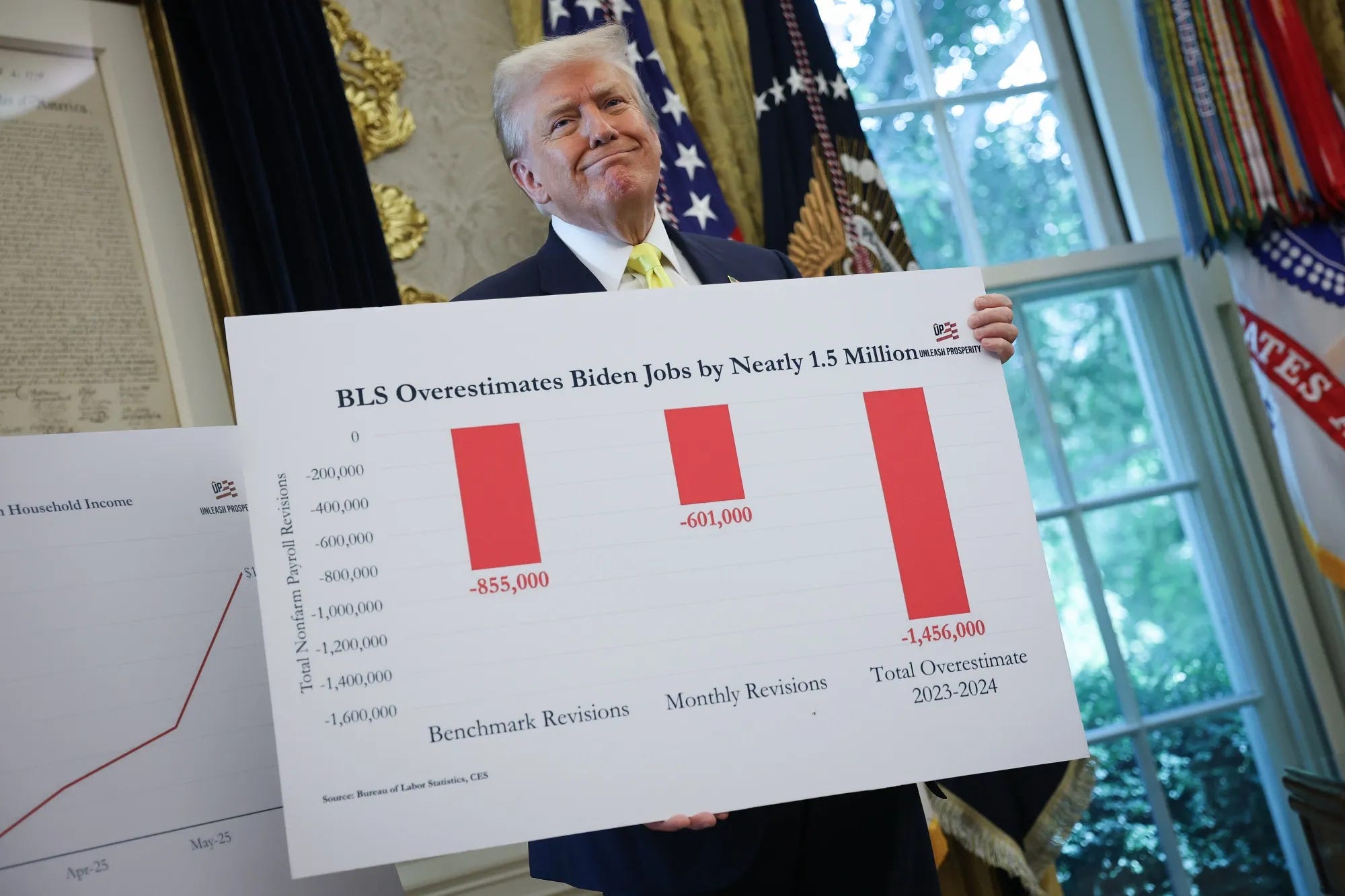
The market suddenly realizes it's dancing to a tune where the drumbeat changes at any moment. The successive 'number fixes' not only create noise in economic signals but also stir up an uncomfortable question: how far off is this economic metronome running - and if it's wrong, who will pay the price?
In this article, Viet Hustler will take you behind the scenes of the 'BLS engine room':
The operating mechanisms of NFP and CPI, and why they are considered the 'lifeblood' of monetary policy.
The birth–death model - the controversial artificial beat generator that can pump hundreds of thousands of 'phantom' jobs each month.
The revision shocks of the 2023–2025 period - and their immediate impact on the Fed, yields, and USD.
Post-COVID: survey responses in freefall, BLS resources shrinking, and the risk of data politicization.
Because BLS is not just a statistics agency. It is the musician keeping the beat for America's macroeconomic symphony - where a missed beat, just one off clapper, is enough to make the entire piece waver.