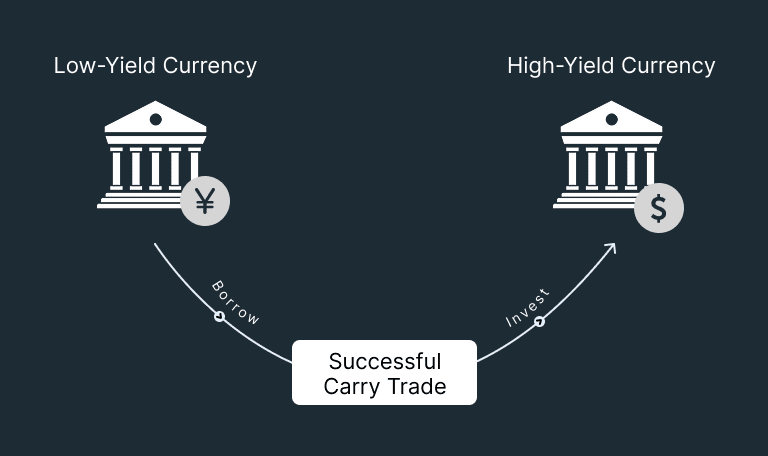
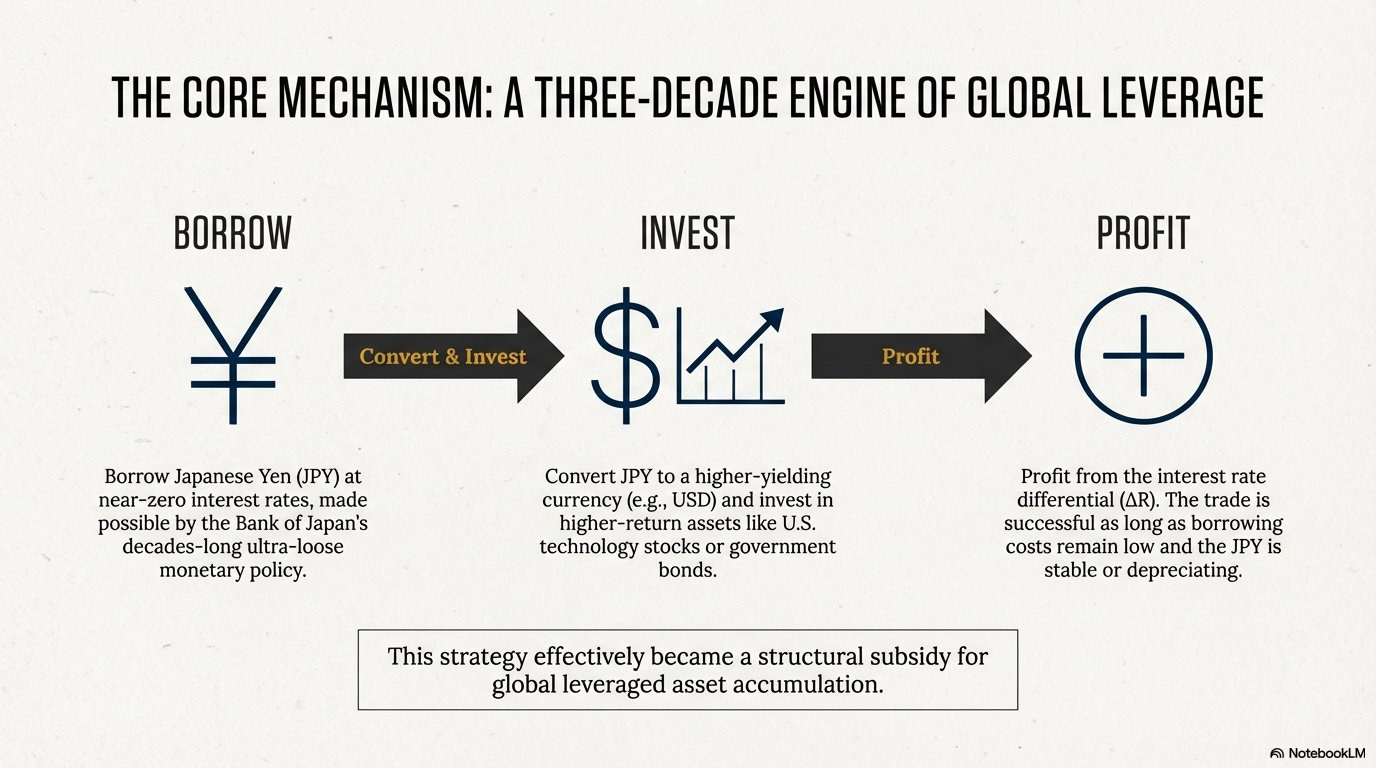
The Japanese Yen has become a “cheap source of capital” for the world for decades thanks to near-zero interest rates. This is the foundation for the carry trade strategy: borrow Yen, convert to higher-interest currencies, then invest in income-generating assets.
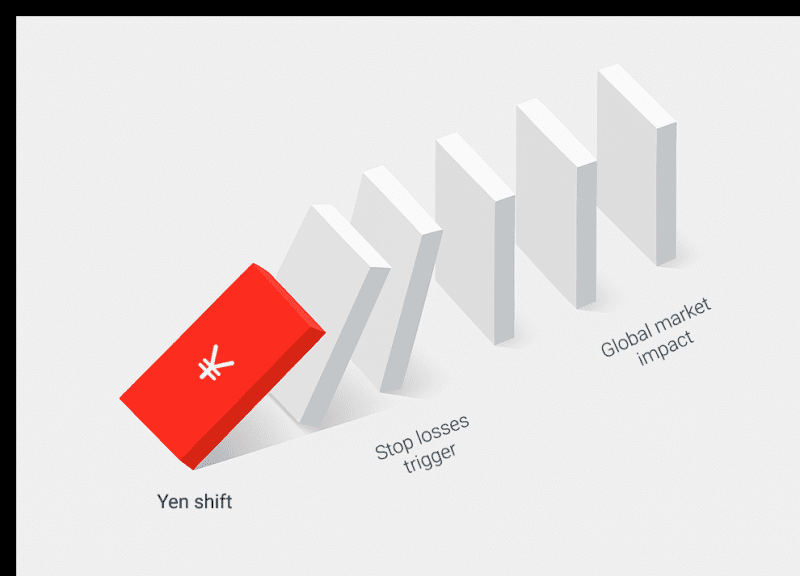
When the market is stable, this strategy generates steady profits from interest rate differentials. But if exchange rates reverse or monetary policy changes unexpectedly, the entire system can spiral into “unwind” – forcing investors to liquidate assets to repay Yen, causing widespread volatility as seen in August 2024.
In this article, Viet Hustler will guide you through six detailed sections to understand the Yen carry trade – from mechanics to systemic volatility potential, and why the August 2024 unwind scenario is unlikely to repeat at the end of 2025:
Section 1 – Mechanics and Risks: How carry trade works, why the Yen was once the “global funding currency”, and the breaking points when exchange rates reverse.
Section 2 – The 8/2024 Shock: BoJ unexpectedly hikes rates, Yen surges, global markets forced to close positions – from Nasdaq to Bitcoin all plunge.
Section 3 – Late 2025 Situation: BoJ continues tightening policy, JGB yields rise sharply, but Yen is no longer a safe haven – on the contrary, it's depreciating.
Section 4 – Current Carry Trade Scale: Yen borrowing flows have cooled, speculative positions more balanced, system clearly less leveraged.
Section 5 – Why the Shock is Unlikely to Repeat?: No more policy surprises, markets are prepared, Yen no longer reflects risk-off sentiment as before.
And finally, the carry trade “bomb” is no longer primed to explode, but the era of cheap Yen is gradually closing, and that will reshape global capital flows.
Viet Hustler is a reader-supported publication. To receive new posts and support my work, consider becoming a free or paid subscriber.
Section 1 - Carry Trade Japanese Yen: Operating Mechanism and Core Risks
1.1 Carry Trade Mechanism
Carry trade is a strategy to profit from interest rate differentials between two currencies:
Borrow capital in low-interest currency – for decades, the Japanese Yen was the popular choice due to super-loose monetary policy.
Convert to higher-interest currency – e.g., USD, Mexican peso, or NZD – to invest in income-generating assets.
Invest in risky assets such as:
Government or corporate bonds
Stocks, especially in emerging markets
Commodities (gold, oil…)
Real estate
Cryptocurrencies
Profit from two sources:
Interest rate differential between borrowing currency and investment currency
Additional profit if investment currency appreciates against borrowing currency
This strategy works effectively when exchange rates are stable or borrowing currency continues to weaken. Conversely, if exchange rates reverse sharply, carry trade can cause large losses and trigger a wave of unwinding.
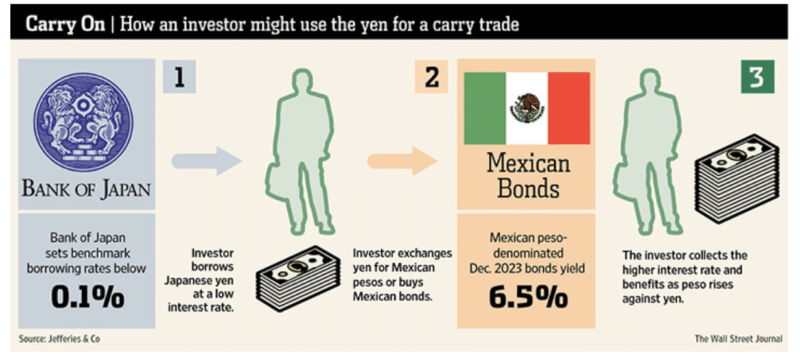
Example: An investor can execute Yen carry trade in three steps:
Borrow Yen at low interest rates – Example: BoJ maintains rates below 0.1%, investors borrow Yen almost for free.
Convert to another currency for investment – Investors exchange Yen for Mexican peso and buy Mexican government bonds with a 6.5% yield.
Profit from interest rate differential – Investors benefit from the differential between the cost of borrowing Yen and the high interest rate of peso bonds. If the peso appreciates against the Yen, profits increase further.
In stable conditions, carry trade operates as a strategy to generate stable cash flow:
Low cost of capital: Yen borrowing rate is nearly 0.
Higher asset yields: The spread between investment interest rates and cost of capital generates sustainable profits.
That is why the Yen has become an important funding instrument for the global financial system for over three decades.
The simplest explanatory video on the mechanism of Carry Trade:
1.2 Why is the Yen the “ideal funding currency”?
The Yen is widely used in carry trade mainly due to three structural conditions:
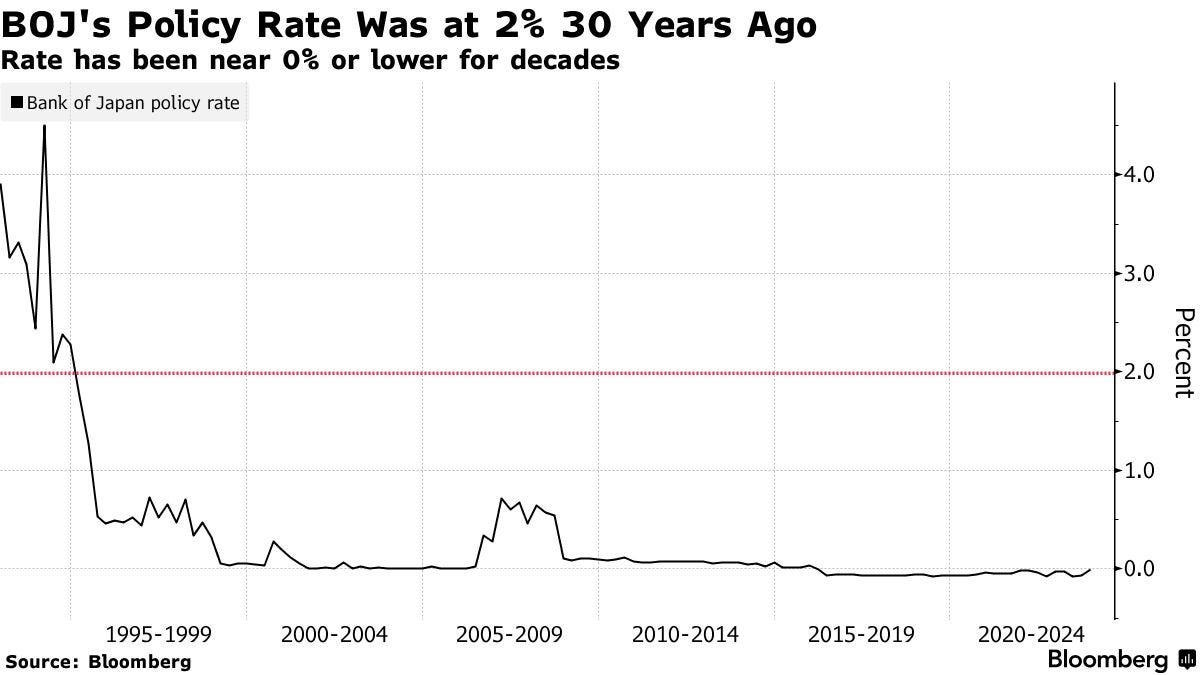
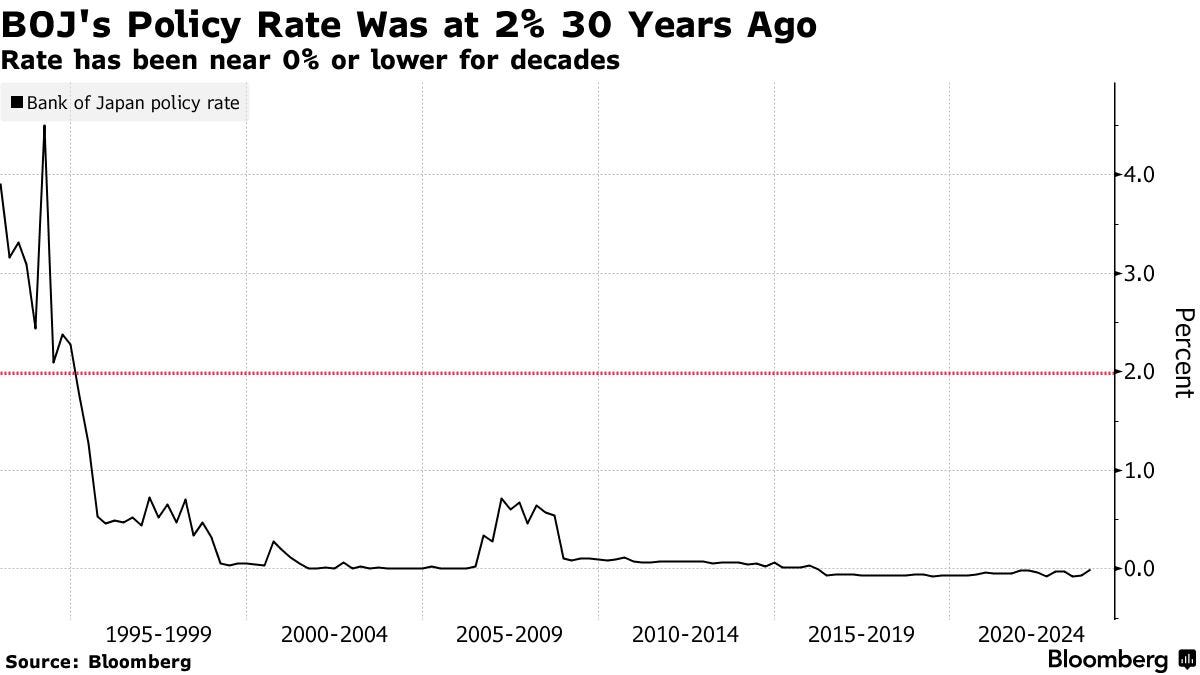
Prolonged ultra-loose monetary policy: Since the bursting of Japan's asset bubble in the early 1990s, the Bank of Japan (BoJ) has continuously maintained a near-0 interest rate policy, even pushing it into negative territory from 2016 to early 2024.
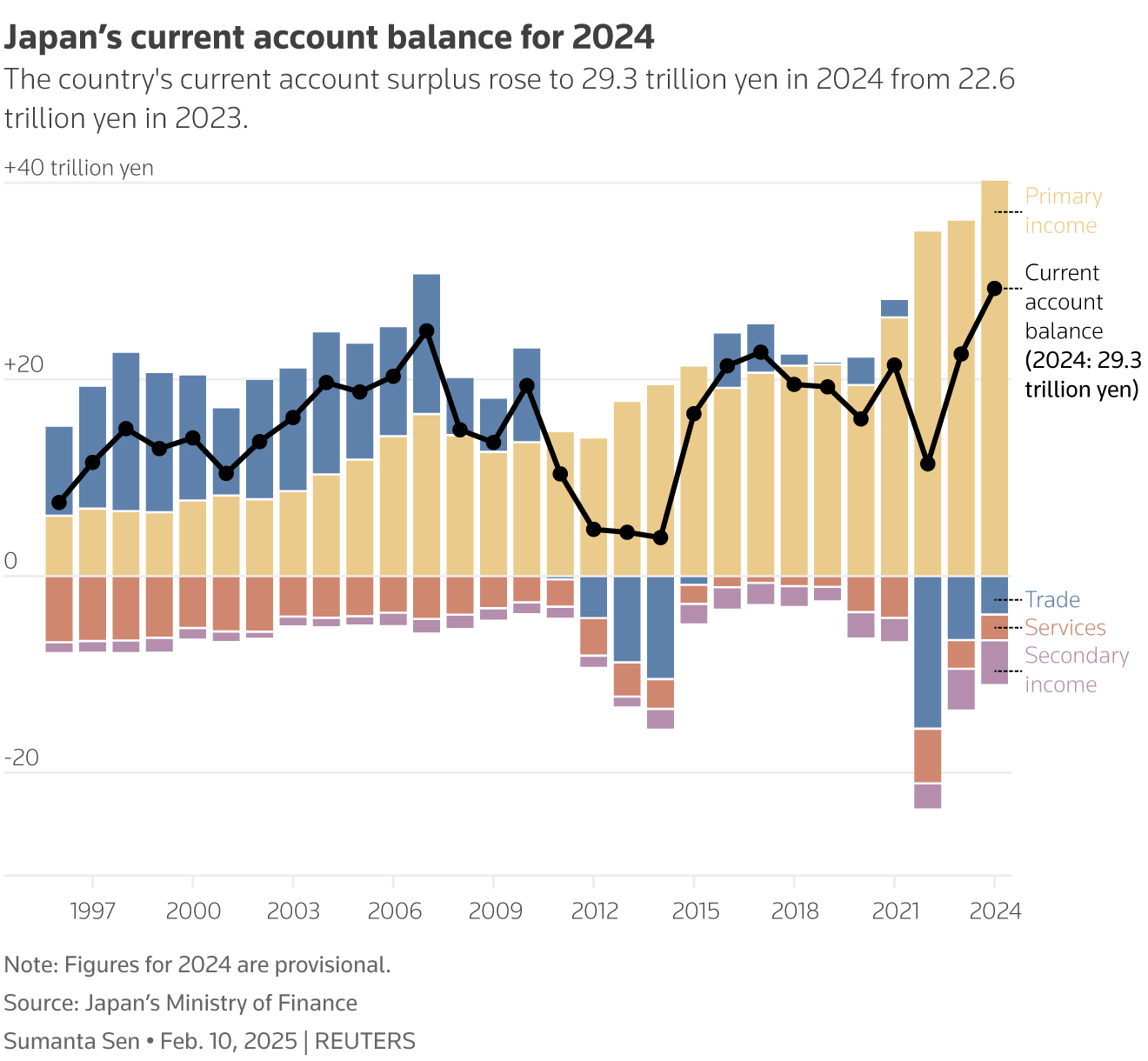
Sustainable current account surplus: Japan maintains a net exporter position and large foreign exchange accumulation, ensuring liquidity for the Yen and creating a solid foundation for overseas investments.
Developed financial markets, flexible capital channeling mechanisms:
Japan's banking system is capable of providing Yen funding at low costs.
Many international companies access Yen funding through Samurai bond issuances or currency swap transactions (currency swaps).
As a result, over the past two decades, Yen borrowing has flowed into every corner of the global financial markets – from US Treasury bonds, tech stocks, to assets in emerging markets.
1.3 Core risks: Exchange rate volatility and “unwind” spiral
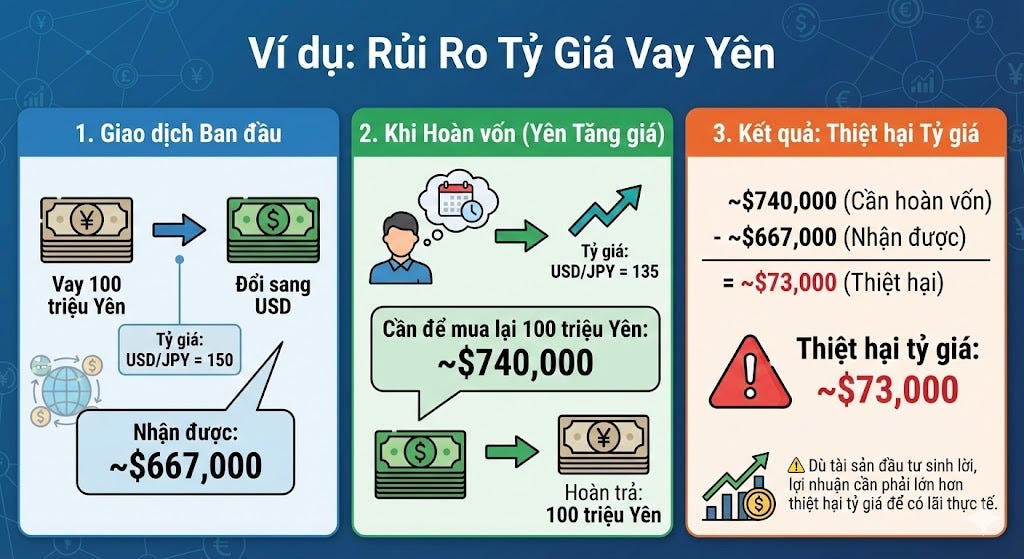
The biggest risk of carry trade lies in exchange rate volatility. When borrowing in Yen and investing in another currency (e.g., Mexican peso), investors must buy back Yen in the future to repay principal. If the exchange rate moves unfavorably (i.e., Yen strengthens), the entire profit from the interest rate differential can be wiped out or turn into a loss.
This situation triggers the “unwind” phenomenon:
Investors sell investment assets to raise funds to buy back Yen for debt repayment.
Mass buying of Yen causes further Yen appreciation → the loss spiral continues to expand.
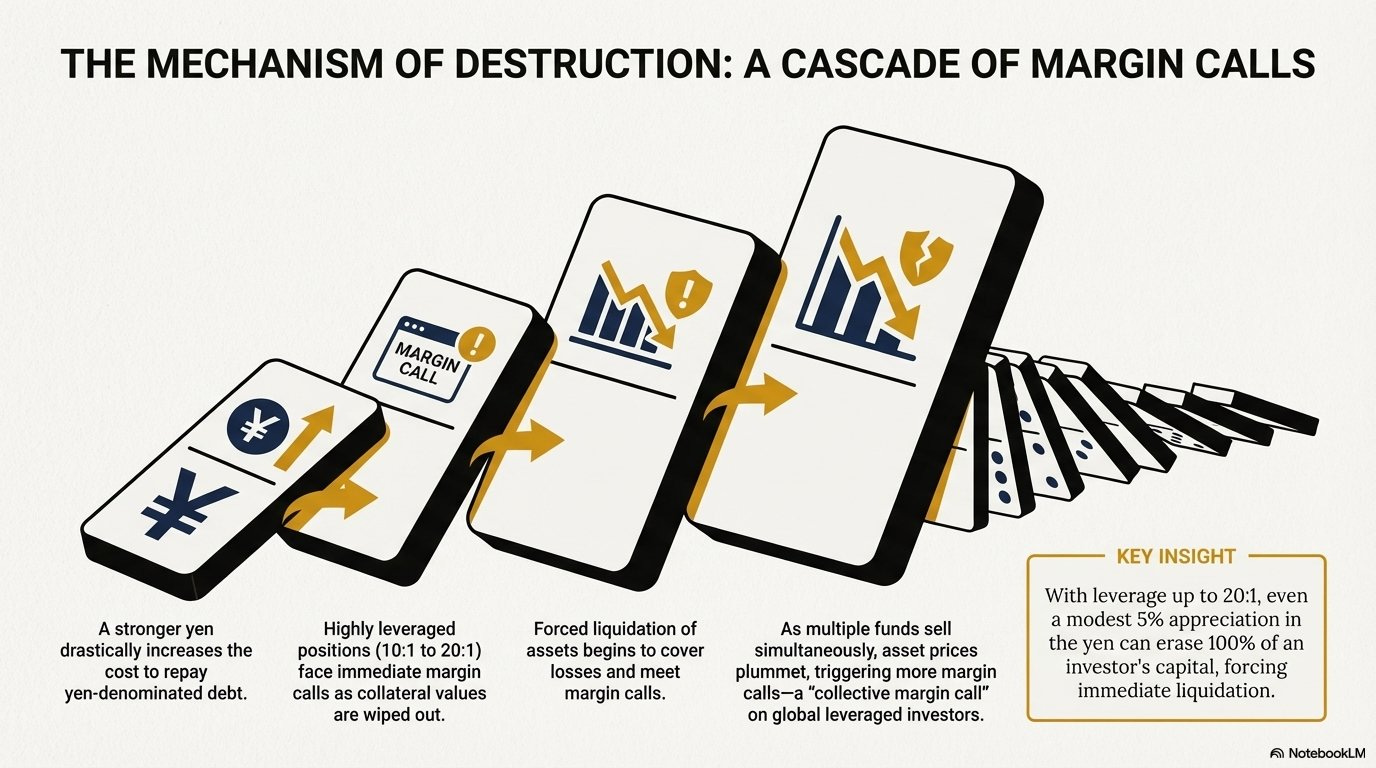
For highly leveraged positions, even small fluctuations can trigger margin calls and chain-reaction selling.
Therefore, the strategy only works well when the Yen is stable or weakening. If the Yen suddenly strengthens sharply, carry trade becomes a systemic risk – especially when the market has accumulated large unhedged positions.
1.4 Dangerous factor: The “safe haven” role of the Yen
The Yen has long been viewed as a safe haven asset during periods of market instability. During financial panics, international and domestic Japanese capital flows typically withdraw from risky assets and return to the Yen.
The impact of this is very clear:
International investors must close positions, exchange USD or EUR for JPY
Japanese investors sell foreign assets, repatriate funds
Demand for Yen surges in a short time → JPY exchange rate surges suddenly
According to IMF data, Japanese investors currently hold more than 3,620 billion USD in foreign assets. If even a small portion (~1–2%) is repatriated en masse during volatility, the Yen could rise several percent in a few sessions – enough to cause significant damage to unhedged carry trade positions.
1.5 Assessment
It can be seen that Yen carry trade is an important part of international capital flows over many decades. This strategy relies on the stable foundation of the interest rate differential between Japan and major economies. However, it is also highly vulnerable to exchange rate shocks, sudden BoJ policy changes, and widespread “risk-off” sentiment.
When the Yen surges, the unwind process occurs quickly, forcefully, and in a chain reaction. This explains why global investors always closely monitor Japan's monetary policy developments – even though the Yen accounts for only a small portion of global foreign exchange reserves, its impact on risk capital flows is often far from insignificant.
Part 2 - Lesson from August 2024: When Yen Carry Trade Causes Systemic Volatility
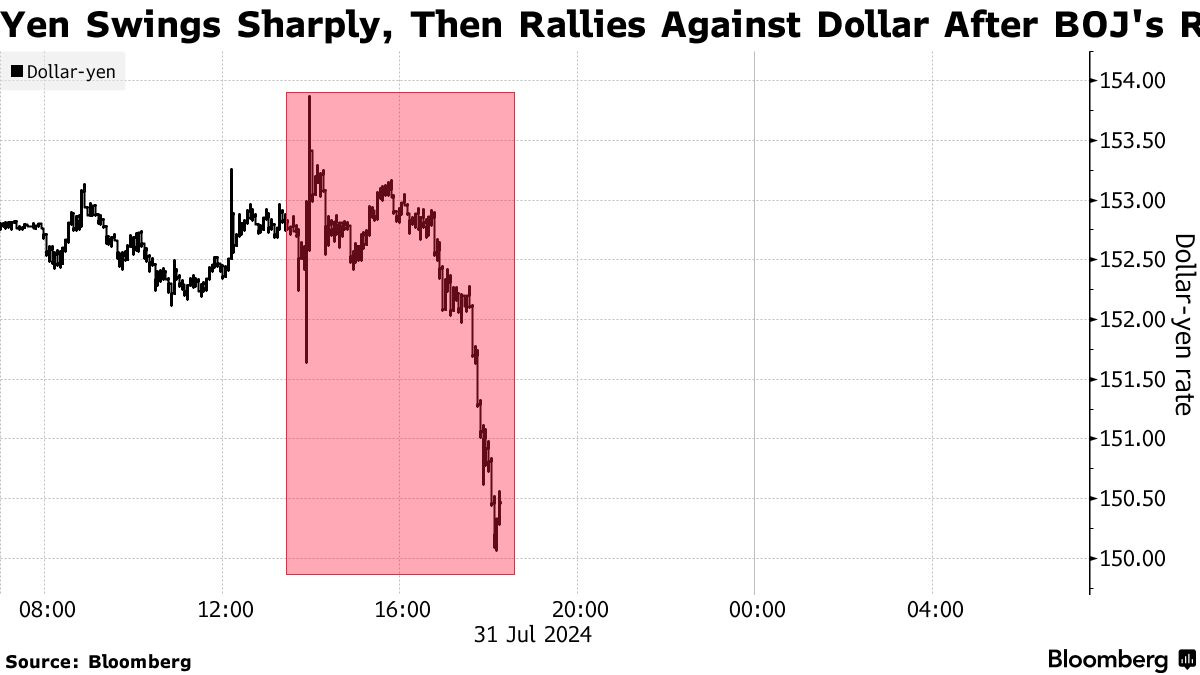
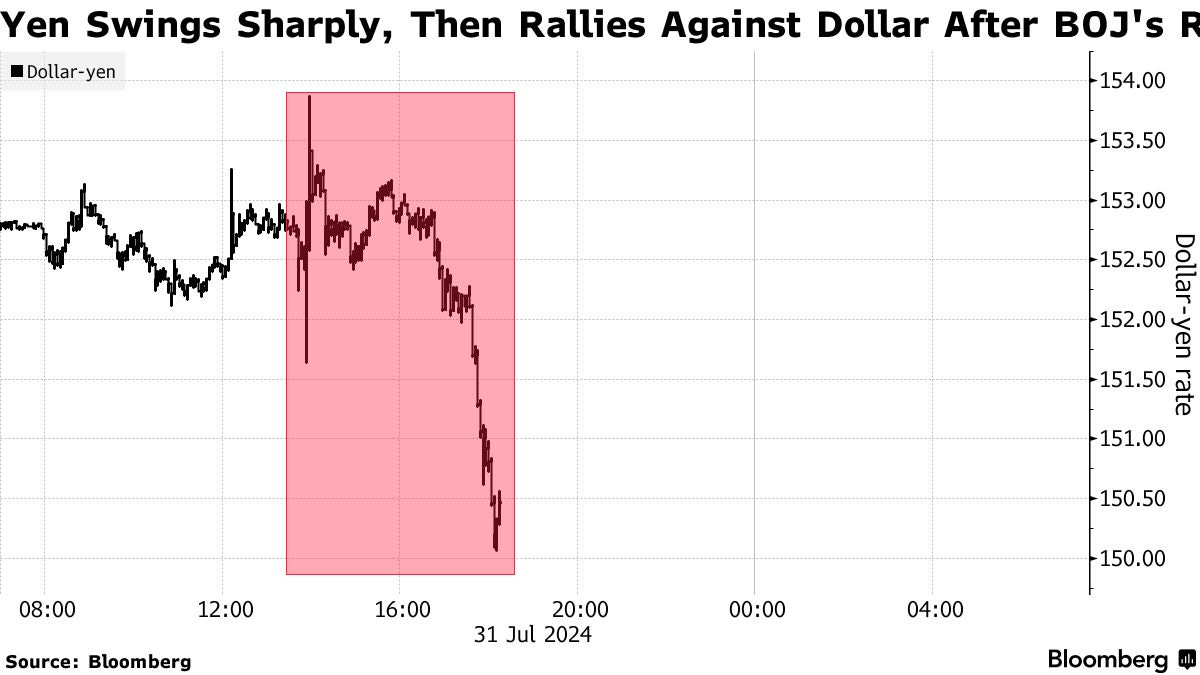
Japan's and international financial markets experienced a severe volatility episode in early August 2024, starting from a sharp Yen appreciation and ending with a large-scale sell-off across multiple asset markets.
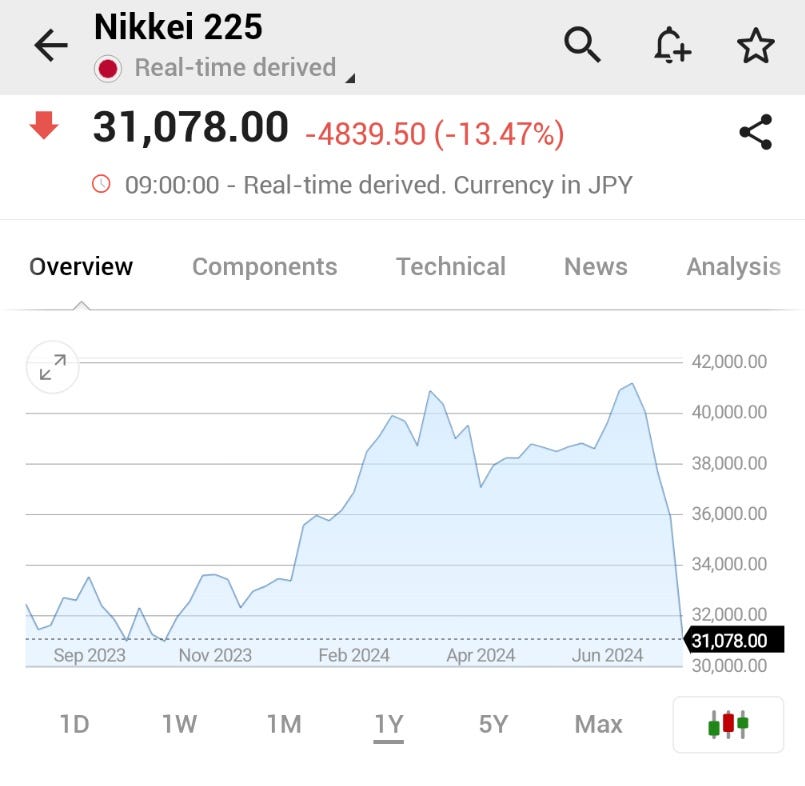
On 5/8/2024, the Nikkei 225 dropped more than 13% in one session – the largest single-day decline since “Black Monday” in 1987.
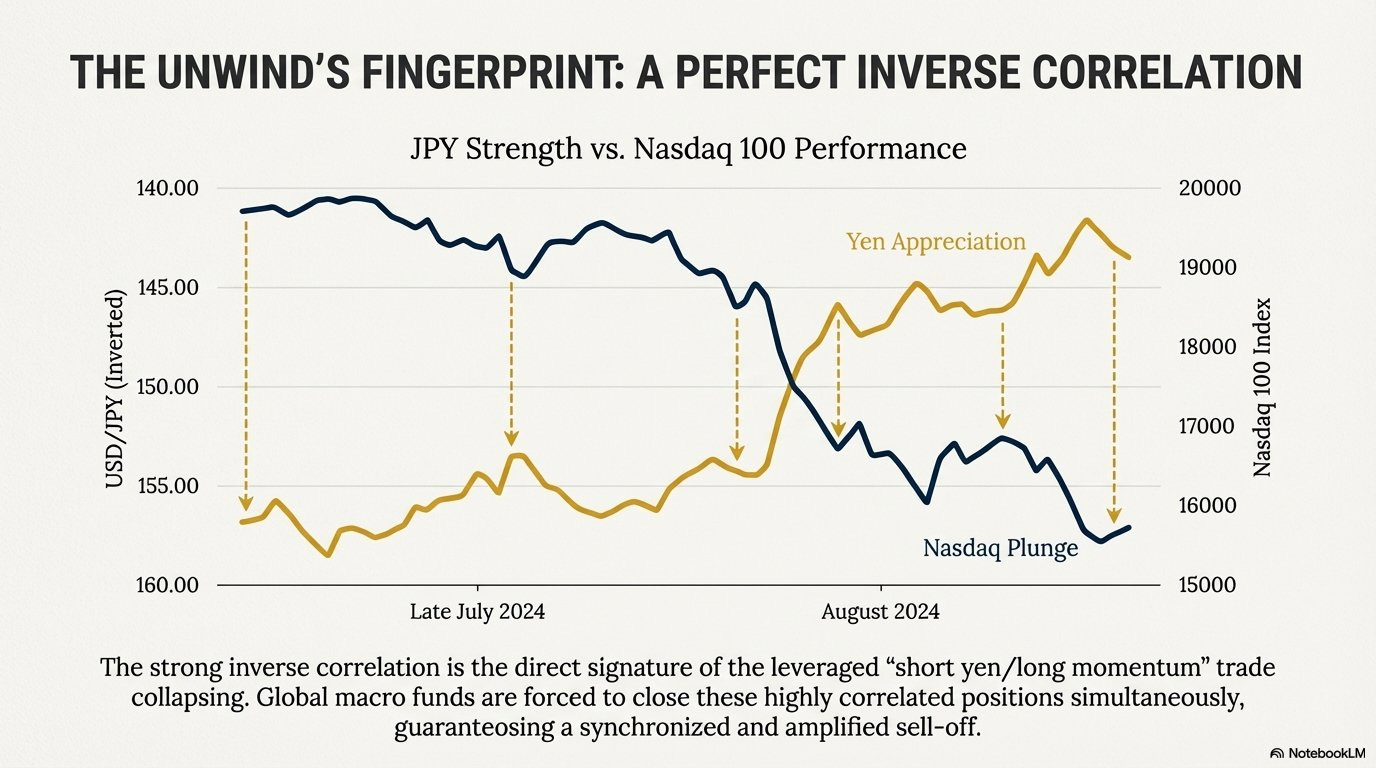
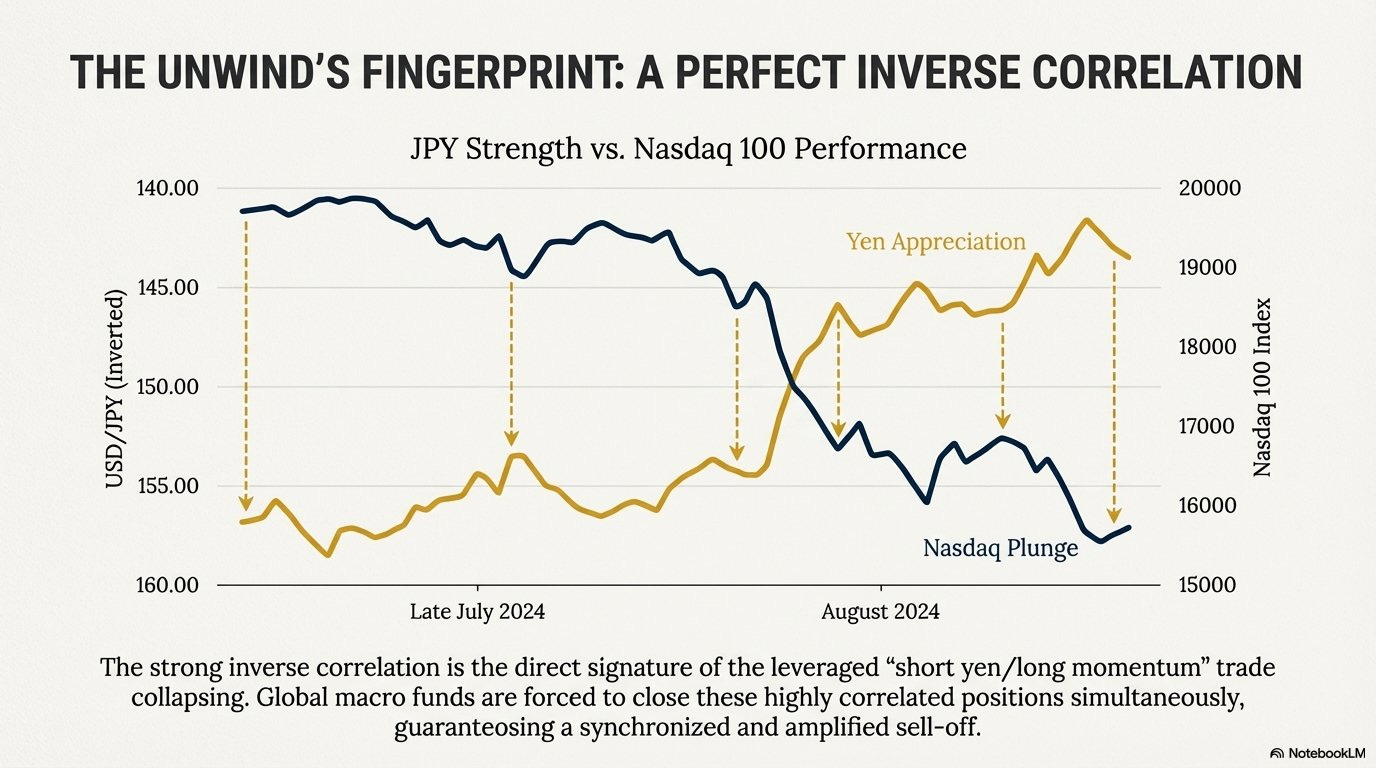
At the same time, the USD/JPY rate fell nearly 3% on the same day, marking the strongest local currency appreciation in nearly a year.
In the month prior, the Yen had recovered a total of about 14% against the USD. This event not only impacted the Japanese market but also exerted widespread pressure on global risky assets.
2.1 Key developments: Surprise rate hike and chain market reaction
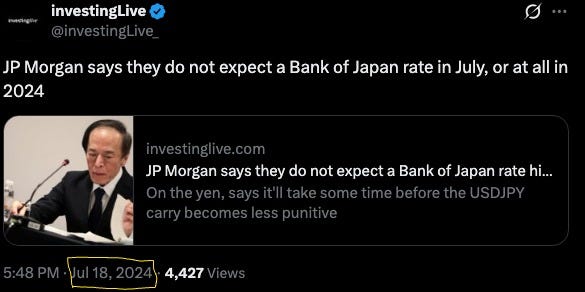
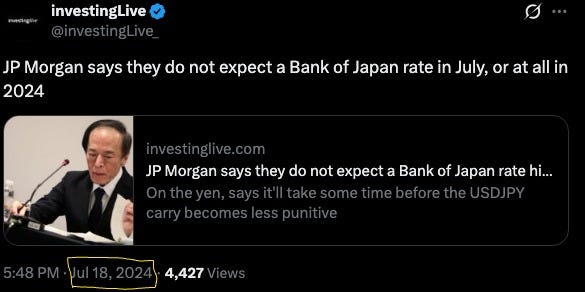
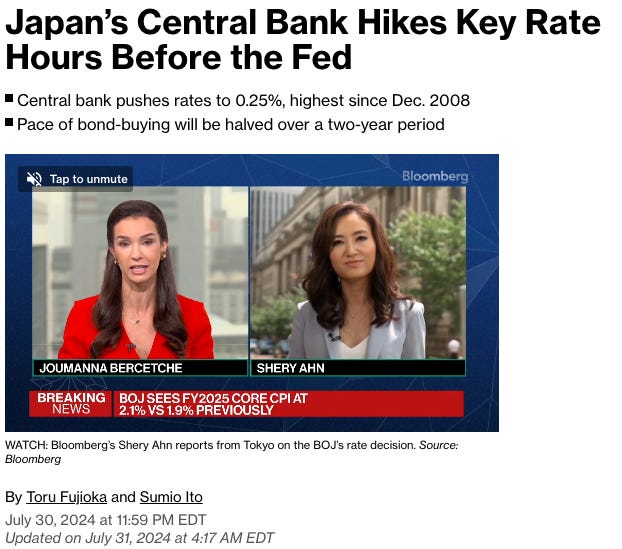
In July 2024, global markets witnessed a monetary policy shock from BoJ. The shock was not in the magnitude of the increase (only 0,15 points %) but in the fact that no one prepared for it. The developments can be summarized as follows:
BoJ acted while the market priced in nearly 0% chance of change
Before the meeting, the OIS model showed >90% of investors expected BoJ to keep interest rates unchanged.
BoJ officials did not send hawkish signals, leading the market to believe that “BoJ will stand still”.
BoJ has long been seen as “the most cautious central bank in the world”, further reinforcing the belief that there would be no surprise moves.
➡️ Therefore, the decision to raise interest rates by 0,15% became a true expectation shock.
The shock was even stronger because it happened right when Fed was expected to cut
US data slowing → market betting Fed rate cut in Q3/2024.
BoJ hike → Fed cut → USD–JPY spread compressed sharply and quickly.
Core advantage of carry trade (borrowing cheap Yen – buying high-yield USD assets) eliminated in a few hours.
➡️ This was the catalyst reversing USD/JPY trading violently.
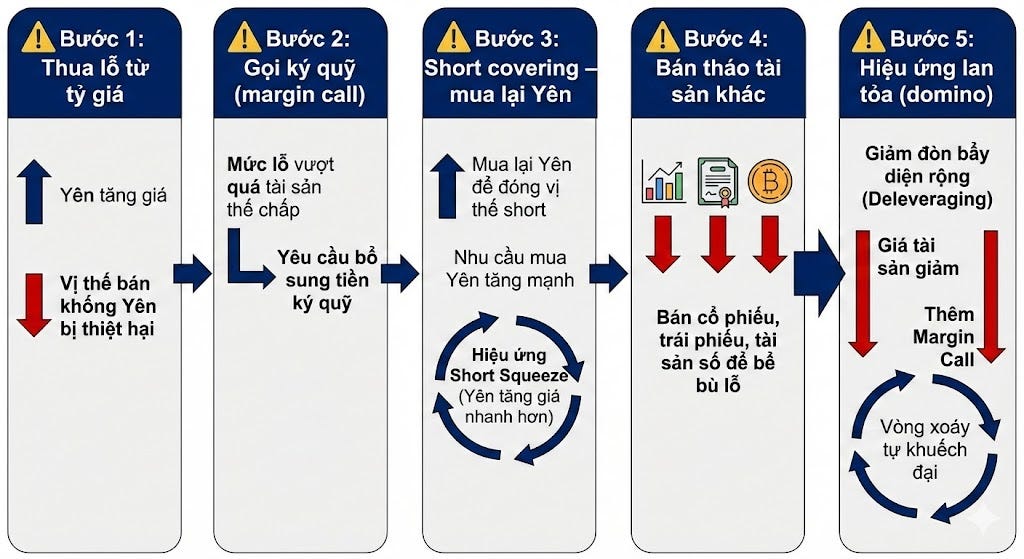
When USD/JPY fell sharply, short JPY positions began losing quickly.
High leverage + no FX hedging → immediate margin calls.
Investors forced to:
Sell assets (tech stocks, HY bonds, commodities, crypto…)
Buy back Yen to close positions → causing Yen to strengthen further, creating a self-reinforcing spiral.
➡️ This is the mechanism forming the “Yen short squeeze”.
Impact spread to entire asset markets
Nikkei 225 over 13% in one session – equivalent to Black Monday.
Nasdaq, S&P 500 corrected sharply despite no bad news from the US.
Bitcoin fell over 10,000 USD in a few days.
UST 10Y yield fell due to safe-haven flows into US bonds.
➡️ A small BoJ move became global deleveraging, because the trading structure around Yen was too large and too concentrated.
2.2 Market positions before the event: High leverage, one-sided bets
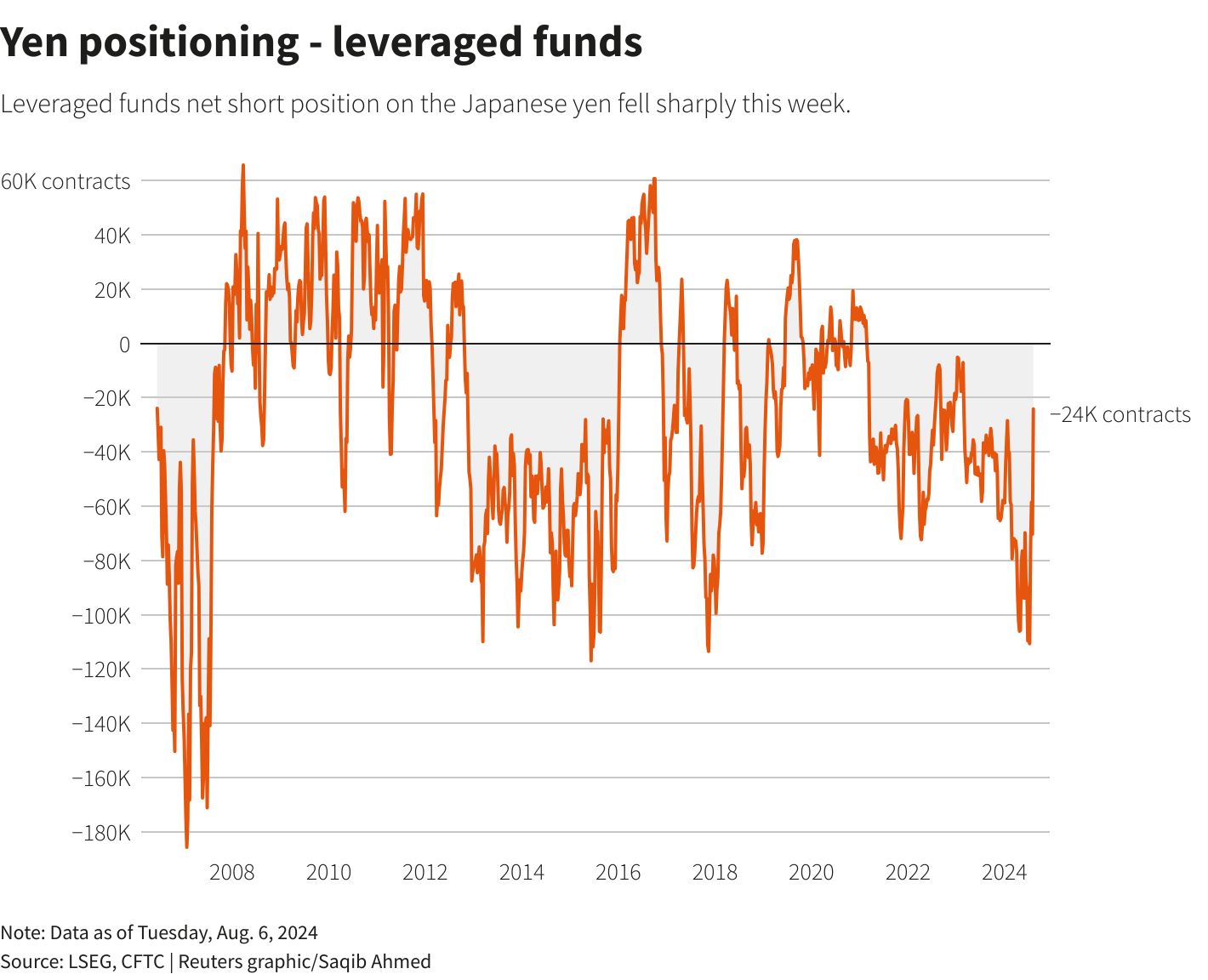
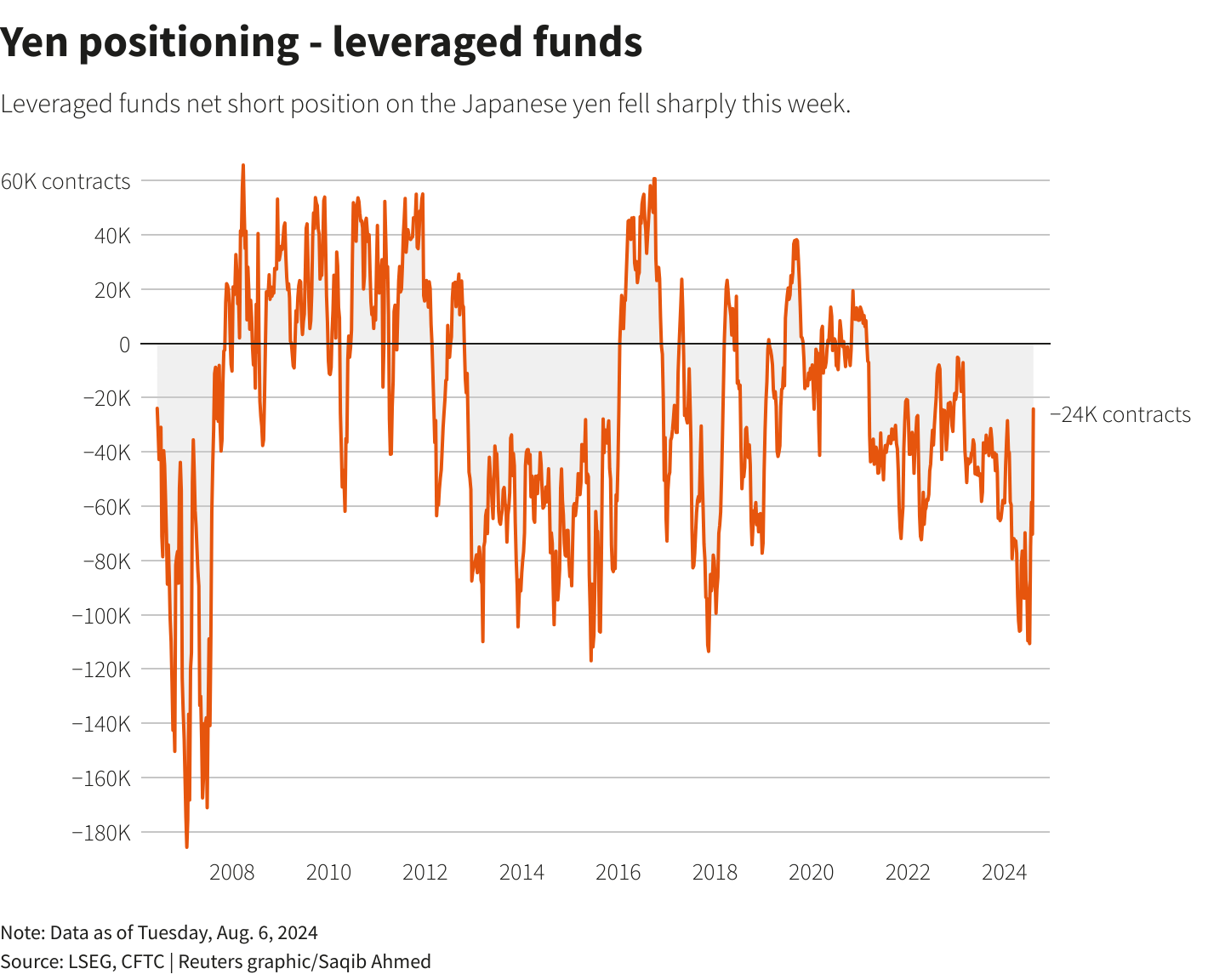
Before August 2024, FX market had accumulated large short Yen positions – i.e., speculators borrowing Yen to buy risky assets, betting Yen would continue weakening.
According to data from US Commodity Futures Trading Commission (CFTC), early August:
Hedge funds held about 70,000 short JPY futures contracts, equivalent to nearly 9 billion USD in bets that Yen would continue depreciating.
This was one of the largest one-sided positioning levels since before the 2008 financial crisis.
When BoJ raised rates unexpectedly and Yen began recovering quickly, entire carry trade system reversed. Chain reaction mechanism occurred in the following sequence:
2.3 Spillover effects and lack of preparation by policymakers
The event on 5/8/2024 is viewed as an unanticipated policy shock and a typical example of shortcomings in forward guidance communication from the Bank of Japan (BoJ).
Immediately after BoJ's sudden interest rate hike, Japan's then-Finance Minister – Mr. Shunichi Suzuki – had to speak out to reassure, acknowledging that “the market's reaction far exceeded normal economic fundamentals.” This is a sign that both the market and the government lacked full preparation.
Independent analysis organizations later identified two key causes:
BoJ changed policy too abruptly, with no prior cushioning communication steps.
Large accumulation of carry trade positions in Yen, high leverage, unhedged risks.
This led to a simultaneous trigger effect: as soon as the USD/JPY rate reversed sharply (Yen appreciated), a series of Yen borrowing positions faced “margin call” simultaneously. The consequence was widespread selling of risky assets to free up liquidity.
Reactions in global asset markets:
Nasdaq Composite plummeted more than 4.5% in just 3 sessions from 5–7/8/2024, with growth tech stocks sold off the hardest (Tesla, Nvidia, ARK Innovation ETF down over 7%).
S&P 500 lost nearly 3%, despite stable US economic data – indicating a global psychological shock not reflecting internal fundamentals.
Bitcoin dropped from ~$56,000 to below $49,000, dragging over $600 billion in market cap “wiped out” from the crypto market in just a few days.
US 10-year Treasury yield dropped sharply (~15 basis points) due to flows into bonds – a warning signal of widespread defensive sentiment.
A domestic policy change (BoJ) can trigger a global reaction if coinciding with high leverage levels and one-sided market expectations. The August 2024 shock is a typical example of “systemic coupling” between FX markets, equities, and speculative assets.
2.4 Key lessons from the August 2024 volatility episode
Sudden monetary policy changes in an economy acting as a “global capital provider” (like Japan) can cause larger-than-expected liquidity shocks, especially when carry trades using that domestic currency are prevalent.
Markets can accumulate large speculative positions in prolonged stable environments, making price reactions nonlinear when conditions change abruptly.
Need to closely monitor positioning data in the FX market, especially Yen futures positions during the phase when BoJ rates begin shifting, to assess the risk of mass “forced position closures.”
Monetary policy communication plays a crucial role in managing market expectations. The lack of clear forward guidance signals from BoJ in mid-2024 is seen as a contributing factor to the unnecessary financial “storm.”
Part 3 - End of 2025: Japanese Yields Surge and Concerns over Carry Trade “Bomb” Reigniting
3.1 BoJ policy developments and JGB yields
Over a year after the August 2024 shock, the Japanese market entered a clear phase of monetary policy adjustment. BoJ, under Governor Kazuo Ueda, has gradually shifted away from decades-long super-accommodative policy. Key steps in 2025 include:
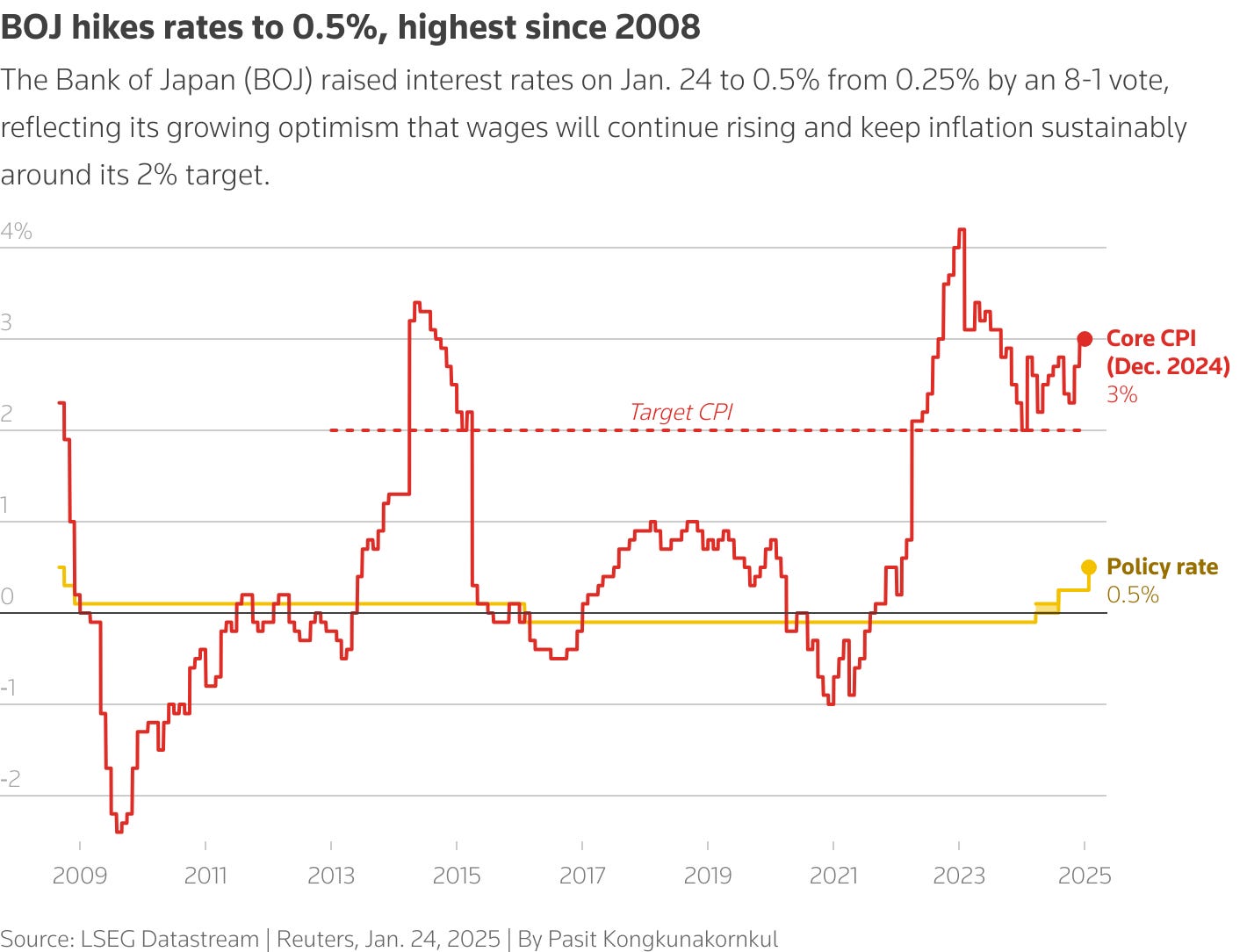
January 2025: BoJ raises policy rate by an additional 0.25 percentage points, bringing the rate from 0.5% to 0.5%.
Mid-2025 onward: BoJ continues easing Yield Curve Control (YCC) limits, allowing 10-year JGB yields to fluctuate more flexibly around 1.5–2%.
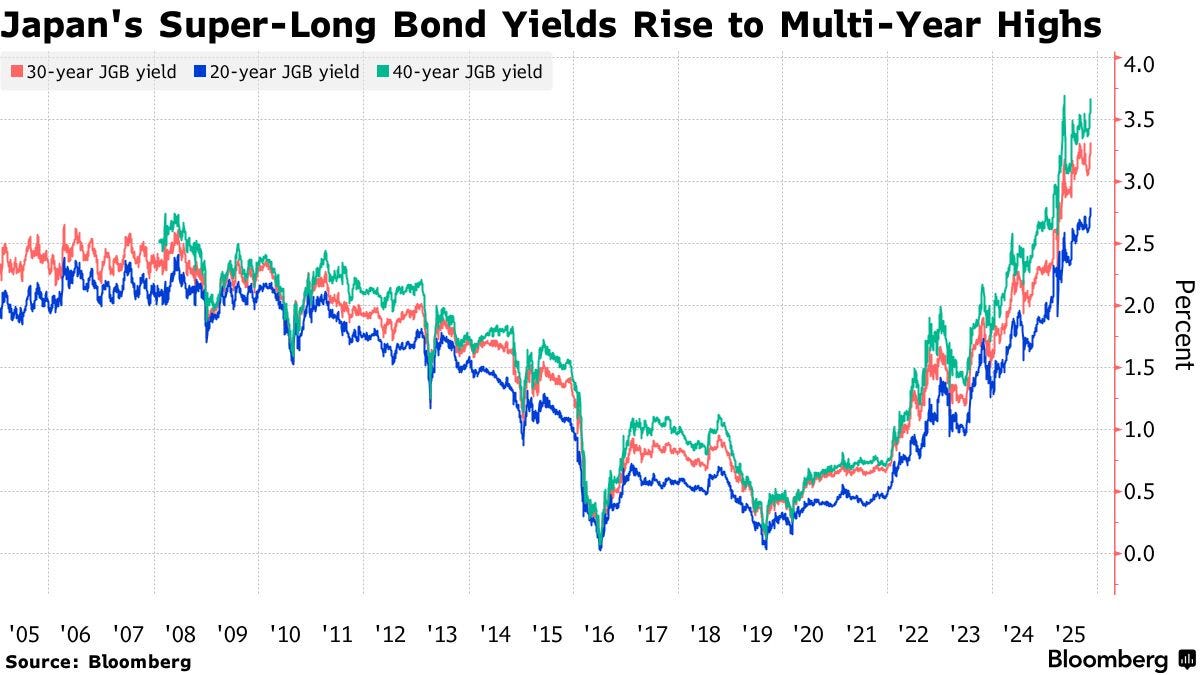
December 2025: 10-year JGB yield surpasses 1.9%, highest since 2007, reflecting ongoing monetary tightening expectations.
Although inflation in Japan has cooled from 2023 peaks, CPI remains above the 2% target, hovering around 3% – providing policy basis for continued rate hikes. However, real rates remain negative, keeping Japan a potential destination for carry trade strategies, though the scale may differ from prior periods.
3.2 Exchange rate developments and declining “safe haven” role
A notable point is that the Yen in 2025 no longer exhibits its former “safe haven” role. Instead of appreciating as domestic yields rise, the Yen ranks among the weakest G10 currencies:
November 2025, USD/JPY exceeds 158, Yen's lowest in 10 months.
Simultaneously, Yen hits historic lows against Euro and GBP.
In international markets, the Yen is viewed as facing double risks:
(1) strong domestic fiscal spending, and
(2) political expectations maintaining loose real rate policy despite nominal increases.
This prevents capital from flowing back to Japan amid rising global risks – a clear shift from previous volatility episodes. In other words, expectations of sharp Yen appreciation amid instability have been largely dispelled.
3.3 Expectations for BoJ December rate hike and market sentiment
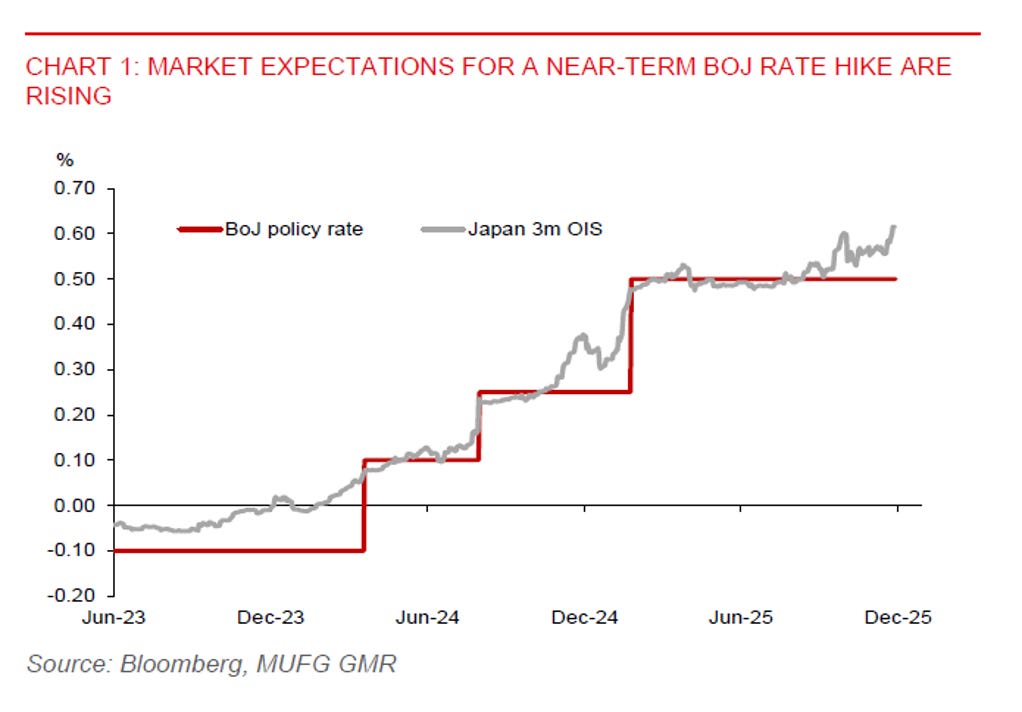
According to overnight interest rate swap contracts (OIS), the market prices an 80–90% chance of BoJ hiking by another 0.25% at the December 18–19/2025 meeting. This move was clearly signaled in advance:
Governor Kazuo Ueda has repeatedly stated that BoJ will act if inflation remains above the 2% target.
Other Policy Board members also do not oppose further rate hikes.
The Japanese government under new Prime Minister Sanae Takaichi rolled out a stimulus package worth 21.3 trillion Yen in December 2025 – reinforcing forecasts that BoJ must tighten policy to maintain medium-term inflation expectations.
Therefore, unlike in 2024, this rate hike is not surprising. The market has had ample time to prepare and adjust positions.
3.5 Views from major institutions: Slightly reduced risk level
Contrary to the cautious sentiment on informal channels, many experts from major financial institutions express neutral to cautiously optimistic views on the possibility of a broad “carry unwind” recurring like in 2024:
Bob Elliott (Unlimited Funds, former CIO Bridgewater): Believes the current global impact of yen carry trade is exaggerated (clickbait). According to him, most carry flows using Yen no longer operate under the risky model as before 2008.
Institutions like BNP Paribas and BCA Research all emphasize that:
Large Japanese investors like GPIF or insurance companies have medium-to-long-term investment plans, not reacting immediately to short-term fluctuations.
BoJ's current policy is more transparent and less surprising compared to 2024.
Part 4 - Yen Carry Trade Scale End of 2025: Significantly Reduced, Systemic Risk Decreased
After more than a year since the August 2024 shock, current data shows that the actual scale of yen carry trade has significantly contracted. Although still present in the global financial system, cheap Yen borrowing flows are no longer accumulating at dangerous levels as before. There are three key indicators to assess the activity level of this strategy:
4.1. Yen-denominated credit abroad: Slowing growth, no longer hot
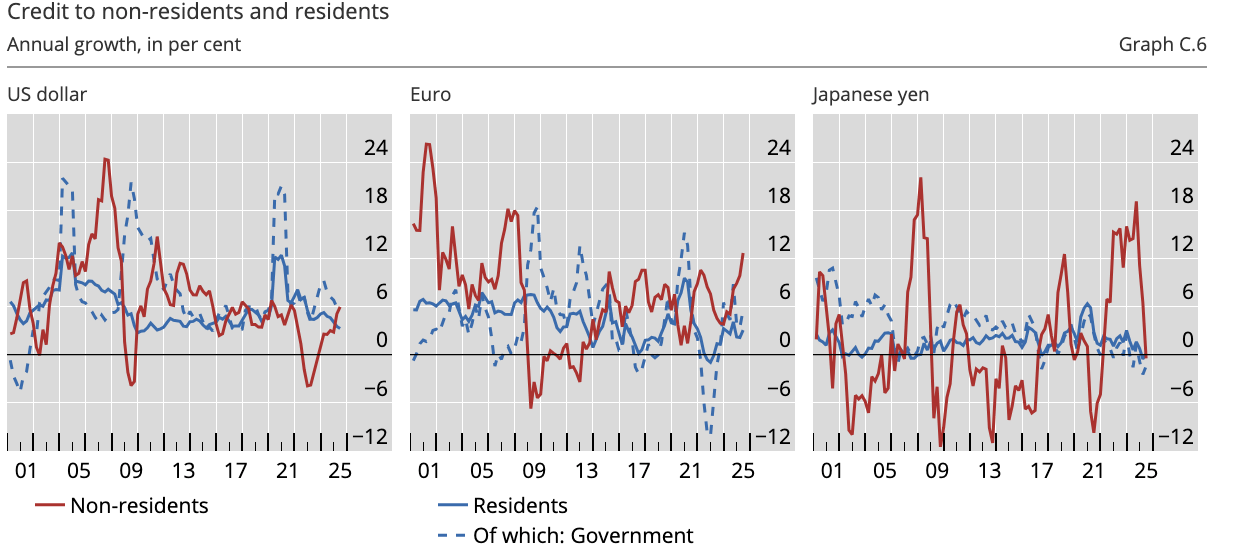
The latest BIS data shows a very clear reversal: yen-denominated credit extended to non-residents – the group acting as the “driving engine” of global carry trade because they are the direct borrowers of cheap Yen, converting to USD/EUR to buy higher-yielding assets – has almost stopped growing since late 2024 and even declined slightly in 2025.
This indicates that demand for Yen as a funding currency is structurally weakening, in contrast to the 2021–2023 period when yen credit abroad grew double-digit and fueled strong carry trade development.
By Q2/2025, total yen credit to non-residents reached about 65.6 trillion Yen (~450 billion USD).
YoY growth fell to –0.46%, meaning not only slowing but turning negative.
This is in complete contrast to the 2021–2023 period, when yen credit growth frequently reached double digits, reflecting extremely strong demand for Yen borrowing to deploy carry trade when BoJ rates were near 0%.
There are three main reasons, all directly related to BoJ starting the “rate normalization” process:
BoJ rate hikes → Yen borrowing costs no longer cheap
From Q3/2024, BoJ shifted to tightening policy, raising rates and allowing JGB yields to rise. As Yen funding costs increased, many strategies of borrowing Yen to invest in foreign assets became completely ineffective.
Greater FX volatility → unhedged carry trade becomes risky
Carry trade relies on the assumption of stable or gradually weakening Yen. But after the August 2024 shock, USD/JPY exchange rate fluctuated sharply → investors reduced demand for unhedged Yen borrowing due to excessive FX risk.
Samurai bonds flat → foreign companies no longer want to borrow Yen
According to Bank of America tracking, the Samurai bond market (Yen bonds issued by foreign entities) has not recorded a new issuance cycle. This reinforces the message:
➡️ Demand for Yen borrowing in international markets has cooled significantly.
4.2. Speculative positions in derivatives market (futures&options, etc): Neutral, no longer dangerously skewed
One of the reasons the August 2024 shock was so severe was that hedge funds held large amounts of short Yen, creating a “crowded” state. When Yen appreciated rapidly, all those positions were forced to close (short squeeze), causing a chain reaction.
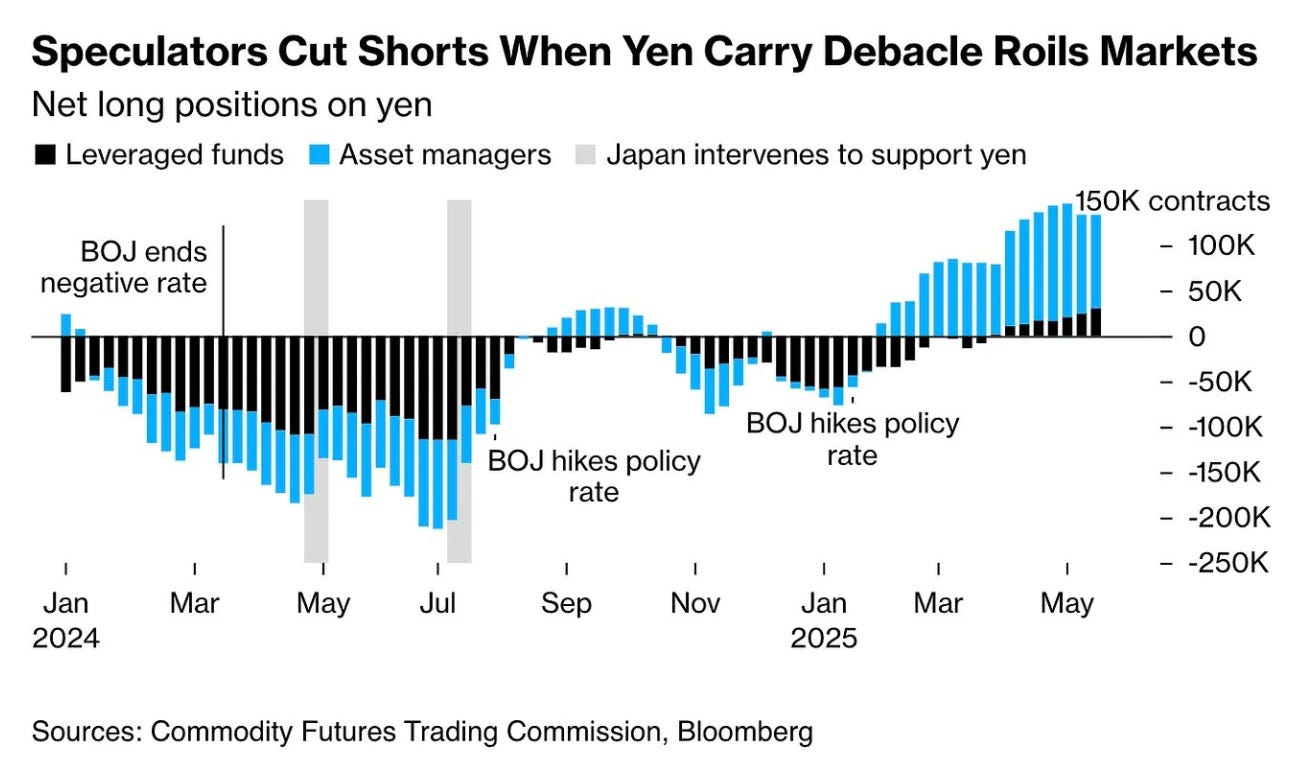
Data up to end of 2025 shows a completely different picture. The CFTC net positions chart shows:
In the first half of 2024, leveraged funds and many asset managers maintained very large short Yen positions, at times short contracts exceeded 250,000 contracts.
After the August 2024 “carry trade debacle”, this stance contracted quickly; short-selling pressure tightened and was replaced by hedging demand.
Into 2025, the trend is even clearer: asset managers switched to holding net long positions, bringing total market positions to a balanced area, even slightly tilted toward supporting the Yen.
Assessment:
Lower leverage → less domino risk.
Fewer “crowded” positions → less likely for mass selling effect.
Even if Yen fluctuates sharply, the market is still capable of absorbing it without causing a systemic shock.
Simply put: The market is no longer betting one-sidedly on the weakening Yen. Therefore, even if BoJ raises interest rates, the room for a widespread short squeeze is very small.
4.3. Activities of Japanese investors: Outbound capital flows slow down, domestic priority increases
A special factor in Yen carry trade is Japanese individual and institutional investors – the group accounting for the majority of capital taking Yen out globally:
Previously, 0% interest rates led many Japanese individual investors (“Mrs. Watanabe”) to use margin and FX products to exchange Yen for USD, AUD, or NZD – currencies with higher interest rates.
However, the change in the shape of the JGB yield curve has affected investment behavior:
The 10-year Japanese bond now yields nearly 2%, attractive enough for conservative domestic investors.
Many Japanese banks, insurance companies, and pension funds are considering reallocating to domestic assets, limiting exchange rate risk.
Outbound investment flows have not disappeared completely, but are slowing and tending toward hedged investments (hedged carry) or short tenors.
At the same time, BoJ is shrinking its balance sheet – reducing bond purchases, withdrawing liquidity – making the Japanese financial environment less favorable for large-scale carry trade.
4.4 Assessment: Carry trade still exists, but not at alarming levels
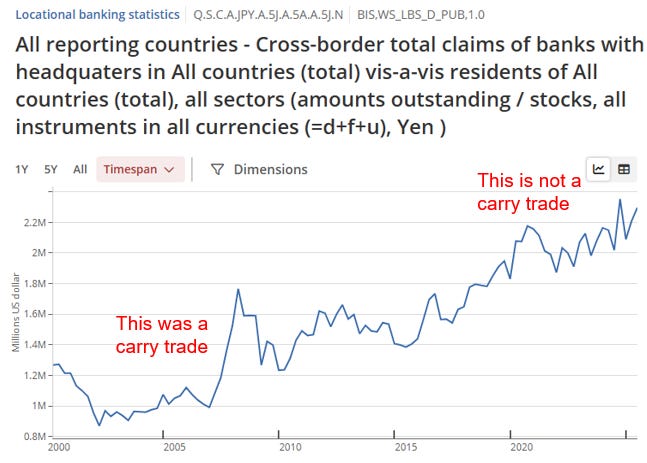
During the 2004–2007 period, carry trade exploded because international funds and banks were willing to borrow Yen unhedged to fund risky asset portfolios. After the global financial crisis, the risk management environment changed completely: almost all major institutions banned or strongly restricted naked FX borrowing (unhedged FX borrowing).
Period 2000–2007: Cross-border Yen credit declined, then surged strongly. This was the period when global investors borrowed Yen unhedged, deploying large-scale carry trade into all kinds of risky assets.
Period 2010–2025: Yen credit flows increased steadily, slowly, and structurally – mainly reflecting normal banking activities, not high-risk borrowing flows to fund carry trade.
This leads to a fundamental difference between yesterday's carry trade and 2025 carry trade:
No more large-scale Yen borrowing to run unhedged risky strategies.
No more extreme one-sided positions like before the August 2024 event.
Japanese outbound investment flows remain weak, only returning to pre-COVID levels.
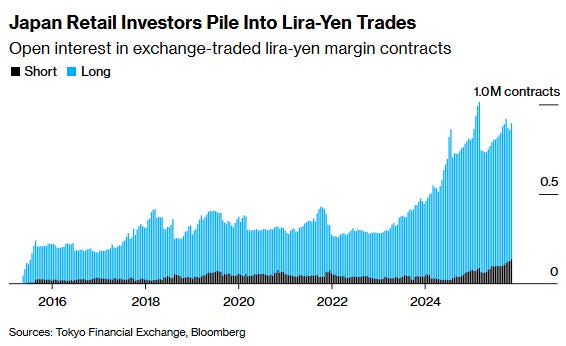
Retail carry trade (e.g., into Turkish Lira) is too small to have macroeconomic significance (~212 million USD).
Therefore, although current macroeconomic conditions – weak Yen, high interest rate differentials, strong rise in risky assets – resemble the golden age of carry trade 20 years ago. But
There is almost no carry trade large enough to create a systemic unwind chain. Today's Yen carry trade is mainly a psychological image, not a market driver.
Yen carry trade still exists within limited bounds, but scale, leverage, and risk concentration have all decreased significantly. At the same time, post-2008 market structure, combined with more balanced positions at end-2025, makes the possibility of a “carry trade panic” like 8/2024 or 2007–2008 very low.
Part 5 - Assessment: Why the 2024 Unwind Scenario is Unlikely to Repeat in December 2025?
Based on the synthesis of previous analyses, many factors indicate low risk of a repeat large-scale “carry trade rout” like August 2024. Here are the five main pillars supporting this view:
5.1. The market has been well prepared, minimizing surprise factors
Unlike the surprise rate hike in July 2024, the December 2025 policy adjustment was anticipated by the market with 80–90% probability. BoJ under Governor Kazuo Ueda has proactively communicated forward guidance, sending clear signals months in advance to avoid surprises.
Investors have had time to restructure portfolios, including:
Reducing risky carry trade positions.
Shifting to defensive positions or staying sidelined.
Therefore, if BoJ raises rates 0.25% as expected, it will be a fully “priced in” event rather than a new policy shock.
Specifically, unlike the surprise rate hike in summer 2024, BoJ's December 2025 move was anticipated.
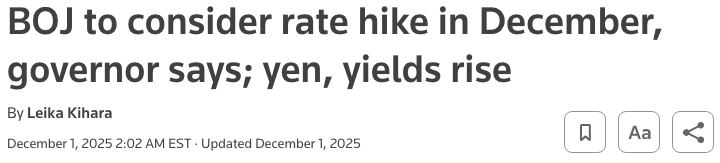
On the night of December 1, Governor Kazuo Ueda sent clear signals from the Nagoya meeting, after US tariff policy risks eased and Japan's economic outlook improved due to a new trade agreement
10-year JGB early last week rose to 1.879% – highest since 2008, but did not cause systemic shock.
10-year UST rose slightly to 4.095%within normal ranges.
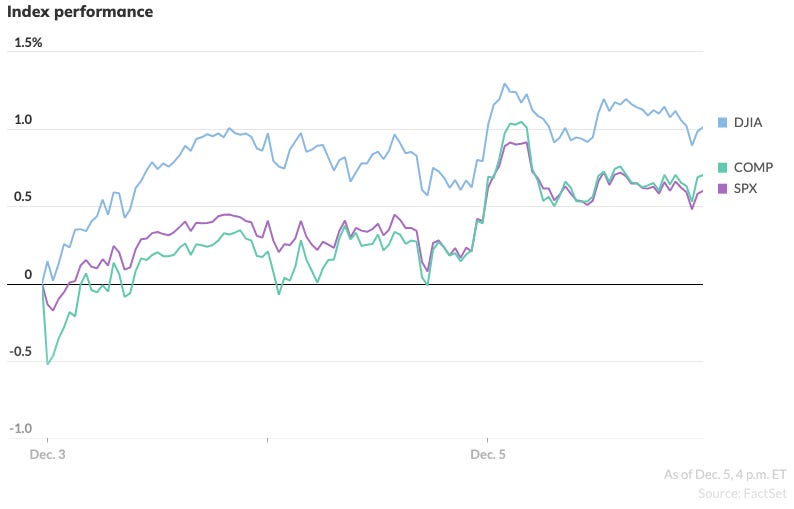
US Stocks light adjustment on that very day 12/01: S&P 500 (-0.5%), Nasdaq (-0.4%), mainly due to profit-taking, not a panic reaction like 8/2024.
➡️ Risk of margin call waves or chain selling due to liquidity shortage is very low. No more situation of “weak hands” being forced to liquidate simultaneously.
5.2. Current market structure is no longer extreme
In 2024, global speculators focused on shorting the Yen at record scale, creating conditions for the short squeeze effect to spread widely.
By the end of 2025, according to CFTC data and analysis banks:
Speculative positions have become balanced or tilted towards buying the Yen.
Overall leverage in the system has decreased markedly, due to tightening global financial conditions.
Current environment:
High global interest rates → Increased borrowing costs → Fewer investors dare to “hold” large positions.
Stricter margin management → Less likelihood of domino margin call chains.
5.3. The Yen is no longer a global risk indicator
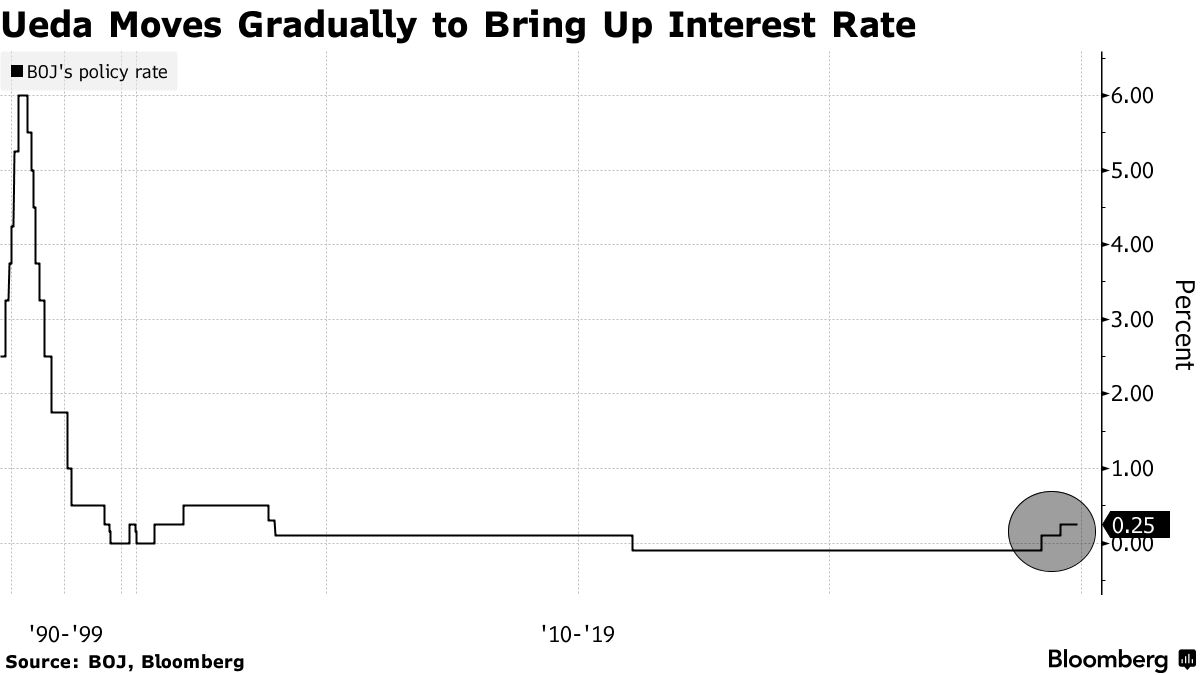
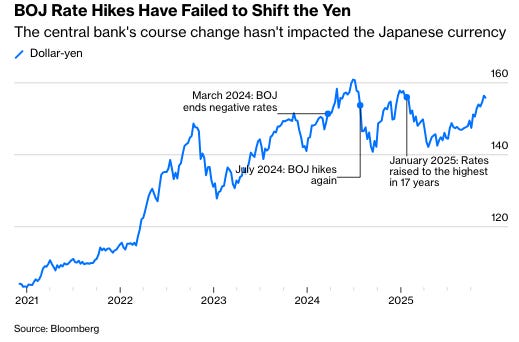
One of the biggest changes in the 2025 market is that the Yen no longer plays the role of “risk gauge” as in the 2008–2020 period. Even though BoJ raised interest rates three times (March/2024, 7/2024, and 1/2025), the Yen continued to weaken – indicating that policy shocks from Japan no longer have enough power to create global chain reactions.
The chart above shows: even major milestones like ending negative interest rates or raising rates to the 17-year high failed to reverse the Yen's weakening trend. This reflects a new reality:
USD has replaced the Yen as the number 1 safe-haven asset: High interest rates and superior US growth make defensive capital flows prioritize USD, no longer prioritizing JPY.
Yen – US stocks correlation has almost disappeared: Previously: Strong Yen → stocks down → risk up. However, this year 2025: many large S&P 500 adjustments, Yen did not rise at all – even weaker.
Even if BoJ raises interest rates, Yen may not strengthen: US-Japan interest rate differential still too wide; market does not believe BoJ can launch a long-term tightening cycle amid sensitive Japanese economy and pressure from US tariffs.
Carry trade leverage has contracted significantly: No more “mountains” of short JPY positions like before August 2024 → less domino risk when Yen fluctuates. Even CFTC records the state of slight net long for JPY in 2025 → meaning the market no longer bets one-sidedly against the Yen.
Global reaction to BoJ now more “orderly.” The December 2025 rate hike only caused a mild US stocks adjustment (S&P -0.5%, Nasdaq -0.4%) – completely opposite to the August 2024 panic.
Overall assessment: The Yen has lost its important risk indicator role. And in the new 2025 market structure, even if BoJ continues raising rates, spillover to the global asset system will be much lower than before.
5.4. Japanese capital repatriation likely to occur slowly and controllably
Concerns that Japanese investors will abruptly withdraw capital from global assets to buy domestic bonds are unlikely in reality.
According to BCA Research analysis, concerns that rapidly rising JGB yields will cause a strong reversal of Japanese capital flows do not fit reality. Large institutions, like GPIF, life insurance funds, and Japanese commercial banks, operate on long-term and stable allocation strategies. That means:
They adjust portfolios gradually, not reacting with “dump everything.”
Asset allocation changes are structural, not short-term tactical.
Therefore, even rapid and sharp JGB yield increases are not enough to trigger a simultaneous sell-off of foreign assets.
Moreover, BoJ maintains a gradual tightening message, per data → giving parties time to adapt.
Observations since after August 2024:
Even with JGB yields rising more than 1 percentage point, no signs of large-scale capital withdrawal from foreign assets.
Japanese investors' holdings of US and European bonds remain stable.
5.5. Fed has not reversed policy, helping stabilize USD/JPY exchange rate
A key factor causing the 2024 carry trade unwind was policy divergence: BoJ raising rates, Fed rumored to cut → USD down, Yen surges.
Currently, Fed maintains “higher for longer” stance, with rate cuts only very gradual in 2026.
This prevents the USD-JPY interest rate differential from narrowing abruptly, helping the exchange rate evolve more stably.
→ Exchange rate shock risk – main cause of carry trade unwind – significantly mitigated.
Risks Still Exist But Significantly Reduced
Cannot completely rule out risks, especially if unexpected market shocks occur (like geopolitics or sudden global liquidity tightening). However:
Carry trade scale has shrunk;
Speculative positions are dispersed, not extremely concentrated;
Investment institutions react in a planned manner.
According to WisdomTree, if there is a new unwind, volatility will be localized and temporary, unlikely to create a global chain reaction like in 2024. Assets that previously benefited greatly from cheap Yen flows – such as cryptocurrencies, growth stocks – may face short-term adjustment pressure, but the financial system has sufficient resilience to absorb the shock.
“If the Yen appreciates due to unwind, it will be part of a pre-prepared adjustment process – no longer an unexpected blow.”
- Peter Vassallo (BNP Paribas)
Part 6 - Conclusion: “Carry Trade Bomb” Unlikely to Explode, But the Era of Cheap Yen is Closing
Based on current data and analysis, the likelihood of a large-scale Yen carry trade unwind at the time of BoJ's interest rate hike in December 2025 is quite low. The current market picture has changed significantly compared to August 2024: no more overloaded one-way positions, leverage levels have decreased, and BoJ's policy is well-communicated, limiting unexpected shocks.
Some key factors to reassure the market:
The current scale of carry trade has clearly narrowed, both in terms of international Yen credit, derivative speculation activities, and Japanese individual investment positions. There are no longer many “triggers” as before.
The market has anticipated BoJ's interest rate hike, unlike the unexpected shock in 2024. The probability of rate hikes has been priced into assets, helping to limit unwind behavior.
The Yen is no longer an extreme variable, the Yen's safe-haven role is fading, and investors have separated Japan from general global risks.
Global leverage is lower, markets have tightened margins and reduced risk positions, making any shock – if it occurs – less likely to spread widely.
However, it is undeniable that the era of cheap Yen is gradually closing. JGB yields exceeding 1.9% reflect that the cost of capital from Japan – one of the world's largest sources of cheap liquidity – has risen to a new level. This will impact:
The ability to cheaply finance speculative strategies or purchases of risky assets – such as growth stocks, assets in emerging markets, cryptocurrencies…
Japanese capital flows abroad may stagnate, shifting gradually to domestic investment channels – a factor that could reduce international liquidity to some extent.
Investment strategies based on easy money flows will be challenged, instead, investors will have to focus more on fundamentals such as corporate earnings and valuations.
The December 2025 meeting will also be a major test for BoJ. If they successfully raise rates without causing major market volatility, it will be a positive signal for the policy normalization process in 2026. Conversely, if the market reaction gets out of control, BoJ can still adjust the pace. Nevertheless, the important thing is that the lesson from August 2024 has made the entire system more vigilant, and that preparation is the “vaccine” that limits the possibility of a carry trade shock recurring.
The current market no longer resembles the 2010s era with zero interest rates and infinite liquidity from Japan. It is a new cycle – where the Yen is no longer free, and profit expectations must come with tighter risk management.