VIDEO: INTRODUCTION TO WALL STREET JOURNAL SERVICES
If You Missed the Best Recent Articles:
“The factory of the world has always been wherever the cost is lowest - until the day it isn’t.”
- Kishore Mahbubani (paraphrased from research on economic geopolitics, 2022)
In January 2026, ISM Manufacturing PMI surged from 47.9 to 52.6 - the first expansion reading after 26 straight months of contraction. February held at 52.4. March edged up to 52.7. To markets, the signal was clear: manufacturing had bottomed out.

The narrative quickly took shape with splashy headlines. “American Manufacturing is Back” proliferated across front pages. Apple pledged $500 billion in domestic investment. TSMC Arizona began production. The Reshoring Initiative announced nearly 240,000 jobs brought back to the U.S. in 2025. Since the start of Trump's second term, over $1.2 trillion in investments have been announced - all read as the opening salvo of an “industrial renaissance.”
If you only look at Fed regional surveys and ISM data, the current manufacturing picture leaves little room for doubt.
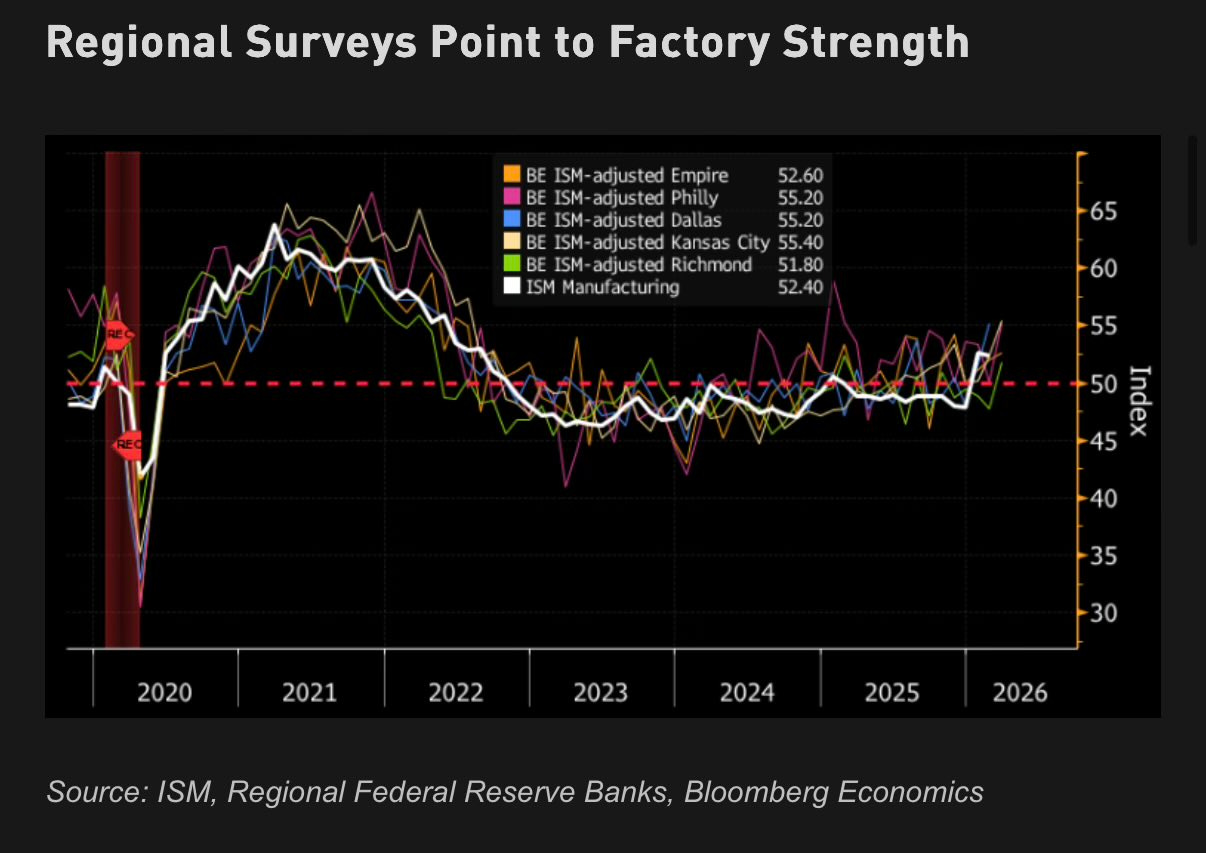
From Empire, Philly to Dallas and Kansas City, most regional indexes have climbed back above 50 - even hitting multi-quarter highs. ISM Manufacturing PMI aligns with that story. At the headline level, this is a synchronized, broad-based recovery that seems strong enough to revive the familiar narrative: “American manufacturing is back.”
But right where the data seems most convincing, the problems start to emerge.
Because when you peel back one layer - not to headlines, but to operational structures and business behavior - the picture starts to diverge. Activity may be expanding, but demand isn't fully keeping pace. Capex may be rising, but employment isn't responding in kind. And most critically, business confidence in the long-term operating environment is deteriorating.
In other words, manufacturing has no shortage of evidence proving it's recovering. The issue is: almost all that evidence is surface-level.
The question is therefore no longer whether reshoring is happening - it is. The question is: Is this a genuine return of production capacity, or merely a policy-, subsidy- and expectations-driven expansion phase? And if it's the latter, much of the current narrative may be conflating investment scale with genuine economic efficiencyreshoring isn't a market outcome
In this week's article, Viet Hustler breaks it down in seven parts: from separating reshoring data from narrative, to the geopolitical drivers behind it, the structural barriers the U.S. faces, and ultimately the key question - one year after Liberation Day, has manufacturing truly returned to America, or is it just being redrawn on the map in a different way?
In this week's article, Viet Hustler breaks it down in seven parts:
Part I - What Is Reshoring: What Data Says, What Narrative Says
Part II - Why the U.S. Wants Reshoring: Drivers Beyond Pure Economics
Part III - The Core Problem: America No Longer Has Factory Advantages
Part IV - 'Real Reshoring' vs. 'Phantom Reshoring'
Part V - Nearshoring: Factories Not Returning to U.S., Shifting to 'Buffer Zones'
Part VI - One Year After Liberation Day: Has Manufacturing Returned to the U.S.?
Part VII - Conclusion: Factories Are Returning - But Not Where You Think