Christmas is very close, although there's still 1 week until the new year, Viet Hustler wants to sit back and evaluate the overall economic fluctuations throughout the past year.
With the fastest interest rate hiking process in Fed history to curb inflation, the US and global economy have grown very resiliently this year. This is good news but also a big question mark about economic growth potential in 2024 when resources have been exhausted (details below).
Before stepping into 2024, Viet Hustler's weekly Macroeconomic Analysis column takes some time to summarize the top 10 representative economic-financial events of the past year as follows:
Top 1: Base rate hits peak - Fed's temporary victory.
To curb inflation, Fed implemented the fastest interest rate hiking cycle in history. Therefore, the most prominent event of 2023 must include:
Fed rate peaked (5.25% - 5.50%) from July 2023 and Fed officially announced halting the rate hiking cycle after December FOMC.
And Fed's small victories this year can include:
First, inflation has been somewhat controlled:
Headline CPI growth at +3.1% y/y and on a downward trajectory.
In particular, PCE growth (Fed's preferred inflation measure) down to +2.6% y/y (quite close to the target) in November.
(With the first monthly deflation: -0.1% m/m after more than 1 year.)
Fed's next victory is the temporary soft-landing achieved in 2023:
With GDP of the first 3 quarters all positive (expected Q4 GDP growth also at +2.7% q/q - St. Louis Fed).
However, Fed cannot declare complete victory as core inflation (core CPI growth) remains quite high: +4.0% y/y
Viet Hustler article analyzing Fed's rate cutting trajectory in 2024:
Top 2: Silicon Valley Bank collapse - igniting the endless liquidity crisis of the US banking system
This March, Silicon Valley Bank officially collapsed within 48 hours (followed by the collapse of 2 other small banks):
The cause was SVB investing up to 92% in US Treasury bonds and safe assets backed by the US government during 2020-2022.
Because this was considered a quite safe portfolio, but SVB forgot the inflation and interest rate risk!
When inflation rose, Fed hiked rates, on 03/08, SVB recorded a -USD 1.8 billion loss from bonds and fixed income.
(The loss recognition was due to SVB selling USD 21 billion fixed income investment portfolio.)
The -USD 1.8 billion loss was not severe, but triggered the subsequent bank-run storm: - USD 42 billion withdrawn from SVB within 24h.
SVB stock dropped > -60% right after.
On 03/10, regulators closed SVB and seized the bank's assets.
SVB collapse signals risks of unrealized losses from devalued bonds on banks' balance sheets in high interest rate conditions:
Stress from unrecognized bond losses continues to escalate to the present.
To date, silent bank-run situation continues in the banking system, massive deposits withdrawn in March-April this year remain un-replenished:
Thus, currently Fed is ramping up liquidity injection into the banking system… to cover deposit shortfalls and unrecognized bond losses.
(- through term lending program - BTFP and short-term - discount window.)
Related articles: Silicon Valley Bank - systemic financial risk and twin crisis
Top 3: Public debt explosion and looming twin-crisis due to high interest rate environment.
Due to high interest rate environment and already high cumulative US government debt pushing US Treasury (T-bond) yields higher in 2023.
The higher the T-bond yield, the larger the unrealized losses of banks, as banks hold a large amount of T-bonds as reserve accounts.
(The market price of this amount of T-bonds decreases when the market T-bond yield increases.)
=> Tipping point of twin-crisis (banking crisis + debt crisis).
High yields in the context of large outstanding debt => the interest payments the US government must pay on debt have risen rapidly to USD 949 billion per year…
… this amount has exceeded US defense spending.
This further accelerates the rapid increase in outstanding debt in 2023:
Related articles: US public debt crisis….
Top 4: The explosion of tech stocks - AI, and the Magnificent 7 group
Along with the advent of Open AI’s Chat GPT, BloombergGPT for the financial sector, and recently Google’s Gemini…., 2023 is truly the year of the AI explosion with
… adoption by users at a dizzying speed….
… and Nvidia's revenue - the AI chip maker - also surged 152% in the first 3 quarters of this year.
The value of the “Magnificent 7” stock group ( ^AAPL, ^MSFT, ^GOOGL, ^AMZN, ^NVDA, ^META, ^TSLA) has risen to +80% this year with a soaring P/E ratio (~ 29x).
While the remaining 493 stocks in the S&P500 only delivered 7% returns.
This increases the concentration risk in the US stock index S&P500: when the top 10 largest market cap stocks account for 35% of the total index weight.
— equivalent to the dotcom crisis era in the 2000s.
Top 5: Commercial real estate crisis unfolding silently
A series of events in the real estate (RE) market recently have heightened concerns about an impending commercial real estate crisis:
We-Work collapse sounds the alarm for the commercial real estate market.
By the end of November, US commercial real estate has "risen" to become the top concern among credit system risks for managers at large investment funds.
Office building vacancy rates have reached 21% in North America:
Delinquencies on commercial real estate loans in the banking system have hit the highest level in 10 years.
Top 6: Attacks on the Red Sea raise the risk of a supply shock returning - will inflation rise again?
Shipping traffic congestion through the Red Sea has been the top concern in news headlines over the past week.
Since early October, Houthi rebels in Yemen (backed by Iran) have continuously attacked commercial cargo ships passing through the Bab-al-Mandab Strait - purple point (entrance to the Suez Canal) to pressure Israel to stop attacking Gaza.
Because of these attacks, the world's 5 largest shipping companies (accounting for ~65% of global shipping volume) have rerouted their ships — going around the southern Africa area, around the Cape of Good Hope…
… causing shipping costs and time for this route to increase by ~40%.
This happens just as freight rates have normalized and supply chain congestion during the Covid period has been resolved.
As a result, the Containerized Freight Index has surged in consecutive days - raising concerns about a supply-side price shock.
This is the index of container shipping costs from Asia to Europe and the UK.
Therefore, this event raises concerns that commodity prices will rise again in Europe and globally: creating a new supply shock to inflation.
Attacks on the entrance to the Suez Canal could affect 12% of international cargo volume.
This is also the main transport route for essential goods from Asia to Europe and the UK.
In particular, the Suez Canal/Red Sea is extremely important for global oil trade:
it is an important oil transport route from Middle Eastern countries to Europe and northward:
Not only transporting oil from the Middle East and Africa through Europe, the route through the Red Sea also serves the crude oil export route from Russia to India and China…
(after these two Asian powers became major crude oil customers of Russia).
As a result, Brent oil price last week rose back above 75 USD/barrel (despite a series of price drops in previous weeks due to low demand).
And currently, China, India, and Asian countries are still the world's factories. Oil is still the fuel for industrial production activities. Therefore, not only Europe, the US and global countries may also be affected by this supply shock.
Therefore, the US has hastily formed an international force to protect the Red Sea together with France, UK, Italy, Norway, Netherlands, and Spain… to avoid disruption of international trade.
Top 7: The end of excess saving among Americans
Excess saving is the amount of savings that people do not want or did not plan to save.
(usually due to an economic shock that gives them extra money or money they cannot spend, e.g.: Covid-19…)
The surge in excess saving during the Covid period was the “backing cushion” for strong consumer spending by Americans throughout 2022-2023.
=> The reason why GDP continues to grow but inflation is more stubborn …
However, excess saving is expected to be depleted by 2024:
Without the excess saving cushion, with high prices (due to previous inflation) and high interest rates, the US economy in 2024 may face a shock from declining consumption!
Top 8: De-dollarization movement - the position of USD slightly shaken
In 2023, a bloc alliance of emerging countries led by China is implementing the plan de-dollarization: to gradually replace the role of USD in international trade and foreign exchange reserves.
03/29: China and Brazil reached an agreement to use their local currencies in trade transactions.
03/28: China completed the transfer of a 65,000-ton LNG (liquefied natural gas) contract with UAE to France's TotalEnergies using CNY.
Also at the end of March, Russia announced it is considering using CNY as a strategic reserve currency to replace USD.
Saudi Arabia reached an agreement with China to build an oil refinery using CNY (worth 83.7 billion CNY ~12.2 billion USD).
The BRICS bloc of emerging countries (Brazil, Russia, India, China, South Africa) plans to use a common currency (possibly CNY).
Nevertheless, USD still leads as the most common currency in international payments, foreign exchange reserves, and international financial transactions:
But in the past November, CNY has risen to account for 4.6% of international payment transactions (this figure was < 0.1% in 2010).
And the share of USD in global central banks' reserves has decreased from 59.4% (Q2/2023) to 59.2% (Q3/2023)
Therefore, the United States should be wary of the possibility that USD may gradually lose its monopoly position: because nothing is irreplaceable!
Top 9: Inverted yield curve: recession or soft-landing?
The million-dollar question throughout 2023: the yield curve has been inverted all year, will a recession occur next year?
Top 10: China enters deflationary period
Will China get stuck in a lost decade like Japan in the 1980s?
China's economy in the 1990s - 2000s developed quite similarly to Japan's economy in the (1960s-1970s):
land reform => investment in infrastructure => development of export factories to earn foreign currency… => income increases, average wages increase
=> with excess money, people return to investing, however, it creates asset bubbles (in China it's real estate, in Japan it's the Tokyo stock market).
Related articles: Déjà vu in China's economic story
And the problem comes when the giant asset bubble bursts…
China's real estate crisis (due to the bursting of the real estate bubble) from mid-2021 has caused China's real estate value to drop rapidly…
…. and expected to continue declining in 2024:
Real estate is no longer the main growth driver for China's GDP: pulling China's GDP growth from +8.4% y/y (2021) down to +3% y/y (2022).
Every -5% drop in real estate value is equivalent to an average loss of -19,000 billion CNY in people's savings.
This forces people to tighten their belts and reduce spending accordingly in major Chinese cities.
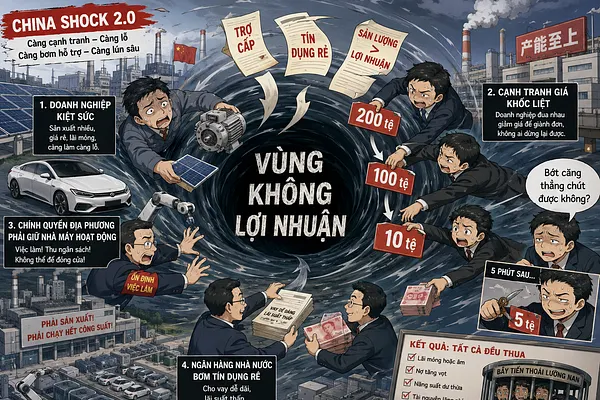
When domestic demand weakens —> consumption collapses —> leading to disinflation and deflation in China:
China's CPI growth in November is at -0.5% y/y.
China's PPI has also been growing negatively for over a year.
Importantly, once deflation occurs, this situation can persist long-term like Japan's lost decade to this day, because monetary policies cannot restore people's spending structure.
Will that continue to happen in China?
CONCLUSION
2023 is gradually closing with big questions about twin-crisis: as the simmering liquidity crisis in the banking system and the US public debt problem remain unsolved. Even though Fed rates have peaked, how can the Fed's rate-cutting process next year balance both sides: ensuring inflation doesn't rise again but continues to fall, while ensuring the economy can overcome the twin crisis?
Meanwhile, external factors may continue to cause unpredictable variables for the economy:
Will the current situation in the Red Sea ignite a new supply shock and inflation?
Will the de-dollarization movement shake the position of the USD and the US?
Will the exhaustion of excess US household savings cause a consumption shock in 2024 leading to recession?
How long will China's entry into a deflationary period last, and will it affect the global economy?
All will be answered in time. However, Viet Hustler will also bring predictions from major investment banks about 2024 Economic Outlook in next week's Macroeconomic article.


Comments (0)
No comments yet
Be the first to comment
Login to comment