Unlike the rest of the world, which has not yet escaped high inflation, the world's second-largest economy - China - is facing a severely disinflated and deflationary economy due to the collapse of consumer demand. But disinflation/deflation is not the only challenge facing China today. Local government public debt issues, liquidity in the financial system, geopolitical tensions, and declining FDI investment... are attacking China's economy all at once.
Therefore, this week's macroeconomic analysis article from Viet Hustler will review the checklist of major issues in China's billion-population economy: factors that could ignite a comprehensive crisis here.
Alongside that, Viet Hustler will delve deeper into US-China geopolitical tensions at the end of the article, and the subsequent impacts on the US and global economy.
Checklist of difficulties China is facing
It can be said that China's economy is facing myriad difficulties in almost all key sectors: consumption, real estate, and finance!
(1) Bogged down in deflation and disinflation due to collapsed consumer demand
China's CPI fell to negative territory again (-0.2%) in October 2023. Meanwhile, PPI has remained negative throughout the past year.
Bloomberg believes that low inflation is one of the main reasons why the economy is growing below potential and China needs more monetary and fiscal stimulus measures.
However, Viet Hustler wants to counter part of Bloomberg's view, because:
Injecting money into the economy (monetary and fiscal stimulus) can only help businesses with capital issues => that is, stimulus from the supply side.
In China's deflation case, it stems from weak consumer demand => Monetary stimulus measures from the Central Bank will not be effective.
Fiscal policy can only be effective if it targets consumer spending demand: e.g., increasing subsidies for low-income people, increasing the number of holidays in the year …
Evidence of weak demand in the Chinese market:
Business results reports from Chinese companies all tell the same story: Most companies' business performance is below expectations.
Discretionary consumer goods and utilities/services are the only two categories with revenue higher than expected.
Even essential consumer products have nearly 50% of companies failing to meet expected revenue.
In particular, 85.7% of real estate companies (Real Estates), >70% of materials suppliers (materials) and production (industrials) companies did not meet expected revenue levels.
The retreat in China's economic production activity is evident: PMI for all sectors declined in October 2023.
(2) Liquidity tightening in the financial system
In October, China's central and local governments issued debt rampantly on a massive scale (total value >1000 billion CNY)…
(to prepare funds for upcoming fiscal policies to stimulate consumption).
=> a large amount of cash was withdrawn from the market in a short time (and locked in the government's fiscal budget).
In addition, foreign companies repatriating profits earned from China has also contributed to additional liquidity stress in the Chinese market from September until now.
Interestingly, China is paying its foreign investors in their home countries more than it earns from investing abroad.
(even though interest rates in most markets are higher than in China)
As a result, credit institutions are severely short of capital to maintain safe reserve levels as well as investment and lending activities:
Overnight interest rates on the interbank market rose +50% for non-bank institutions last week.
Meanwhile, banks are aggressively borrowing short-term funds: bank Certificate of Deposit issuance reached an all-time high.
In addition, China has lost FDI inflows from abroad (which was once the driving force of China's economic development in the 2000s)
Net FDI outflow from the billion-population market reached -USD 11.8 billion in Q3/2023 (the first net outflow since this figure was officially recorded in 1998).
Actual utilized FDI in Q3/2023 was also lower than the same period last year.
(3) The iceberg of local government public debt issues
Last week, China's once-every-5-years policy forum discussed tighter control over the public finance sector.
Beijing announced it will establish a 'long-term mechanism' to resolve local debt risks and the central government may increase borrowing.
However, the allocation of local government public debt has many hidden and unclear portions:
Off-balance sheet loans (LGFV) are 'opportunistic' loans, i.e., mostly issued by richer provinces with higher repayment capacity.
In contrast to the official debts on the balance sheet (local government bonds) allocated in a seemingly 'humane' way: poorer provinces have higher borrowing levels (on the balance sheet).
(4) Real Estate: This world's largest market cap market is struggling to escape the crisis
Following the downward trend of the real estate market, the price of USD-denominated bonds issued by China Vanke Co., (China's 2nd largest construction company by revenue) has plummeted since last month.
Therefore, the local government has affirmed it will support Vanke with liquidity.
State-owned Metro Group Co., Vanke's largest shareholder, also affirmed it will not withdraw shares + prepare to buy Vanke bonds in the open market.
Immediately, Vanke's bond prices rose again (though still lower than before).
=> This feeble move is also considered a good signal for Chinese real estate developers, especially if the government nationalizes part of this industry.
Meanwhile, last week Evergrande had its last chance for debt restructuring (debt restructuring) before having to actually liquidate and go bankrupt.
Evergrande proposed to foreign creditors to swap debt for 30% equity.
Currently, the company has a deadline until 12/04 to submit a complete debt restructuring plan to the court.
FYI: 66% of total assets of Chinese households are locked in real estate investments.
This causes the Chinese real estate market freezing over the past 2 years to affect people's consumption decisions (details discussed below in comments).
Negative impact of China's economic situation on the US and globally
Impact on liquidity in the US and globally
China, once the country holding the most US Treasury bonds during 2002-2014, is now the largest seller of T-bonds.
In the context of cash shortages in China's financial market and this country running a deficit in foreign currency revenues from abroad (both from exports and FDI), upcoming US Treasury bond sales will be intensified even more.
More T-bond sales from foreign investors will negatively impact the US public debt issue and global liquidity:
US bond yields will remain high => public debt burden,
US bonds held in reserve by China being sold will cause liquidity in other markets to be withdrawn to flow back to China.
The global economy will lose more than it gains if US-China trade political tensions escalate:
Related articles: Geopolitical tensions - the straw that breaks the camel's back for the US public debt crisis?
On the US side:
Apple's sluggish holiday revenue growth comes from sales issues in China:
increased competition with Huawei and hostile business environment make iPhone sales expected to be flat vs 2022 (0% y/y growth).
On the China side:
Revenue of Semiconductor Manufacturing International Corporation (SMIC) dropped -15%, especially net income dropped to -80%.
SMIC claims that geopolitical tensions are the main cause.
On the global supply chain:
Major fashion brands like Adidas and Nike, although wanting to shift their supply chains out of China, have faced considerable difficulties…
because they have built a production ecosystem over decades to ensure supply issues, transportation costs, labor…
The relocation of supply chains from China to other developing countries is progressing quite slowly.
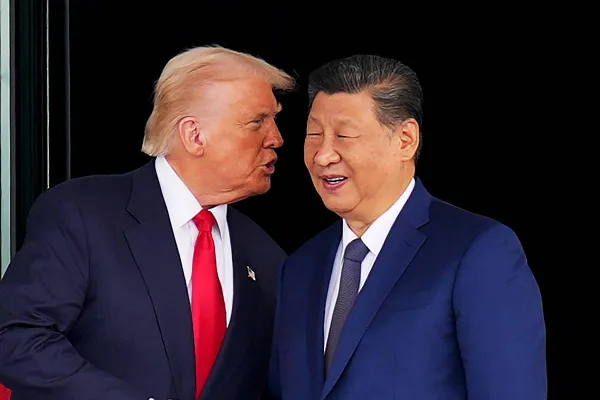
The US and China are trying to engage in dialogue on trade competition issues
The two countries have started a series of dialogues on technology trade issues including a series of events:
US Treasury Secretary Janet Yellen met Vice Premier He Lifeng last Thursday to discuss the recent trade conflicts between the two countries.
(The content of the meeting as reported by bloomberg is: “using security measures in trade relations”)
Upcoming, Chinese President Xi Jinping will meet President Biden and hundreds of CEOs from major US companies — an important sideline event at the APEC summit (San Francisco).
However, a relationship of both cooperation and competition will always exist between the two US-China poles:
The energy transition process is fueling the outsourcing war between China and the US.
The US is reviving the railway line connecting African mines to US ports on the Atlantic coast.
But Washington seems to have arrived late, as Beijing has dominated most of the infrastructure and mineral resources in Africa.
Not only that, China has continuously increased subsidy cash flows to developing countries along its One Belt One Road initiative corridor from 2014-2021…
- even through informal channels (yellow column).
CONCLUSION
China is facing myriad difficulties in most of its pillar sectors of the economy:
Declining consumer demand is causing the world's second-largest economy to sink deeper into deflation/disinflation.
The hasty preparation for the fiscal stimulus plan has led central and local governments to issue massive debt, pushing the financial system into severe liquidity contraction.
The sharp decline in foreign currency revenues from FDI and exports is making the currency shortage in the financial market even more severe.
The gigantic real estate market has been frozen for 2 years despite still struggling to escape this situation.
Finally, geopolitical tensions with the US are causing businesses on both sides to struggle and disrupting global supply chains.
It is still too early to assess the negative impacts of the financial and real estate crises in China on the global economy. In particular, China's currency is not a major reserve currency or a currency for issuing debt in other countries like USD and EUR. However, the cash shortage in China will intensify the wave of selling US bonds (even stocks) by Chinese investors.
In addition, the decline in demand in China will have a significant impact on US and European businesses operating there (Apple is a typical example).


Comments (3)
E nghĩ vấn đề thanh khoản không đang lo vì cầu tiền đang yếu. FDI cũng vậy, TQ bh nên là thằng đi đầu tư chứ không phải được đầu tư nữa. Không rõ ảnh hưởng của thị trường BĐS đến tiêu dùng người dân như thế nào mà cầu tiêu dùng yếu như vậy? Đa phần các nguồn chỉ nói đến các DN BĐS héo.
FYI: 66% tài sản của các hộ gia đình TQ bị khóa trong các khoản đầu tư BĐS nhé bạn :) Mình update số liệu trên bài viết cho bạn rồi.
Điều bạn nói về thanh khoản cũng đúng, nhưng mình nhìn ở góc độ systemic, việc ngân hàng thiếu tiền mặt (tạm thời) có thể khiến depositors panicked. Điều này sẽ dẫn tới bankrun nếu thị trường TQ là thị trường tự do như Mỹ. Còn chưa kể tiền hiện đang bị khóa ở ngân sách tài khóa, mà các chính sách tài khóa thì take time để thực hiện. Nên nói là liquidity squeeze trong tgian ngắn nhưng đã 3 tuần rồi mà các ngân hàng vẫn bị thiếu tiền. Dù doanh nghiệp giờ nhu cầu tiền giảm nhưng ngân hàng vẫn phải đảm bảo lượng reserve và hoạt động cho vay của mình. BĐS ảnh hưởng rất lớn đến tiêu dùng người dân, trước kia lúc giá nhà cao, người dân thi nhau mua nhà. Ở Châu Á, nhiều người dùng tiền tiết kiệm để mua nhà an cư và coi là khoản tiền dưỡng già. Nhưng giờ BĐS đóng băng, giá nhà thấp, họ sẽ có tâm lý thắt lưng buộc bụng vì nghĩ khoản tiền tiết kiệm của mình đã bị sụt giảm. Chưa kể nhiều ngân hàng dùng tiền của depositor cho vay dựa trên các tài sản thế chấp là BĐS, BĐS đóng băng đồng nghĩa với việc các khoản thế chấp này của ngân hàng bị giảm giá trị. Thế cho nên lúc Evergrande mới bắt đầu sập, nhà nhà người người đi rút tiền tại bank là vì thế.
Login to comment