Video: Opportunities in the Commodities Market, Changes in Market Structure, and How to Own Apex's 250k Funded Account with 99% Discount
Last week, although the market rejoiced that US inflation eased slightly – when looking at the overall picture of the inflation process over the past more than 2 years, Viet Hustler still believes that inflation has not yet been controlled.
Meanwhile, last week's labor data showed that the labor market is trending towards loosening and could weaken if the consumer market also weakens.
And most recently, US-China geopolitical tensions are escalating with threats from the two US presidential candidates to increase import tariffs from China – putting even more pressure on the US inflation situation.
In such an economic - geopolitical context, this week's Viet Hustler Macro Economics column will provide the most comprehensive overview of the 3 threats above to the US economy.
Disclaimer: Some of the views below come from the personal perspective of the author group based on economic data - but are by no means investment advice!
1 - Inflation Not Yet Controlled - While High Interest Rates Harm the Economy
Last week, investors were all pleased when inflation (headline CPI growth) fell to +3.4% y/y as forecasted:
The detailed analysis of the CPI report has been covered by Viet Hustler in the mid-week market article.
Below are just a few additional comments on the current inflation situation and the Fed's interest rate policy issue:
Inflation Persists
If looking at the above inflation figures of 3.4% and core inflation 3.6% – US inflation is still too high:
A Simple Comparison:
The Eurozone bloc initially had higher inflation than the US with heavy impact from supply shock, but currently, Eurozone inflation is only at 2.4% (core inflation 2.7%).
Because the biggest issue with current US inflation is that the labor market is still driving spending growth (unlike in Europe where wage growth is quite slow) – this will be analyzed more clearly below.
The US inflation rate has currently been above +3% y/y for 37 consecutive months – this is currently the longest inflation period since the late 1980s - early 1990s.
What are the Effects of Long-term Inflation?
Decline in USD purchasing power (purchasing power parity) - cost burden on low-income people.
Fed Forced to Extend Quantitative Tightening (QT) Period and Keep Interest Rates High!
Impact of High Interest Rate Environment on the Economy:
The Fed extending the QT period and high interest rates will harm people's lives and the economy:
On the Consumer Side: low-income groups will bear both pressures – high prices and high consumer borrowing
Delinquent consumer debts are from low-income people who need consumer borrowing the most (debt utilization rate 90-100%)
And for the first time in history, US households' interest payments on non-mortgage debt equal major mortgage interest expenses:
Overall Economic Environment: gradually weakening in a high interest rate environment
US Industrial Production in April only increased +0.01% m/m (only 1/10 of forecast):
While industrial production was revised down in 11 / 13 recent months.
Also in April: retail sales showed no growth (0% m/m - much lower than the forecasted +0.4% m/m) while inflation persists!
(Overall CPI still up +0.3% m/m)
Analysis from MIT (SLOAN Management school) points out: the credit tightening situation may continue to be tense and longer-lasting:
Regarding the aspect of US economic influence globally: the Fed keeping interest rates high compared to other central banks, although making USD price high, but accelerating the de-dollarization process even more.
The use of gold as a safe-haven asset replacing USD-denominated assets has continuously increased over the 24 months since the Fed raised interest rates.
Because the high interest rate environment increases bankruptcy risk for businesses or even the US Treasury (since they borrow in USD).
For example: Gold price up ~+50% in the 2018-2020 period and ~+55% in the 2006-2008 period.
And even though USD value is high, the current purchasing power of the USD (purchasing power parity) is still being eroded by inflation:
In addition – there's an interesting analysis on CPI for April 2024: The 2 largest CPI growth components are car insurance and housing costs
These are 2 components rising due to the Fed's high interest rate policy.
Perhaps it's time for the Fed to plan an early interest rate cut…
2- Labor market: strong surface hiding the iceberg
Signs of loosening in the US labor market were discussed by Viet Hustler in last week's Macro Economy article:
Related article: Labor market and consumption push back the Fed's soft-landing dream
The issue with the US labor market is having quite many jobs (more than the number of unemployed):
This causes wage growth (+3.9% y/y) to be higher than price growth – prolonging spending growth making inflation unable to fall below 3%
Not to mention the current job growth situation is not very sustainable:
51% of Americans in the GALLUP survey say this is a bad time to find a good job - the highest rate since 04/2021.
In reality, although official data shows the US has added over 100,000+ workers each month for the past 40 months – most of these new jobs are part-time jobs.
Number of part-time jobs increased +978,000 — while number of full-time jobs decreased -1.136 million jobs in Q1/2024:
3- US-China trade war and the Xi Jinping administration's de-dollarization plan
China sold a total of USD 53.3 billion US Treasury bonds in Q1/2024.
Of which USD 22 billion was processed for sale in Belgium (where there are many agents overseeing China's overseas assets).
Note, China's large sale of US Treasuries occurred in the context of the Fed slowing QT to prepare for interest rate cuts.
This is not only to protect the Yuan (as the Yuan clearly had weaker periods before - e.g. September 2023) but clearly intentional in the de-dollarization campaign.
To gradually replace USD reserves and USD bonds, China also increased gold holdings – sparking the gold fever in Asia from the end of last year — pushing global gold prices even higher this year:
PBOC gold reserve value proportion rose to 4.9% of the balance sheet in April 2023 - the highest since 2015.
China's selling of Treasuries and USD-listed assets could intensify if the US-China trade war escalates:
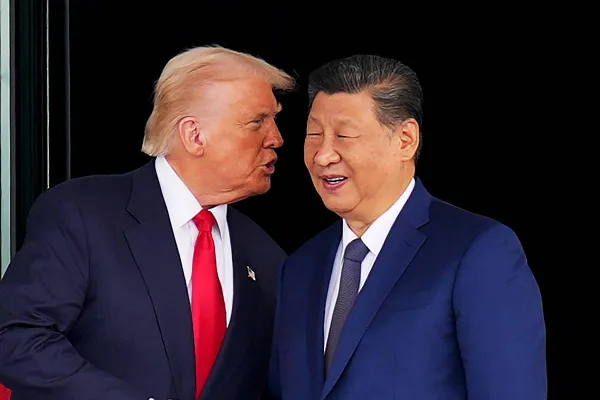
Recently, Biden announced broad tariff hikes on a range of Chinese imports:
While Trump also stated he could impose over 60% tariffs on imports from China if re-elected:
Although the trade war aims to maintain America's position on the global economic map…
… but in reality, tariff barriers will cause US domestic prices to rise sharply – especially potentially reigniting US inflation at this time!
The importance in global trade and economy of the expanded BRICs group (led by China with the de-dollarization campaign) is quite large:
BRICs is gradually expanding and recruiting more “members”…
They account for 25% of export output and 43% of global oil production in 2023…
The consequences of the trade war will only weaken the US economy:
The US trade deficit with China remains very high:
And if GDP is adjusted for purchasing power parity, the BRICs group's GDP has surpassed the G7 in 2023.
CONCLUSION
Although the market was quite upbeat last week as inflation returned to a downward trend — but according to Viet Hustler, this downward trend is quite fragile. The drop from +3.5% (y/y) inflation in March to +3.4% in April 2024 does not reduce the price pressure on people's lives.
And inflation remaining above +3% for the past 37 months will only make the Fed worried and maintain high interest rates for longer. And the high interest rate environment is clearly putting pressure to slow spending, increasing stress in the capital markets - causing reduced production activity — and will likely soon affect corporate labor hiring in the near future. Therefore, in the second half of 2024, the duo of challenges: inflation accompanied by high interest rates + weakening labor market could gradually mount a strong attack on the US economy.
However, besides the two issues mentioned above, the third issue for the US economy is the US-China trade war and the de-dollarization campaign initiated by the BRICs group (led by China). In the current high inflation context, increasing tariffs on imports from China will only cause prices in the US to rise higher. And as Viet Hustler has emphasized, China is holding a large amount of US bonds as hostages and will be ready to sell them if it benefits them more!


Comments (1)
Bài viết hay cảm ơn tác giả
Login to comment