MACROECONOMICS

Geopolitical tensions - the straw that breaks the camel's back for the US public debt crisis?

War risks and disagreements in unbalanced fiscal policy could ignite a multi-year public debt crisis

The market is worried about the impact of recent geopolitical events on financial markets, the possibility of increasing inflation and recession risk. Viet Hustler analyzed these possibilities in last week's macroeconomics article. And this week, the Fed itself also warned of the impact of geopolitical events on financial markets.

However, amid the latest developments in global geopolitical risks, there is one variable that has been overlooked more, which is the possibility of a public debt explosion in the US due to recent geopolitical events.

Viet Hustler is a reader-supported publication. To receive new posts and support my work, consider becoming a free or paid subscriber.
This week's macroeconomics article by Viet Hustler will continue the story on geopolitical risks, but will focus on the possibility that these risks will ignite a real public debt crisis erupting in the US.

What you need to know about the US public debt crisis

Highlights in public debt crises

  1. Public debt crises always come with banking financial crises (twin crisis):

  • Caused by government bonds previously held by banks/financial institutions losing value due to rising current interest rates.

    => This creates unrealized losses (unrealized loss) => causing a banking financial crisis. 

    • In the past 2 years, TLT (ETF tracking US Treasury bonds) has had the deepest decline ever (-51% since August 2020):

      • TLT is currently fluctuating around USD 83 ~ the lowest level since 2006 (before the financial crisis).

      Image
  • => In this situation, financial institutions all want to “dump” the old bonds, causing a surge in the bond sell-off wave, further pushing up bond yields.

    => Higher bond yields further increase the public debt burden

    • The number of US Treasury bond sell orders has reached a record high in the past year (orange-yellow area).

    Image
  1. Public debt crisis is increasingly recognized and escalates in a high interest rate environment:

Government debt accumulated over many years becomes increasingly large and grows even faster in a high interest rate environment:

  • Previously, the continuous QE process starting from 2009 and excessively ramped up in 2020 created abundant liquidity in the market and low borrowing rates.

  • Creating conditions for the government to hide huge debt servicing costs (since government borrowing rates were still low at that time) along with spending deficits not yet too large.

    + The government also downplayed the public debt issue (since debt servicing costs were much lower than economic growth).

  • When inflation rises, central banks are forced to raise interest rates to stabilize prices

    => Higher interest rates (accompanied by high borrowing costs), the huge accumulated debt grows day by day and gradually emerges. 

    • Debt servicing costs also rise sharply, causing large budget deficits, which can create a bad economic environment.

      Image

Conflict of objectives between the US government and Federal Reserves: Debt-price spiral!

  • Fed, as the central bank, will prioritize the price stability objective: this comes with the supreme task of curbing and reducing inflation with high interest rates!

  • However, with the public debt burden, high interest rates (accompanied by high borrowing costs) make the government unable to afford debt servicing costs.

    => The government will want extremely low or negative real interest rates (inflation > nominal bond yields) to minimize real debt costs (after deducting inflation).  

Conflict of objectives between the government and the central bank could be one of the pressures forcing the Fed to slow down the interest rate hiking process.

This could make the inflation-public debt spiral (debt-price spiral) more persistent.

There is still no way out for America in debt-price spiral!

Some traditional solutions to resolve public debt will become difficult in the current economic environment:

Option 1: The government may decide to buy back debt to reduce the debt burden (while also stabilizing the bond market), but that entails 2 risks:

  • … injecting liquidity into the market, causing inflation to rise again 

  • the budget deficit becomes even more severe.

  • And above all, these deficits will have to be covered by tax revenues from the people.

Option 2: Increase tax revenue

  • … will cause people to cut spending (reduce demand => reduce inflation) and cover the budget deficit, the government can also pay off debt.

  • However, this method is quite cruel to the people: when they have to bear both the burden of inflation and the tax burden => most people will not agree.

  • The government, close to elections, will also not choose this method to avoid losing the people's support. 

Option 3: The forex market is another escape route for the US government in particular, but it is an extremely risky gamble.

  • The US can rely on the increased global demand for USD due to high interest rates in the US to exchange USD for other foreign currencies. 

  • Then, wait until the Fed lowers interest rates next year (USD will depreciate), the US can sell foreign currencies to get more USD to pay debt (and also stabilize the USD value at that time).

  • However, betting on the forex market is quite dangerous, especially when China, Saudi Arabia, and other countries are reducing USD reserves and US Treasury bonds. 

Therefore, all 3 options: debt buyback + increase tax revenue + rely on USD value fluctuations to solve part of the mounting public debt problem are not very feasible for the current US government! 


Geopolitical risks could exacerbate the US public debt crisis

Latest updates on current geopolitical risks

Ukraine-Russia and Israel-Hassam wars: energy/fuel issues back on the table 

  • The new war breaking out in the Middle East has once again increased fears of geopolitical risks (geopolitical risk index rising high) similar to the Ukraine-Russia war.

    Image
  • This week, oil prices continue to rise also stemming from concerns about geopolitical risks from the war in the Middle East:

    Image
    • …even though oil and fuel production is still forecasted to be stable:

      Image
  • Many opinions suggest that this war could disrupt the oil supply chain again, causing inflation to rise again. 

    • This may be true for other countries except the US because the US has become increasingly less dependent on the Middle East for oil supply since the 2010s.

US-China trade war: Trade war is on… again!

  • Last week, the US tightened regulations on AI-chips to restrict Nvidia and other chip makers from selling high-tech semiconductors to China.

    • Nvidia stock (company with up to 25% of revenue from selling chips to China) dropped ~ -7.5% the next day on NYSE:

      Image
  • Immediately after, China retaliated with regulations limiting graphite export volume - an important mineral in electrical engineering and the US electric vehicle manufacturing industry.

    • The US was previously always China's largest graphite import partner. 

  • The review and crackdown on Big Tech in China over the past more than 2 years has also contributed to accelerating the US-China economic decoupling in the technology sector.

Additionally, Canada is planning to withdraw dozens of diplomatic officials from India:

  • The reason is that Ottawa accuses New Delhi of being involved in the murder of a Canadian citizen.

Impact of geopolitical risks on the US public debt burden

The two major current geopolitical risks—Russia-Ukraine war / Israel-Hassam and the US-China trade war—are likely to push the US government deeper into debt-price spiral! 

The US may increase government spending… because the war is nearly half a globe away

  • Mid-last week, Biden submitted to Congress for consideration a national defense security funding package worth more than USD 100 billion,

    • …. of which up to USD 75.7 billion is used to fund Ukraine and Israel.

  • This means government spending may continue to increase, exacerbating the budget deficit problem.

  • Importantly, the US does not need to increase defense costs for an “offshore” war: even though this may stimulate the US defense industry, it will cause the public spending deficit to increase further - amid public debt rising to an unprecedented record level in US economic history!

US-China trade war: exacerbating debt-price spiral!

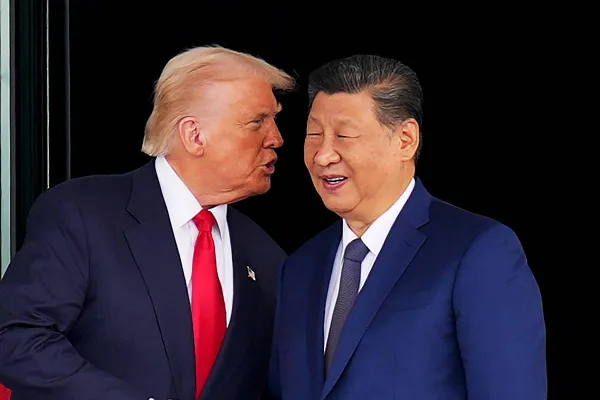
Viet Hustler believes that the US-China trade war should not be heated up at the current time, because this war will exacerbate the recession risk for both countries.

  • For China, facing cooling domestic consumption, exports are the only lifeline for its goods manufacturing and industrial sectors. 

    • If it loses its largest import partner, the US, China could soon fall into recession and lose momentum to return to economic growth.

  • For the US, losing cheap supplies of goods and production materials from China will have a significant impact on the debt-price spiral:

    • Consumer prices in the US will rise sharply once trade-war tensions heat up: this is the new geopolitical variable most likely to increase inflation right now!

    • High inflation will prolong the Fed's interest rate hiking cycle, causing Treasury bond yields to continue rising 

    => Government debt will truly explode if interest rates rise even higher!

CONCLUSION

Public debt in the US is an issue that should concern both the government and the Federal Reserve because public debt crises always come with banking financial crises. Especially, the pace of public debt accumulation will accelerate even faster in a high interest rate environment. The interplay between high public debt and inflation (and interest rate policy) is not just an economic issue but also a political one in the conflict of objectives between the government and the central bank (debt-price spiral).

In the context of high inflation and high interest rate environment, the US government will be limited in public debt management tools through the financial markets: precisely, the US government and the Fed have no way to "have it both ways" to solve both public debt and inflation issues at the same time.

At the same time, geopolitical risks will exacerbate the public debt problem, mainly due to subjective reasons from the US: 

  • If in a normal situation, the US funding wars in Eastern Europe or the Middle East wouldn't be an issue. But now, public debt is rising high, public spending deficit is increasing rapidly due to high borrowing interest rates and the economy is struggling with inflation and credit crunch. The US increasing public spending to aid these two "offshore" wars in the current context could trap the US in an inescapable public debt crisis.

  • At the same time, the US and China continue to heat up the trade war between the two sides. This is truly not a good time when: China is facing deflation and a collapsing consumer market while the US is trying to curb inflation partly caused by supply chain disruptions during the Covid period. Blocking trade between these two major economies could be a mistaken decision!

Viet Hustler is a reader-supported publication. To receive new posts and support my work, consider becoming a free or paid subscriber.
Login to read the full article

Create an account to access premium content.

0

Comments (0)

No comments yet

Be the first to comment