What Are the Threats to the US Economy and the Dollar's Position?
Last week's CPI data shows inflation continuing to decline as expected by the market, why did the FED lower the number of rate cuts and raise the inflation forecast for this year?
Employment data continues to be stable, why does Powell feel worried about the economy in 2025?
Saudi Arabia may end the agreement to sell oil only in Dollars, could this be the event marking the end of the Dollar's position?

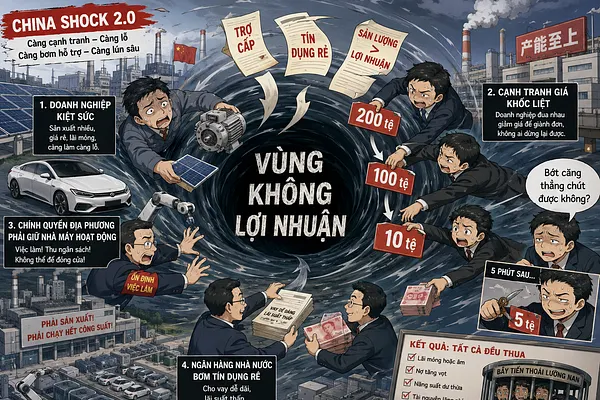
Last week's macroeconomic data in China shows that May CPI in the country is still in the severe deflation zone. The longer the stagnant inflation persists, the greater the chance the economy could fall into a lost decade like Japan.
Many efforts to revive consumption in China will not be very promising if real estate (RE) prices continue to plummet!
Real estate losses further encourage people to tighten their belts: stop spending to save for investment. The economy prolongs deflation — while financial companies in China sit on a “pile of cash” invested by the public. But due to declining domestic consumption demand, borrowing demand from many businesses is also decreasing in May!
Therefore, it can be said: all serious problems of China's economy still always come from the stagnation in the real estate market in recent years.
Therefore, this week's macroeconomic article from Viet Hustler will continue to update on the “pain” of the Chinese economy named “Real Estate” this!
Latest Data on China's RE Market: Will the 1000 Billion RE Bailout “Make a Difference”?
Low demand is not the only problem: excess supply exacerbates China's RE issues
Excess “housing supply” amid bottom-level home buying demand causes the RE market to sink deeper:
Bloomberg reports there are about ~60 million unsold houses - right in major cities in China:
The average time to sell a residential RE unit has increased to 26.8 months.
Beijing is the city with the most difficult house sales (houses vacant for nearly 49 months before selling)…
… while Wuhan has the largest area of unsold housing.
In previous years, high RE prices spurred housing construction activity, so now excess housing supply as buying demand declines:
China currently has 390 million m2 completed residential units that have not yet been sold.
This figure has become a financial burden for RE developers.
Excess housing supply amid extremely weak home buying demand has caused house prices in China to continue falling deeper:
China's house price index fell -0.6% m/m in April (the largest drop since 2014)
New home prices fell -3.5% y/y - existing home prices fell to -6.8% y/y in April.
Latest data (06/17): May new home prices continued to fall -4.3% y/y, existing home prices fell even deeper: -7.5% y/y.
Where is China's RE After the 1000 Billion CNY Bailout?
The Chinese government's 1000 billion CNY bailout package focused on the RE sector is addressing from 2 aspects:
1 - The Chinese government—through state-owned banks, has quickly supported RE developers on capital issues.
Therefore, in May, Vanke - a major real estate developer in China, managed to have enough capital to repay debt – avoiding default and asset liquidation:
But after this debt maturity wave, there will be others: the key is whether these real estate developers can sell houses to repay the subsequent debt waves?
In fact, 2 major commercial real estate developers: Longfor and Vanke are holding real estate assets (unmortgaged) with value greater than their short-term debt obligations.
That is, if they can't sell houses – they won't have money to repay the upcoming maturing debts => they may continue to default.
2 - The Chinese government is striving to boost home buying demand:
A series of supportive policies to boost demand include:
Reducing mortgage interest rates and down payment amounts,
Reducing the standards for assessing buyers' repayment ability….
… implemented from May after the bailout package was introduced (details here).
It will take a few more months to know if this policy will boost mortgage loan contracts for home purchases…
… but until the end of Q1/2024, personal mortgage debt growth in China is negative — people are not very interested in borrowing to buy houses.
Actually, the cautious sentiment in home buying demand among the people is completely understandable — when house prices continue to decline in recent months as mentioned above:
Recall: Since 2000,
~56% of home sales contracts in China were sold after 2015
~ 38% were sold after 2018 (when real estate prices began to explode).
When second-hand real estate prices drop below 2018 levels as now — it has caused nearly 40% of existing homeowners to suffer capital losses with their previous high mortgage loans.
Therefore, if people are still wary that house prices will drop further, they won't want to take on more debt to buy houses! (even if mortgage policies are improving).
Thus, the prolonged downturn in China's housing market (~3 years) as above – has made buyers' sentiment extremely pessimistic.
The aspects that China's supportive policies aim to address may not yet be thorough enough – or need much more time (and more money) to truly take effect!
Pessimism with the domestic economy: paving the way for an “offshore” investment wave
Real estate losses continue to drag down domestic consumer demand
Still the same old story: Loss-making real estate investments cause Chinese people to save and invest more instead of consuming.
Deflationary conditions in China raise concerns that weak demand could really drag this country into a lost decade like Japan:
CPI in May only increased +0.3% y/y (< estimate +0.4% y/y), just enough to escape deflation (negative inflation) but shows consumer stagnation.
PPI producer price inflation continues the deflationary streak since 2022.
China's April retail sales growth only reached +2.3% y/y – much lower than the estimated +3.8% y/y.
Motivation to “find ways” to invest abroad!
So, when people don't spend but save to invest domestically: can they achieve the desired returns?
Bloomberg reports: “Financial investment companies in China are currently sitting on piles of money from people's savings to invest in high-yield financial assets.”
However, previously, Viet Hustler reported 06/14: China's debt growth is at an unprecedented low — largely composed of government debt.
Simply because reduced demand for goods causes domestic businesses to have no need to borrow more capital to expand production.
Investment in corporate bonds increases – but borrowing demand decreases:
=> causing corporate bond yields (which are riskier) to drop nearly equal to government bond yields (safer assets).
Therefore, the returns from domestic investments for Chinese people are also gradually declining.
So what will they do? => Find ways to invest abroad!
Chinese people are transferring billions of CNY to Hong Kong to seek higher investment returns compared to the domestic market!
… despite the USD 50,000 outbound remittance limit from Mainland authorities.
CONCLUSION
As mentioned above, the latest data still shows that real estate prices in China continue to decline. The reasons are not only low demand but also abundant supply. And the greater the supply compared to demand, the lower house prices, — people become even less willing to invest in housing — which continues to pull demand lower. This creates a vicious cycle that has caused China's real estate market to sink deeper over the past 2 years.
And Viet Hustler has emphasized that China's bailout package, although massive, is a drop in the bucket compared to the “capital losses” of the entire population due to falling house prices. Efforts to support real estate developers may be hard to sustain if their short-term debt exceeds the value of the “dead” real estate projects in their hands.
Capital losses from real estate lead Chinese people to restrict spending and save for investment instead. However, borrowing in China in May grew quite weakly. Domestic bond investment returns are declining — leading Chinese people to “find ways” to invest abroad.
FYI: In another development, China and its BRICS group allies are striving to escape the problem Original Sin and elevate the status of the CNY:
China's debt primarily denominated in the domestic CNY currency has increased by +11.14 trillion CNY (~USD 1.57 trillion) in the first 5 months of this year:
China wants to escape the influence of borrowing in USD or EUR.
New Development Bank - the development bank of the BRICS bloc has announced it will issue bonds/debt in CNY for international investors!


Comments (2)
Các bạn cho thêm ý tưởng của NBD ra trái phiếu dựa trên đồng Yuan: 1 đồng tiền đó đang mất giá và kinh tế Trung Quốc không vững chắc 2. Tính chất minh bạch làm giảm đi niềm tin 3. Chính trong nội bộ của các nước tham gia cũng không tin tưởng Trung Quốc và không tin tưởng nhau 4 hiện tại thì phần trăm giữ tiền Trung Quốc không đáng là bao so với đồng tiền khác Như vậy phát hành trái phiếu liệu có phải là quá nguy hiểm hơn cơ hội tích lũy không?
Cái ngân hàng đó phát hành trái phiếu CNY phần nhiều chỉ là để promote "local currency" của khối BRICS thôi ạ. Mục đích chính trị nhiều hơn mục đích tài chính. Họ kêu năm nay or năm sau mới phát hành thì em cũng chưa rõ là trái phiếu đó bán được giá không. Hoặc có lẽ chỉ nhà đầu tư trong khối đó mới mua ạ 😅
Login to comment