MARKET KNOWLEDGE

Amazon: Strategic Direction for the Next 8 Years?

What is Amazon's Valuation in 2032? Comprehensive Analysis of Investment Opportunities After the Disappointing Q2 Financial Report

Continuing from last week's article "GOOGLE - Overvalued or Undervalued?", this week, Viet Hustler presents to readers the analysis of Amazon - the world's e-commerce giant - after the recent Q2 financial report:

  • Introduction to Amazon

  • Business Model

  • Competitive Advantages

  • Financial analysis

  • Amazon's valuation in 2032

Đây là bài viết FREE. Nếu bạn yêu thích bài viết này của Viet Hustler, đừng bỏ lỡ các bài viết hàng ngày và subscribe Viet Hustler.

Introduction to Amazon

Founded in 1994 in Seattle by Jeff Bezos, Amazon initially operated as an online bookstore. Later, Amazon expanded its business to other products such as: electronics, fashion, food, furniture, video games, toys, jewelry,...

After 30 years, Amazon dominates 2 fast-growing markets: cloud and e-commerce, and is the third-largest provider in the digital advertising market.

Is This a Real Picture of Jeff Bezos in Amazon's Office in 1999? |  Snopes.com

History of Amazon's Formation and Development:

  • 1994: Jeff Bezos quit his job at the hedge fund D. E. Shaw & Co. to open an online bookstore.

  • 1997: IPO with a value of $438 million, and at the end of that year launched the 1-Click purchase button

  • 1998: Acquired IMDb for ~$55 million USD and began adding more new product categories beyond books.

  • 2000: Launched Amazon Marketplace - allowing others to sell products on its site, from used books, DVDs to other products.

  • 2005: Amazon Prime launched, offering customers free 2-day shipping option in the US for $79 USD/year.

  • 2006: Launched Amazon Web Services (AWS) - allowing companies to run their own Internet business operations from the cloud.

  • 2007: Released the Amazon Kindle e-reader product.

  • 2014: Acquired the game live streaming platform Twitch for 970 million USD.

    • In November of the same year, the smart speaker Echo launched, allowing users to talk to the digital assistant Alexa.

  • 2017: Acquired Whole Foods for 13.7 billion USD, integrated into local grocery delivery service

  • 2018: Acquired the home security company Ring for more than 1 billion USD.

Amazon's Leadership Team

  1. Jeff Bezos - Founder, former CEO

In the early days of founding Amazon, Bezos faced many financial difficulties

  • He had to borrow $245,573 from his parents in 1995 to build Amazon

    • If his parents had kept their shares, those shares are estimated to be worth 30 billion USD today

  • Bezos once invited 58 investors to invest $50,000 for 1% of Amazon but only 20 agreed. The remaining 38 missed out on an investment worth 15 billion USD today

Image

To bring Amazon to its current peak, Jeff Bezos has a very unique leadership style:

  • Putting customers first

  • Maintaining the "Day 1" mentality - never stop experimenting, learning, and even failing

  • Don't care about the stock market: Caring about the company's daily stock price fluctuations is a losing game and a waste of time

Bezos created Amazon's meeting culture by banning PowerPoint and requiring everyone to write a 6-page memo before meetings.

  • Amazon even has a custom-designed process and specific writing guidelines to implement this.

Image

Besides Amazon, Bezos also has ambitions in the space race with Blue Origin

  1. Andy Jassy - Current CEO

Andy Jassy became Amazon CEO in 2021, after being with the company from the early days. Andy Jassy's 24-year journey with Amazon:

  • Jassy joined Amazon in 1997 as Marketing Manager

  • In 2003, he and Jeff Bezos came up with the idea to create Amazon Web Services. Jassy led AWS and the team of 57 people, playing a key role in the development and success of this platform. 

  • Under his leadership, AWS experienced tremendous growth, reaching a value of 40 billion USD

    • He was promoted from senior vice president to CEO of AWS in 2016.

  • When Jassy took over as CEO of Amazon, Amazon increasingly solidified its position as the “King of eCommerce”

Under Bezos' management, Amazon had thin profit margins, making the stock look unattractive with P/E reaching up to 350 at times. This changed since Jeff Bezos handed over operations to Andy Jassy. Amazon now has clearer operations and better financial discipline.

  • In the letter to shareholders in Q1 2024, Andy Jassy committed to finding ways to control costs, even as the company ramps up investment in AI

    Image
  • Amazon's Q1/2024 operating profit margin reached the highest level in history

→ With a CEO from an AWS background, along with the advantage of high profit margins, AWS can be seen as Amazon's spearhead for development in the coming period with a focus on operations

Amazon's business model

Amazon sells products, services, and infrastructure. The company's revenue sources can be divided into 7 groups:

  • Online stores: Amazon.com

  • Physical stores: Whole Foods Market plays the main role

  • E-commerce platform services: commissions, shipping fees, storage, etc.

  • Subscription services: Amazon Prime membership, Audible

  • Amazon Web Services: databases, storage, and other B2B services

  • Other sources, accounting for only ~1% of revenue

Because Amazon is a complex ecosystem with many interconnected business segments, it is very difficult to aggregate revenues by categories such as: advertising or subscription from streaming platforms. For example:

  • Amazon has advertising revenue from both marketplace (Amazon.com) and Audible

  • Subscription revenue also comes from multiple business units such as marketplace, Whole Foods, Prime Video, etc.

  • Only cloud revenue is not linked to the other segments and can be easily distinguished.

→ This is why Amazon consolidates all revenue into three categories:

  • North America: Includes all revenue generated in North America from marketplace, advertising, subscription, and all other services.

  • International: All revenue from marketplace, advertising, subscription, and services generated outside North America.

  • AWS: Revenue from cloud generated worldwide.

Before continuing, you can read more about the incredibly complex supply chain behind Amazon's trillion-dollar online retail system in Viet Hustler's article from 2 years ago:

Amazon's main sales drivers can be divided into 3 segments: cloud services, e-commerce, and advertising. In this article, Viet Hustler will focus on these 3 segments.

1. Cloud computing (AWS)

Amazon Web Services (AWS) provides technology services to institutional and enterprise customers.

  • Products include: computing, storage, databases, analytics, networking, mobile, developer tools, IoT, security, and enterprise management applications.

  • Target: developers, startups, government agencies, and academic organizations worldwide

15+ AWS Projects Ideas for Beginners to Practice in 2024

$AMZN is the world's number 1 company in cloud infrastructure with 32% market share in Q2/2024.

  • This figure far surpasses 23% of Microsoft Azure and 12% of Google Cloud.

In the cloud service provision segment, AWS also maintains a stable market share over time in the range of 31-34%.

CIS Q224

Although cloud computing is not the main revenue contributor for Amazon, it is the company's primary profit source

  • Q2/2024: AWS generated revenue of 26.3 billion USD with operating income up to 9.3 billion USD

  • AWS has an amazing operating profit margin of 37%

AWS is also the leading group in developing artificial intelligence at Amazon across 3 AI technology layers: 1) Infrastructure, 2) Models, and 3) Applications.

1) Infrastructure layer (Trainium and Inferentia)

CEO Jassy said:

“We have a deep partnership with NVIDIA and have many existing NVIDIA instance options, but we have listened to customers and understand that they want a better performance-price ratio”

Amazon has developed custom machine learning chips such as:

  • Trainium for training.

  • Inferentia for inference.

Graviton is provided for general-purpose CPU chips at competitive prices. Future improved versions of these chips could bring significant upgrades in price-performance.

2) Model layer (Bedrock)

Amazon provides “LLM as a Service”:

  • AWS customers can access large language models and customize them with their data. AWS handles security and privacy.

LLMs require large investments. That's why many companies building next-generation AI applications will use Amazon Bedrock to leverage existing LLMs.

Jassy explains:

“Bedrock has the most model choices, the best generative AI quality in key areas like model evaluation, RAG, and agents, and then makes it easy to switch between different model types and sizes.”

Bedrock models include Anthropic's Claude 3.5, Meta's new Llama 3.1, and Mistral's new Large 2.

3) Application layer (Amazon Q)

The top layer includes consumer applications like ChatGPT or Gemini.

Amazon has released a workplace-focused AI assistant, Amazon Q. Jassy seems very optimistic about this launch, calling it a “breakthrough”:

“Q has the highest scores and acceptance rates to date for code suggestions, but it does more than just provide code suggestions. It reviews code, outperforms all competitors in caching security vulnerabilities, and leads all software development assistants in connecting multiple steps together and applying automated actions.”

  • As the current market leader, Amazon has a potential advantage in commercializing these tools

Decoding Amazon's Generative AI Strategy - The New Stack

Đây là bài viết FREE. Nếu bạn yêu thích bài viết này của Viet Hustler, đừng bỏ lỡ các bài viết hàng ngày và subscribe Viet Hustler.

2. E-commerce

Amazon is the leading company in the e-commerce industry in the United States.

  • Amazon holds 40% of the US e-commerce market share and is expected to reach 41% by the end of 2025.

  • It is also the world's second-largest e-commerce company with 12% market share, just behind $BABA with 13%.

Image

AWS may be Amazon's darling, but Amazon.com is still the company's first product.

Last year's Buy with Prime feature was rolled out to all US sellers. Thus, Prime members will enjoy the program's benefits at online stores beyond Amazon.com

  • This feature has increased buyer conversion rates by up to +25%

  • With nearly 200 million Prime members worldwide, this upgrade could help Amazon grow even stronger, threatening Shopify

3. Digital advertising

$AMZN is a latecomer in the digital advertising field, but is currently growing rapidly.

  • Global market share has increased from 3.8% in 2019 to 7.1% in 2023.

  • $GOOGL has operating margins of 25-30% in its advertising operations, and Amazon will be the same

Image

Amazon's advertising revenue reached 12.8 billion USD in Q2/2024, corresponding to:

  • 26% Google Search advertising revenue (+1pp Y/Y).

  • 33% Meta's advertising revenue (-1pp Y/Y).

  • 147% YouTube advertising (+8pp Y/Y).

Prime Video ads start in Q1/2024. All Prime members will see these ads by default unless they pay an extra 2.99 USD/month.

→ Amazon has turned all Prime members into potential Prime Video users

This is important because:

  • Prime is expected to have 180 million members in the United States in 2024.

  • Amazon has created a massive ad-supported streaming platform overnight.

    • Netflix had 84 million paid members in North America at the end of June and only a small portion of them opt for the ad-supported plan

Although not all Prime members watch Prime Video, when it comes to reach and distribution, Amazon is taking control of potential deals with publishers. Look at the NBA:

Summary of the NBA deal :

  • Value: Media rights package worth 76 billion USD (Disney + NBC + Prime Video).

  • Duration: 11 years starting from the 2025-2026 season.

  • Distribution : United States, Mexico, Brazil, France, Italy, Spain, Germany, United Kingdom and Ireland.

  • Exclusive games on Amazon: 66+ regular season games, some playoff games.

This strategic move expands the NBA's reach to Amazon's massive subscriber base. Amazon has tens of millions of Prime members outside the US, giving the company a key advantage over Warner Bros. Discovery.

  • Prime Video accounts for 3.1% of TV broadcasting time in the United States in June and more than 1/3 market share over Netflix (> Disney+ and Paramount+ combined).

  • If Amazon continues to invest in live sports and expand its content portfolio, Prime members may spend more time on this service

Image

Đây là bài viết FREE. Nếu bạn yêu thích bài viết này của Viet Hustler, đừng bỏ lỡ các bài viết hàng ngày và subscribe Viet Hustler.

Amazon's competitive advantages

Amazon's business is protected by network effects, economies of scale, low-price advantages and ecosystem effects.

1. Network Effect (Network Effect)

Amazon is currently a massive marketplace with over 300 million monthly customers and over 2 million active sellers.

  • This creates a special type of network effect: Market effect.

More users attract more sellers and this creates downward price pressure. When prices drop, more sellers come to the platform and the cycle repeats.

  • Technology is not Amazon's unique selling point, the advantage here is 300 million monthly active customers.

  • Amazon has reinvested every dollar earned back into the business for over 20 years to achieve this number.

2. Economies of Scale (Economies of Scale)

There are 3 types of sellers on Amazon:

  • First-party sellers (direct supplier): sell products directly to Amazon. Then, Amazon retails and ships the products.

  • Second-party sellers (Amazon FBA): self-fulfill inventory and use Amazon's shipping services. Users see the label “Fulfilled by Amazon Sold by X” under those items.

  • Third-party sellers (FBM/Private Label): sell private label items and also use Amazon's fulfillment or shipping services.

Amazon is the direct buyer in the first group and then sells to customers on the marketplace. Amazon places large orders from those suppliers.

→ Because it has the largest customer base, Amazon always operates at the most efficient scale possible, maximizing its profit margins.

3. Lowest-cost supplier (Low-cost supplier)

Amazon itself sells some products and also has 2 million sellers, creating fierce price competition where consumers get the lowest possible prices.

Normally, price competition only causes more businesses to fail, but Amazon doesn't lose because they are the platform.

  • Either they sell the product, take commissions from sellers, or hold inventory to sell later.

→ Amazon has created a playing field where they can't lose.

Walmart vs. eBay vs. Amazon Price Comparison

4. Amazon's ecosystem

Amazon links all their products together to create a closed ecosystem that encourages users to use related products.

  • Prime member: same-day delivery, Prime Video viewing, additional savings and cashback at Whole Foods, etc.

→ By connecting its businesses, Amazon makes it hard for customers to leave, just like Apple.

The combination of all these competitive advantages will help Amazon dominate its core areas of operation for decades to come.

Financial analysis

1. Business results: Growth lies in AWS

  • Amazon's quarterly revenue has grown steadily over the past 4 years

  • Compared to the first half of 2020, first half 2024 revenue has nearly doubled, from $164 billion to $291 billion

However, revenue growth is slowing as the market becomes saturated. Q2/2024 financial report:

  • Earnings $1.26 higher than forecast $1.04

  • Net revenue: $147.98 billion (+10% Y/Y, but < estimate $148.78 billion)

    • Online stores: $55.39 billion (+4.6% Y/Y, < estimate $55.55 billion)

    • Physical stores: $5.21 billion (+3.6% Y/Y, < estimate $5.26 billion)

    • Third-party seller services: $36.2 billion (+12% Y/Y, < estimate $36.65 billion)

  • Revenue by geography:

    • North America: $90.03 billion (+9.1% Y/Y, > estimate $89.98 billion)

    • International: $31.66 billion (+6.6% Y/Y, > estimate $32.87 billion)

    • AWS: $26.28 billion (+19% Y/Y, > estimate $25.98 billion)

Image
  • Operating margin 9.9% from previous quarter's peak of 10.7%, slight decline but still the second highest in Amazon's history

  • Cut Q3 revenue guidance to $154-158.5 billion, lower than previous expectation of $158.43 billion

    • Meaning Q3 growth will be the lowest since Q4 2022

  • However, due to better-than-expected results from AWS…

  • … Q2/2024 net income still reached the highest level since late 2021

2. Financial position: Cash flow focused on AI investment

Amazon's balance sheet is extremely solid.

The company once operated with negative equity due to continuous growth focus, but this changed after Andy Jassy took over.

  • Cash: $87 billion

  • Debt: $58 billion

  • Amazon built up significant equity after the Fed began raising interest rates.

  • The company has $236.4 billion equity vs $157.8 billion debt, Debt/Equity ratio of 0.67.

  • Amazon could pay off total debt in less than 3 years as pre-tax profit in the first half of this year is $54 billion

→ Overall, Amazon's financial situation is very strong with no serious risks in the future.

  • Amazon's Operating Cashflow reached $108 billion in just the last 4 quarters, up 75% from the same period last year

  • 12-month Free Cashflow reached $53 billion vs only $8 billion last year.

  • Amazon is reinvesting 50% of operating cash flow back into the company, mostly for AI in phase 1: sites and construction

Image
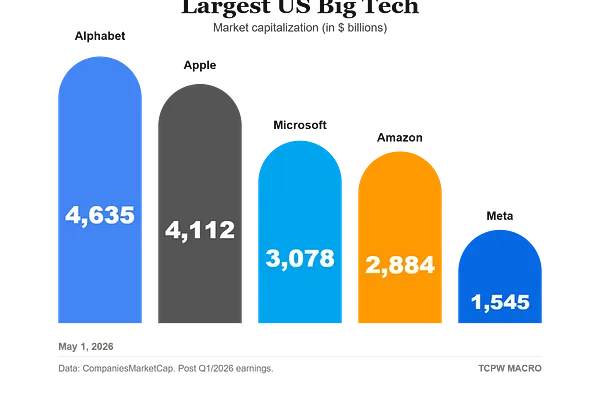
  • Leading the group of 4 big tech companies in investment

Image

3. Operational efficiency: Still room for improvement

Gross Margin

Amazon's product gross margin has consistently stayed above 40% over time and is stabilizing at ~50%

  • Amazon has expanded gross margin from 41% in 2019 to 50.14% in Q2/2024.

This means the company feels no pricing competitive pressure in its core business operations due to optimal utilization of competitive advantages.

Profit Margin

After Andy Jassy took over and the company shifted its strategic focus on operations and finances in 2022, the company's margin has increased steadily.

  • Consolidated margin Q2/2024 at 9.9% from the peak of 10.7% last quarter, slightly down but still the second highest margin in Amazon's history

However, costs in the just-passed Q2 were still higher than expected:

  • Fulfillment expenses $23.57 billion up 11% year-over-year, higher than the expected $22.96 billion

  • Seller costs accounted for 61% up from 60% last year, higher than the expected 60.7%

  • Most of the margin comes from AWS while Amazon's international segment has generally not seen much success

→ In the future, with the help of AI and process improvements, Amazon's long-term operating margin could reach 20% with AWS at 40% and e-commerce at 10%

  • Return on Equity (ROE)

Amazon's average ROE over the past 5 years is 21.9%. This figure is certainly satisfactory as the average for US companies is only 12%.

Amazon's ROE is very volatile over the years but this is acceptable for companies that change the entire market, as Amazon bets on new investments and will reap profits in 10-20 years.

Amazon's valuation in 2032

E-commerce growth but with improved margins

a. North American market

Market forecast that retail e-commerce will grow 9% annually from 2027 - 2032, Amazon currently holds 40% e-commerce market share in the US → US e-commerce revenue reaches 1 trillion USD

Image
  • Amazon also holds 41% retail e-commerce market share in Canada. This market is expected to reach 120 billion USD in 2032

    → Amazon could achieve 50 billion USD in revenue in Canada.

  • Total e-commerce revenue is 1.05 trillion USD from North America.

Amazon's North American margin improves from 6% to 7% yielding 73.5 billion USD in profit

b. International market

  • This is a difficult market to estimate as in the last 6 quarters, international market revenue growth averaged +11% Y/Y. Conservatively reduced to 9% over the next 10 years

→ Amazon's international segment revenue will reach 265 billion USD in 2032

Amazon's international margin improves over time with competitive factors and reaches a very small figure of 4% yielding 10.6 billion in profit

→ Total income from e-commerce is 84.1 billion USD in 2032

AWS maintains 27% cloud market share

  • The cloud market will reach 2.3 trillion USD in 2032 with AWS currently holding 32% market share. Conservatively assuming Amazon loses 5% market share and will only control 27% of the market in 2032.

    Image
  • AWS revenue is 621 billion USD in 2032.

  • Operating margin rose to 37% last quarter and stabilized near 36% in Q2, this is the segment whose margin will improve over time and reach 40% in the long term

→ Amazon could capture 248.4 billion USD in profit from cloud computing.

Digital advertising continues to capture market share

  • Amazon has expanded its digital advertising market share from 3.8% in 2019 to 7.1% in 2023.

  • The global digital advertising market will grow to 1.3 trillion USD in 2032. Conservatively assuming Amazon's market share increases to 10%.

Image

→ Amazon could generate 130 billion USD in revenue from advertising.

  • With a margin of about 30%, Amazon could achieve 39 billion USD from advertising in 2032

In total, we can believe that Amazon will generate 371.5 billion USD in profit (84.1 billion e-commerce + 248.4 billion AWS + 39 billion advertising) in 2032.

Currently Amazon has a P/E of 40 (META 24, GOOGLE 24, APPLE 33).

→ With a low P/E of 15 for a tech company, Amazon could reach a valuation of 5.57 trillion USD in 2032, 3 times the current value of 1.75 trillion USD.

Đây là bài viết FREE. Nếu bạn yêu thích bài viết này của Viet Hustler, đừng bỏ lỡ các bài viết hàng ngày và subscribe Viet Hustler.

Conclusion

Amazon is the most undervalued company in the FAANG group. With extremely conservative estimates including Amazon holding market share and improving e-commerce margins, losing market share in cloud and slightly increasing market share in advertising, Amazon's value could easily reach 3 times the current level in the next 7 years. The 2021 CEO change is a good signal for the company's business model, especially in demonstrating focus on AWS and operational optimization.

Q2 revenue report lower than forecast but a 0.5% deviation for a large company like Amazon is quite normal. Although profit growth is slowing with the shift from strong development to saturation in the e-commerce market, Amazon still has AWS and advertising segments to continue growing further than industry peers.

Amazon CEO Jeff Bezos, wife MacKenzie to divorce | The Blade

Login to read the full article

Create an account to access premium content.

0

Comments (1)

QL
Quan Luu8/6/2024

Hi a Steve và team, thanks team vì bài phân tích. Hóng bài phân tích của team về NVDA