ENTREPRENEUR PERSPECTIVE

"Middle East Powder Keg": origins of conflict and global impact

Will the recent escalation of geopolitical tensions push the Middle East to the risk of all-out conflict?

Nearly 12 years after the first "Arab Spring" uprising (2010-2012) and 6 years after the second Arab Spring clash in 2018, when the economy and people's lives in the Middle East region have only just begun to recover, the area has once again turned into a powder keg amid the new political conflict between the trio Iran - Israel - Palestine.

Since last year, when Hamas naval forces and Houthis disrupted the Red Sea, forcing international shipping routes to be rerouted and the US, UK, France... naval alliance to step in for protection.

Viet Hustler is a reader-supported publication. To receive new posts and support my work, consider becoming a free or paid subscriber.
And last week, the Iran - Israel war began to rumble alongside the unresolved Israel-Hamas war. The Middle East region is once again being pushed to the brink of all-out conflict…

These geopolitical conflicts in the region have raised concerns about maritime security, energy supply and supply chains, as well as global economic growth. In addition, there are humanitarian issues concerning the lives of people in the war.

So, where do the causes of these conflicts come from?

Why has the Middle East been in conflict for decades?

And do Western countries have any role in this chaotic mess?

This week, Viet Hustler will recount the story of the "One Thousand and One Nights" land with a more realistic view of war, politics, and religion.

Middle East - Region Always Latent with Geopolitical Instability

Strategically located, the Middle East is a bridge between Asia and Africa, from here it can trade with Europe via the Mediterranean to reach South Asia.

North Africa and the Middle East Geography Maps - MS. JONES' SOCIAL STUDIES CLASS

North Africa and the Middle East Geography Maps - MS. JONES' SOCIAL STUDIES  CLASS

The problems of the Middle East are always closely tied to religious conflicts. To understand this centuries-deep religious conflict, we need to know the history of the 3 main religions here:

Judaism (Judaism), Christianity (Christianity) and Shia sect (accounting for 15%) Religions of the middle east

Religions of the middle east

3000 years ago, the Jews settled in Saudi Arabia, establishing their capital Jerusalem under the reign of King David.

  • The Jews were continuously attacked by other empires for 2000 years, from the Babylonian Empire, the Roman Empire, and finally the Ottoman.

  • In the 20th century, the Jews faced genocide from Nazi Germany.

  • 2 - Christianity: Born 2000 years ago

1000 years after the Jews were ruled by the Roman Empire, a Jew appeared - Jesus.

  • He was expected to liberate the nation from the Roman Empire:

  • The Old Testament of the Jews clearly states

    • "The future King of Israel will enter Jerusalem on the back of a donkey" so when Jesus entered the city of Jerusalem on a donkey, he was immediately trusted by the Jews.However, just 1 week later, he was crucified after the Roman Empire found out.

  • A group of Jews believed Lord Jesus had died, but others did not. They believed the Lord would resurrect and lead them out of suffering.

Christianity was born with Christmas (Lord's birth), and Easter (Lord's resurrection).

3 - Islam: Born latest but became the largest religion in the Middle East

1400 years ago, Islam emerged last in Saudi Arabia under the leadership of founder Muhammad.

  • However, Muhammad only claimed to be the "Prophet" conveying the words of God. Muhammad said that:

  • The Koran is the original scripture bestowed by God, the "most pristine", "most complete" scripture.

    • While the Old Testament of the Jews and the New Testament of Christians have been distorted.

Muslims began to regard followers of the other 2 religions as heretics.

  • While the other 2 religions consider Islam "extremist".

  • Not stopping there, conflicts exist within Islam itself! Since Mohammed's death in 632, Islam has split into 2 opposing sects:

Sunni sect (accounting for 85%) and Shia sect (accounting for 15%)

  • due to disagreements over the religious succession and legacy of Mohammed.

  • The conflict between the two countries Saudi Arabia and Iran also originated from here, as the majority of Sunni people live in Saudi Arabia, while Shia people are concentrated in Iran.

Graphic showing number of muslims in the world.

History of the conflict between Israel and Palestine

  • After the Ottoman Empire was defeated in World War I, Britain controlled Palestine.

  • The United Kingdom promised to support the establishment of a Jewish state on Palestinian land following the Balfour Declaration.

    • As a result, more and more Jews migrated to Palestine to escape persecution and the Nazi genocide during World War II.

  • But by 1947, Palestine was divided in two: one Arab state, one Jewish state.

  • The city of Jerusalem became an international zone.

The Jews approved of the division, but the Arabs were very dissatisfied because they believed the Jews got more land.

  • In 1948, Britain withdrew its troops from Palestine. The Israel-Palestine conflict has continued ever since.

Image

Conflicts between ethnic groups

The Middle East has four main ethnic groups: Arabs, Persians, Turks, and Kurds.

Of which:

  • Arabs (Iraq, Saudi Arabia, Syria, Jordan, Yemen, Oman, Egypt, Qatar, and Bahrain), Persians (Iran), and Turks (Turkey) all have their own countries.

  • Only the Kurds (population ~30 million people) do not have their own country and are distributed across many countries such as Turkey, Iran, Iraq, and Syria.

    With a not insignificant population, but no rights or political voice, the Kurds continuously conflict in various countries.

Religion and business in the middle east

Thirst for 'black gold' causes disputes to escalate

  • An already complex issue became even more complex when the world's first oil field was discovered in Iraq (Kirkuk) in 1927.

Map of oil fields and pipelines in the Middle East : r/MapPorn
  • Subsequently, the next giant oil fields were discovered (Burgan oil field in Kuwait - 1938, Dhahran oil field in Saudi Arabia - 1938, Karatchok oil field in Syria - 1956,…)

    A series of initial regional conflicts there also began!

The First Oil Discoveries in the Middle East (Report) | IranOilGas Network

Energy conflicts in Iraq: Shia and Sunni ethnic groups

  • In Iraq, oil fields were discovered in the areas inhabited by Kurds - Sunni Muslims, and Saudi Arabians - Shia Muslims

    • From then on conflicts between the two Sunni and Shia sects over ownership of these oil fields were also heightened

  • Conversely, Iraq has hardly discovered any oil fields in Baghdad province, where most Saudi Arabians - Sunni Muslims live Sunni.

Recall: the Sunni sect accounts for up to 85% of Muslims, while the Shia sect only accounts for 15%.

  • The two Sunni and Shia sects have conflicts within Islam itself.

Conflicts in Iran: Saudi Arabians and Persians 90% of Iran's total oil reserves were discovered in Khuzestan province, where Saudi Arabians - Shia Muslims live.

  • While the rest of Iran is Shia Persians.

    • Conflict between Irad and Kuwait

Conflict between Irad and Kuwait

  • Kuwait has a small area but its oil reserves are almost equal to Iraq's.

    • Kuwait was once a province of Iraq under the Ottoman Empire.

Iraq could impose policies to pressure Kuwait to gain benefits from oil resources.

One Map That Explains the Dangerous Saudi-Iranian Conflict

In summary:

Oil fields discovered scattered throughout the Middle East lie interspersed among countries differing in ethnicity, religion, and politics, so it is understandable that conflicts between Middle Eastern countries escalate.

Middle Eastern oil is also in the sights of major countries around the world

  • Crude oil consumption in Middle Eastern countries is quite low compared to other continents → Most Middle Eastern crude oil will be exported to Europe, the US, Japan, China.

Oil consumption, 2022
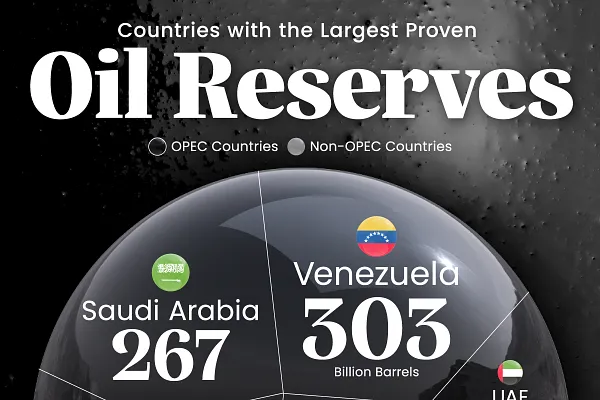
  • The Middle East possesses half of the world's oil reserves, enough to supply the whole world for another 50 years.

    • 1/3 of the oil currently being produced is here.

    Major powers like the UK, France, Russia, the US,… always monitor and want to profit from this region.

Share_of_Global_Oil_Reserves_Black02

The US jumps into the Middle East chessboard - The birth of the Petrodollar

Since after World War I, the US realized a long-term vision:

Whoever controls the oil supply controls the global economy.

Therefore, the US planned to establish the Petrodollar system to turn the USD into an international common currency.

Simply put, all oil transactions in the world must be bought with USD.

The US targets an agreement with Saudi Arabia - the country with the world's largest oil reserves and production:

  • The US provides military protection for oil fields in Saudi Arabia, supplies weapons, and protects the Saudi royal throne from Israeli invasion (at that time, Israel was considered an aggressive country in the Middle East war).

In return, Saudi Arabia must comply:

  • Only accept oil transaction payments in USD.

  • Allow investment of surplus money from oil sales into US debt securities.

The enormous benefits of the Petrodollar

  1. Increases global demand for USD.

    • Countries are “encouraged” to export goods to the US at cheap prices to receive USD. → US consumers benefit greatly.

    • The US naturally obtains a “license” to print money.

  2. Increases global demand for US debt securities - petrodollar recycling

    • Oil-exporting countries need USD reserves. These funds can be directed to domestic consumption and investment, lent to other countries, or invested in the US through bond purchases, also known as petrodollar recycling.

      → TUS financial markets increase liquidity, oil-exporting countries reduce dependence on oil revenues.

Thus, the Petrodollar is a tool to control the world. The US is ready to use the military to “deal with” anyone who touches this system.


Recent escalation of Middle East tensions

Iran-Israel conflict escalates Middle East tensions

  • Previously, Israel has repeatedly accused Iran of providing weapons to Hezbollah (backed by Iran in Syria) and militia groups in Iraq, Syria, Lebanon.

  • On 04/01, Israel airstriked the Iranian Embassy compound in Damascus (Syria), killing 7 Iranian officers, including 1 senior general.

    • Iran accuses the US of responsibility, but the US asserts no involvement.

  • In response, Iran attacked Israel with hundreds of missiles and UAV drones. However, damage recorded in Israel was very minimal.

Iran seems not to want the conflict to escalate, both striking a deterrent move against Tel Aviv, while not being seen as a “weak” country in the eyes of the other countries it leads.

  • On 04/19 yesterday, Israel attacked near Iran's nuclear facility in Isfahan city.

    • No significant damage.

    • Message from The Jerusalem Post on X: “Israel accurately targeted the area around Iran's nuclear facilities - we could do worse, right here if we wanted.”

    • US denies involvement in the attack.

It seems Israel wants to demonstrate that it can strike anywhere in Iran without US assistance.

isfahan_theguardian_19.jpg
  • So far, the Israel-Iran conflict continues, however, we can see that Iran does not want to be drawn into a regional confrontation, and Israel has responded more restrainedly compared to the embassy raid.

    → The retaliatory strikes between the two countries are taking on a de-escalatory nature.


Potential economic losses the world may bear

Threat from Hormuz Strait blockade pushes oil prices higher

  • The Hormuz Strait is one of the world's most important maritime routes with around ~37% of seaborne traded oil barrels passing through daily.

Image
  • "Any attack on Iran's oil production facilities could push Brent crude to 100 USD/barrel. A Hormuz Strait blockade could also push prices to ~120-130 USD/barrel", according to Lipow Oil Association Chairman (US).

  • According to IMF, Middle East tensions have pushed oil prices up 15% + increased shipping costs → Global inflation risk increases ~0.7bps.

    • OPEC group and other major oil producers cutting output also heightens oil price risks.

Middle East escalation could cause new shock to global markets- Image 2.

Market reaction to the conflict

  • Global stocks post sharpest drop since October 2023.

    • MSCI ACWI index down more than 2% this week.

Image
  • Energy sector stocks rise nearly 12% YTD, far outpacing S&P 500's 5% gain. → Challenges in bringing inflation back to 2% target.

Middle East escalation could cause new shock to global markets- Image 4.
  • Demand for safe-haven assets like bonds and gold surges.

    • Yields drop 10bps.

    • Gold up 1.5%.

Image
  • Impact on other global currencies:

    • Middle East tensions could hurt currencies of New Zealand, Australia, Sweden, and Norway as investors flee risk assets.

      • Swiss Franc could strengthen alongside USD.

Middle East escalation could cause new shock to global markets- Image 6.

CONCLUSION

From a continent with a strategic geographic position between Asia and Europe, the Middle East holds trading advantages from a series of the world's most important maritime routes at sea. Interestingly, all three major religions of the Middle East originate from the same Abrahamic religion. However, throughout history, the region has always experienced prolonged instability and wars stemming from religious conflicts.

Additionally, possessing the world's largest oil reserves has become a double-edged sword. Besides reaping economic benefits from oil extraction and export, the Middle East has become a juicy target that any country wants to possess. Oil has invisibly become a catalyst for incessant wars in the Middle East, backed by Western countries. Therefore, the Middle East always harbors risks of instability and escalating conflicts.

The most recent Iran-Israel war continues to worry the world. Although at the latest point, both countries show signs of not wanting direct war, it is still too early to conclude that Iran-Israel tensions have been completely defused.

In summary, to date, there are no signs indicating that the Middle East can soon find peace.

Viet Hustler is a reader-supported publication. To receive new posts and support my work, consider becoming a free or paid subscriber.
Login to read the full article

Create an account to access premium content.

0

Comments (1)

MX
Mù Xa Lý4/24/2024

Mình đọc lại bài viết này lần thứ ba và càng đọc càng thấy cuộc chiến tranh này không thể dễ dàng đi tới hồi kết là hoà bình. Nhưng sức ảnh hưởng sẽ không nhiều nếu không có những nước khác tham gia vào chiến sự. Điều đó cũng thật khó, mà các nước khác đứng ngoài mà không take side. Các cường quốc về vũ khí thì chỉ mong chiến tranh để buôn bán hàng của mình. Mối nguy cơ hạt nhân cũng là một áp lực lớn. Tình hình chung không vui vẻ gì và kéo theo nền kinh tế vĩ mô ảm đạm. Mọi người tìm nơi trú ẩn an toàn thì làm sao dòng tiền luân chuyển tốt. Nhân dịp cũng cảm ơn các bạn có một cái nhìn tổng thể của vấn đề và rất thích nhé

❤ 1