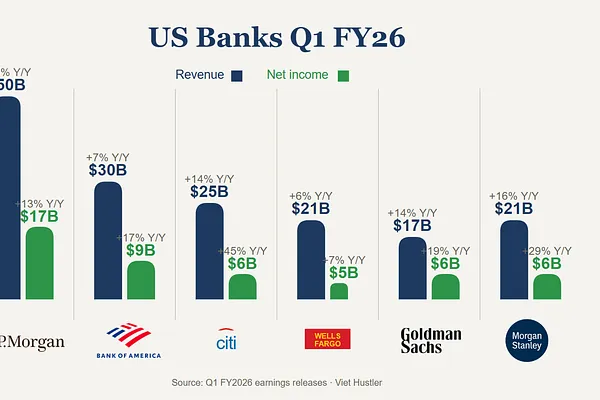
In the previous part, we learned the basic knowledge about the money market, money supply and demand and their relationship with interest rates. Broader still, that is the financial market, where financial intermediaries play an important role in connecting savers and borrowers.
In this part, we will delve deeper into one of the most important financial intermediaries - bank. In particular, one of the two dual mandates of the Central Bank is to stabilize the market, which includes: regulating the money supply in the economy and supervising the banking system.
What is Liquidity Trap?
Definition
Liquidity Trap was first introduced by the founder of the Keynesian school of economics - John Maynard Keynes in the 1930s from the Great Depression in the US.
After that, liquidity trap was further studied by the Keynesian school of economics - led by Krugman when he argued that major countries like US, EU or Japan were all caught in the liquidity trap in the 2000s.
So what is the liquidity trap?
Liquidity trap is a situation interest rates fall to an extremely low level, making people prefer to hold cash or checks rather than spend or invest in bonds or income-generating assets.
The liquidity trap is the difficult position for Central Banks when monetary interest rate policy tools are ineffective in a recessionary or stagnant economy due to deflation:
Expansionary monetary policy is ineffective:
Normally, expansionary monetary policy involves lowering interest rates to stimulate businesses to borrow for investment, while also stimulating consumer spending (since saving and investing do not yield much profit).
Therefore, expansionary monetary policy leads to economic growth.
But if interest rates fall too low - close to 0 → The money demand curve becomes almost horizontal, people hold more money instead of investing.
In many cases, people just hold money without spending: due to collapsed demand (aggregate demand decreases), or due to war...
Nominal interest rates cannot fall below 0: because people will choose to hold cash instead of investing at negative nominal interest rates.
Therefore, once the economy is in liquidity trap, it must face many problems at once: aggregate spending demand decreases, production stalls and employment can be “stuck” at a low level.
Examples of liquidity trap
The Great Depression (The Great Depression) of the 1930s:
Black Thursday (1929/10/24) on Wall Street: stock prices fell -14 billion USD in 24h, fell > 30 billion USD in the week (10 times the federal budget at that time and the total amount the US spent on World War I).
This event sparked the Great Depression: US GDP from 1929-1932 fell -28%.
To stimulate the economy, the Fed kept interest rates below 1% throughout the second half of the 1930s.
This interest rate reduction was due to the Fed's efforts to save the economy amid severe deflation (column 6 - inflation).
However, the Fed's efforts were not very effective as people preferred to hold money rather than spend or invest due to low interest rates and concerns about the war's impact at that time.
Throughout this entire decade: economic growth stagnated and unemployment rose sharply - because US interest rate and monetary policies were no longer effective.
The Great Recession (The Great Recession) 2008-2009:
A similar situation occurred in 2008 when the Great Recession took place after the US real estate bubble burst: GDP declined for 4 consecutive quarters:
In December 2008, the Fed cut the federal funds rate target to 0-0.25%.
According to Krugman (2010), the Fed tried to stimulate the economy by increasing the money supply during 2009-2011, but still could not stimulate prices: as inflation remained below the 2% target.
Japan in the Lost Decade and the Decade of Deflation
Japan is the case that could not escape the liquidity trap for decades due to the complete collapse of consumer confidence: people hold money but do not spend, nor invest domestically.
Japan witnessed 2 financial asset bubble bursts (stocks and large real estate): 1974 - 1975 (the origin of the lost decade) and 1991-1992.
After the second asset bubble burst, the Tokyo financial market could not recover.
Following that, disinflation - deflation for 2 decades (until recently).
The Bank of Japan has endeavored to introduce super loose monetary interest rate policies: including negative short-term interest rates and yield curve control policy….
But still could not get Japan out of the disinflation - deflation situation until recently (only when the global inflation wave occurred).
Related articles: Japanese economy under the Kuroda era and its global impact
Measures to escape the liquidity trap
Increasing inflation expectations
If people expect inflation to increase, it can make them spend money and invest at the present time (due to expectations that prices of goods and asset values will increase in the future).
Devalue the domestic currency
Domestic currency devalues → Domestic goods become cheaper → Stimulate exports.
Monetary policy through open market operations (OMO) of the Central Bank
Central Bank buys mortgages and corporate debt → Increase money supply → Reduce interest rates for various loans → Stimulate business investment.
The Fed used this measure during the 2008 recession for a long period.
However, according to Buiter and Panigirtzoglou (1999), monetary policy through OMO or devaluing the domestic currency by Central Banks will not be effective…
…if the economy enters the liquidity trap loop due to disinflation and deflation causing inflation expectations to collapse (Japan's case).
In this situation, the only thing that makes inflation expectations rise again is a major shock to the economy, for example:
The US entering World War II (ending The Great Depression)…
Supply chain shock caused by Covid leading to global inflation (making Japan's inflation rise again).
Banks and the role of Banks
Financial intermediaries (Financial intermediaries)
Financial intermediaries are financial institutions where savers can indirectly provide capital to borrowers.
The term intermediary reflects the role of standing between savers and borrowers. We will examine the most important financial intermediary – banks.
Bank Balance Sheet (Balance Sheet)
1. Banks operating on the 100% reserve principle
Assume the Bank has $100 in deposits and only operates simply to store money (no lending, no profit, no interest paid to depositors)
In this imaginary economy, all deposits are held as reserves, so this system is called 100% reserve banking.
→ 100% reserve banking does not affect the money supply.
Balance sheet components:
Bank's Assets (Assets): are the bank's reserves ($100).
Bank's Liabilities (Liabilities): are the amount the bank owes to depositors ($100).
→ Bank's Assets and Liabilities must balance.
2. Banks operating on the fractional reserve principle and the money creation process
In practice, instead of holding all reserves, Banks will lend to earn profit.
However, Banks must reserve a portion of money in case depositors want to withdraw, called reserve ratio (reserve ratio), determined by the Central Bank (required reserve ratio) and each bank's policy.
Usually, the minimum capital reserve ratio complies with the Basel agreement: including capital requirements and systemic banking risk measurement.
According to Basel III: banks should have a countercyclical capital buffer (Countercyclical capital buffer - CCyB) depending on the risk level of the CET1 asset group (including stocks and risky financial assets) they hold.
Example of standard minimum reserve levels according to BASEL III:
Assuming the reserve ratio is 10%, the bank at this time only holds 10% of Assets and uses the remaining 90% to lend, we have the balance sheet as follows:
→ Assets: $10 reserves + $90 loans.
Liabilities: $100 deposits.
→ Current money supply (total currency and demand deposits) equals $190
→ In this case, the bank creates money. The economy has higher liquidity due to more means of exchange, but the economy is not wealthier than before.
Conclusion: The operations of banks can be summarized as follows:
Receive deposits from individuals and businesses (deposits)
Reserve a portion of the deposits (reserves)
Purchase financial assets (bonds)
Extend loans to other individuals and businesses (loans)
3. Money multiplier and the process of “creating new money” by commercial banks
Example of money multiplier:
The money creation process does not stop at 1 Bank:
Returning to the example of the Bank's balance sheet above (temporarily called First National Bank), we have:
Assume the borrower from First National Bank uses $90 for shopping transactions at the store. Then, the store owner deposits $90 at Second National Bank (reserve ratio 10%).
→ Assets: $9 reserves + $81 loans.
Liabilities: $90 deposits.
→ Second National Bank creates an additional $81 in the money supply.
The $81 loan from Second National Bank continues to be deposited at Third National Bank through the transaction process, still with a reserve ratio of 10%.
→ Assets: $8.1 reserves + $72.9 loans.
Liabilities: $81 deposits.
→ Third National Bank creates an additional $72.9 in the money supply.
The process repeats continuously; each time a bank receives deposits and makes loans, more money is created. However, this process does not create an infinite amount of money. $100 reserves will create an additional $1,000.
Definition:
Money multiplier is the amount of money that the banking system creates for each USD of reserves.
This is also the ratio between the money supply and the monetary base (money issued by the Central Bank).
In this example, the money multiplier is 10.
The money multiplier is the inverse of the reserve ratio.
If R is the required reserve ratio, then each USD of reserves will create 1/R USD of money.
→ The amount of money created by banks depends on the reserve ratio R. The higher the reserve ratio, the fewer deposits the bank lends out, the smaller the money multiplier.
Central Bank (Central Bank - CB)
The fiat money system needs an agency responsible for regulating and managing the monetary system. In the US, that agency is Federal Reserve, commonly called Fed.
→ Fed is a typical example of Central bank - an organization designed to oversee the banking system and manage the amount of money in the economy.
Role of the Central Bank in the financial system
Regulating and ensuring the soundness of the banking system:
CB monitors the financial situation and acts as the bank for banks (the lender of lenders).
CB acts as the lender of last resort when banks face liquidity difficulties (the lender of last resort)
Controlling the money supply in the economy: implemented through monetary policy.
At the Fed, monetary policy is implemented by the Federal Open Market Committee (FOMC).
The FOMC meets approximately every 6 weeks in Washington, D.C., to discuss monetary policy in various economic situations.
In the final part, we will delve deeper into the Fed's role in regulating the money supply.
Balance Sheet (Balance Sheet) of the Central Bank
Similar to banks, the CB's balance sheet also has 2 parts Assets (Assets) and Liabilities (Liabilities):
Assets (Assets): includes Government bonds (bonds) — easily bought and sold to change the balance sheet and control the money supply.
Liabilities (Liabilities): include currency in circulation (currency) and reserves (reserves) of commercial banks.
For the CB, reserves are the deposits that commercial banks make at the CB
→ Reserves (reserves) are assets of commercial banks but liabilities of the CB.
Money Supply and Demand of the Central Bank
Base Money : The Central Bank (CB) is the sole issuer of money.
A portion of the base money is in circulation, and a portion is held at the CB in the form of reserves of commercial banks.
→ The initial base money equals total currency in circulation and reserves of banks at CBs
Base money differs from money supply (= currency in circulation + deposits at banks and CBs)
However, the money supply is also a multiple (based on the money multiplier) of the base money supply.
In equilibrium, base money supply from the Central Bank = market demand for base money.
Money supply = money demand of the economy.
Interest rates will change based on base money demand (and money demand) (as in the figure).
Thus, the Central Bank regulates the equilibrium interest rate in the market through money supply and base money supply.
→ Money supply Hs increases, interest rate i will decrease. Money supply Hs decreases, interest rate i will increase.
The Fed's role in regulating the money supply
The Central Bank controls the money supply indirectly through the banking system, with 3 main tools:
(1) Open-Market Operations, (2) Reserve Requirements and (3) Discount Rate.
Open-Market Operations (Open-Market Operations)
This is the main tool used:
To increase money supply: Fed buys Government bonds → Increases currency in circulation.
Currency in circulation can be in the form of cash or deposited in banks.
Money deposited in banks will even cause the money supply to increase more (according to the money multiplier effect).
To decrease money supply: Fed sells government bonds → Decreases currency in circulation.
Additionally, if people withdraw money from banks to buy bonds → Bank reserves decrease → Lending decreases → Money supply will decrease more (according to the money multiplier effect).
Reserve Requirements (Reserve Requirements)
The Fed can influence the money supply by setting the minimum reserves that banks must hold against deposits (required reserve ratio - R).
Reserve ratio increases → Money multiplier decreases → Money supply decreases.
Reserve ratio decreases → Money multiplier increases → Money supply increases.
In practice, the Fed rarely uses this measure because frequent changes in the reserve ratio would disrupt bank business operations.
Discount rate (Discount rate)
The discount rate is the interest rate at which the Fed lends to banks.
Typically, banks borrow from the Fed when reserve levels are low. The Fed can adjust the money supply based on this discount rate.
High discount rate → Discourages banks from borrowing reserves from the Fed → Reduces commercial banks' reserve ratio → Money supply decreases.
Low discount rate → Encourages banks to borrow reserves from the Fed → Increases the banking system's reserves → Money supply increases.
FYI: The Fed uses this tool not only to regulate the money supply but also to support banks in times of difficulty.
In 1984, there were rumors that Continental Illinois National Bank was facing a large amount of bad debt, causing massive deposit withdrawals. As the lender of last resort, to save the bank, the Fed provided Continental Illinois with a loan of more than $5 billion.
The current BTFP program and Discount Window are similar.
Conclusion
Thus, in part 4, we have explored the Central Bank and the banking system, the Central Bank's role in managing the money supply and regulating banking activities, thereby understanding the importance of the central bank to a nation's economy.
Understanding the policy impacts of central banks will help investors stay alert to market fluctuations, measure risks, and adjust investment strategies accordingly.


Comments (0)
No comments yet
Be the first to comment
Login to comment