If you missed the best recent articles:
Many investors view business valuation as a complex process requiring detailed financial models and advanced mathematical formulas. This leads to the thought that only financial experts can perform accurate valuations. However, reality is not entirely like that.
Surprisingly, legendary investors like Warren Buffett do not rely on complex spreadsheets to make decisions.
In his view, if a business requires sophisticated calculations to determine its value, the market has probably already reflected all information, and opportunities to find an edge become limited.
At the 1995 Berkshire Hathaway annual shareholder meeting, Buffett reaffirmed that he rarely sits down to calculate numbers.
Business valuation basically consists of two parts:
Qualitative: Evaluating business model, competitive advantages, management capabilities, industry position.
Quantitative: Analyzing financial statements, cash flow, profitability ratios, financial risk.
An effective valuation process is not about building complex models but about the ability to simplify everything. When you understand the business quality well, the quantitative part becomes easier. Conversely, if you don't grasp the core factors of the business, no model can give accurate results.
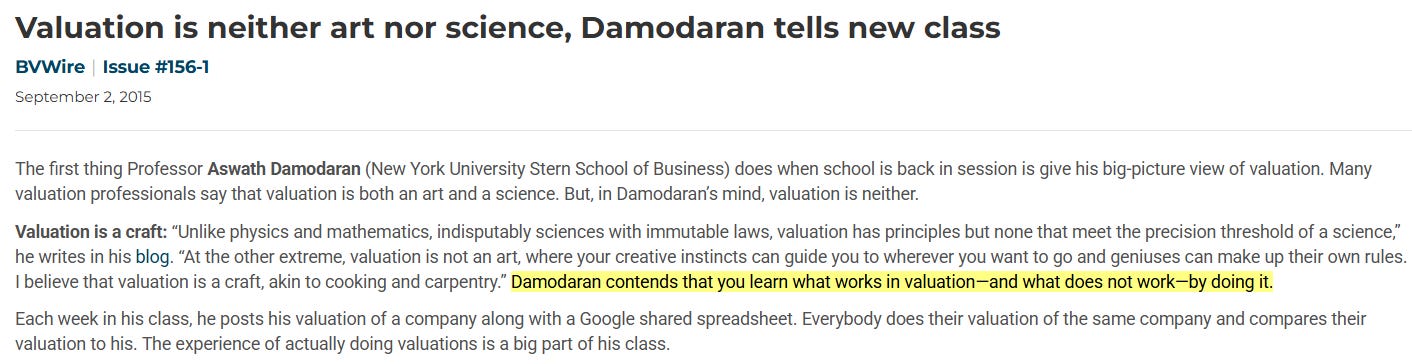
Valuation is not an exact science, as there is no single formula that applies to every case. At the same time, it is not purely an art, as there are still principles to follow.
As Aswath Damodaran once noted, valuation is a practical skill, and improving this skill depends on experience and continuous practice.
In this article, Viet Hustler will delve into a practical and effective approach to business valuation.
Understanding the business you want to invest in - The key to success
Qualitative valuation: Analyzing competitive advantages
Quantitative valuation:
Margin of safety principle
Business results forecasting
Determining comparison multiples
Determining discount rate
Applying to Apple case study
To make valuation more intuitive, this article will apply valuation principles to the Apple case study – one of the world's most successful businesses. The real-world analysis will clarify the approach from qualitative to quantitative, and show how to apply them to investing.