The US banking system with over 4,700 diverse banks plays an essential role in the global economy. The US banking crisis in March 2023 with the collapse of Silicon Valley Bank, Signature Bank, and recently Republic First Bank has raised concerns in the community. The main concern lies in the resilience of the banking system at different levels of scale and importance to the economy.
In today's article, Viet Hustler will introduce readers to the banking system, classification, and characteristics of banking groups in the US.
FYI: The main reason the US banking system is fragmented stems from 19th-century regulations that limited the scope of bank operations to prevent banks from becoming too powerful.
By the 1970s, states began repealing these rules.
The rise of technology and new financial products – ATMs, money market mutual funds, and improved credit scoring systems… allowed distant banks to provide financial services that previously only local banks could offer.
General Overview of the US Banking System
Banking operations in the US began in the 1780s, coinciding with the founding of the country.
First Bank of the United States was established in 1791 to finance the American Revolutionary War.
After merchants in the 13 colonies needed a currency as a medium of exchange, Bank of North America was opened to facilitate more complex financial transactions.
As of the end of 2023, there were 4,470 commercial banks and savings institutions insured by FDIC in the US
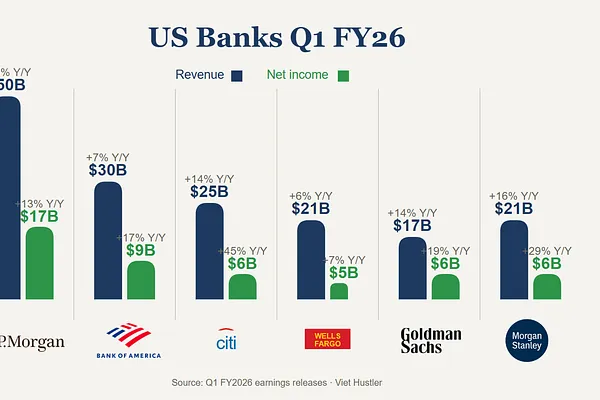
The top 4 largest banks in the United States are JPMorgan Chase, Bank of America, Wells Fargo, and Citibank.
The total assets of these Big 4 banks amount to 9,000 billion USD, equivalent to ~33% of the US GDP in 2023.
Bank Management System
In the US, banking operations are regulated at both federal and state levels, with the most prominent being Central Bank - Federal Reserves and US Federal Deposit Insurance Corporation (FDIC).
1. Federal Reserve - Federal Reserves
The Federal Reserve (Fed) is the US Central Bank, established on 12/23/1913.
The Fed is completely independent, not dependent on or influenced by the US government
The Fed is the only organization in the world permitted to print USD, playing a crucial role in formulating and adjusting monetary policy.
Structure of the US Federal Reserve System:
The Board of Governors consists of 7 members with 14-year terms, appointed by the US President.
Federal Open Market Committee (FOMC)
The FED's banks include 12 regional Federal Reserve Banks, located in major cities
Member banks
Fed's missions:
Promote employment and price stability through monetary policy
Regulate banks and ensure the stability and soundness of the financial system
Fed's monetary tools:
Open Market Operations OMO:
Buy - sell government bonds to regulate the money supply in the economy: through which it also adjusts interest rates in the free capital market.
When the Fed buys government bonds, a large amount of money is injected into circulation, increasing the money supply and lowering interest rates.
When the Fed sells government bonds, a large amount of money is withdrawn, reducing the money supply in the economy.
Meanwhile, demand has not decreased in time, interest rates rise, making bank borrowing more difficult.
Read more: Basic Macroeconomics - Money Supply and Money Market.
Required reserve ratio:
It is the amount of money that the Fed requires member commercial banks to reserve based on the amount of deposits raised, and they must not lend exceeding this reserve level.
When the required reserve ratio increases, the amount of money commercial banks can lend decreases, the money supply in the economy decreases, and interest rates will rise.
When the required reserve ratio decreases, the amount of money that can be lent increases, the money supply increases, and interest rates decrease.
Discount rate:
When needing capital for short-term needs, member commercial banks will borrow from the Fed at the discount rate < interbank lending rate.
2. Federal Deposit Insurance Corporation (FDIC)
The FDIC is an independent organization operating as a federal agency, managing a deposit insurance fund to protect depositors' funds.
The main mission of the FDIC is to protect and promote public confidence in the U.S. financial system through:
Insuring deposits at banks and savings associations;
Identifying, monitoring, and managing risks to the insured deposit funds;
Limiting the impact of bank or savings association failures on the economy and financial system.
The current insured deposit amount at banks managed by FDIC is 250,000 USD per account per bank.
Classification of bank groups
1. G-SIB banks group (Global Systemically Important Banks)
The Financial Stability Board (FSB) publishes a list of 30 banks important to the global financial system (G-SIBs) annually.
The list of globally systemically important banks (G-SIBs) is based on multiple factors:
Bank size
Degree of interconnectedness
Complexity
Systemically important banks must comply with more stringent requirements such as higher levels of capital buffers, or broader supervisory expectations.
FYI: In 2023, FSB removed Italy's UniCredit and Switzerland's Credit Suisse from this list.
Bank of Communications of China was added for the first time
=> Total number of banks on the list decreased from 30 in 2022 to 29
2. Regional banks group
In the U.S. financial landscape, regional banks and credit unions play a pivotal role, forming a solid foundation for community development.
The strength of regional banks lies in their local focus:
They can easily build lasting relationships with customers
=> Providing personalized financial services that meet the specific needs of individuals and businesses.
Ranking of the Best U.S. Regional Banks and Credit Unions by Plant-A Insights Group:
FYI: Although playing an important role in the local economy, regional banks are the most severely affected by rising interest rates and real estate market fluctuations.
282/4,000 U.S. banks may face a double threat from commercial real estate-related loans and potential bond losses in a higher interest rate environment.
Most of these are small banks with assets under 10 billion USD.
Read more: Risks from the current U.S. commercial real estate market
Since the regional banking crisis stemming from the SVB collapse in March 2023, regional bank indices have continued to struggle
Conclusion
The massive U.S. banking system serves as a pillar in the global economy, promoting development and prosperity. Oversight from the Fed and deposit insurance from FDIC make the banking system's operations more transparent.
With 10/29 banks on the G-SIBs list, the U.S. demonstrates its significant role in the global financial system. Meanwhile, the diverse regional banking system across states provides a solid foundation for local development.
However, hundreds of small U.S. banks are currently facing risks from commercial real estate-related loans and potential losses due to the high interest rate environment. Therefore, understanding the banking system, bank group classifications, and characteristics of each group will help investors better evaluate financial conditions, growth potential, and latent risks.


Comments (2)
Ah quên, xin được ủng hộ các bài viết của các bạn với góc nhìn của chuẩn mực kinh tế và có những nhận định giá trị
Tôi được biết thêm một chút về hệ thống nhưng thật sự cách vận hành và những tương quan qua lại giữa các ngân hàng thì tôi nhận thấy quá phức tạp, rắc rối và càng đi sâu vào tôi có cảm tưởng như mình lạc lối với mê cung trận. Rất mong các bạn có những bài viết liên quan hay ít nhất là tóm tắt lại những điều chính yếu nên được để ý. Xin cảm ơn
Login to comment