What Are the Threats to the US Economy and the Dollar's Position?
Last week's CPI data shows inflation continuing to decline as expected by the market, why did the FED lower the number of rate cuts and raise the inflation forecast for this year?
Employment data continues to stabilize, why does Powell feel worried about the economy in 2025?
Saudi Arabia may end the agreement to sell oil only in Dollars, is this the event marking the end of the Dollar's position?
The Volmageddon event on 02/05/2018 was one of the biggest shocks to the financial markets in the past decade. In just a few hours, the Dow Jones index dropped more than 1,000 points, marking one of the worst trading sessions in history. Exchange-traded products (ETPs - exchange-traded products) lost more than 90% of their value in just 1 day. The VIX index - Wall Street's "fear gauge" - surged double from 17 to 37, indicating that investors were extremely panicked and worried about market risks. VelocityShares Daily Inverse VIX Short-Term ETN (XIV) saw its asset value drop from 1.9 billion USD to just 63 million USD. The next day, 6 short-term volatility trading funds (short-term volatility) did not open for trading.
This event not only caused panic among investors but also highlighted the latent risks in the modern financial system, especially derivative financial instruments and ETF funds.
In this weekend knowledge article, Viet Hustler will recount the story of the terrifying Volmageddon event in 2018 and warn about the possibility of similar risks in the future.
Some terms to know
Before hearing the story about Volmageddon, readers will need to know some of the following terms:
1- VIX (CBOE - Cboe Volatility Index)
VIX (CBOE - Cboe Volatility Index) is the index measuring the overall level of market volatility in the next 30 days.
VIX does not measure past volatility but predicts future volatility levels, based on the trading volume of S&P500 (SPX) Options.
Because Options are contracts giving the right to buy stocks in the future.
The volume of Call/Put Options on the market clearly reflects investors' upcoming Bull/Bear sentiment.
High VIX: investors worry about strong market volatility.
Low VIX: investors predict a stable market.
2 - ETN (Exchange Traded Note)
ETN (Exchange Traded Note) is a derivative security whose value fluctuates according to the value of the index/asset/security that the ETN tracks.
FYI: ETN is exchange-traded -- but pays returns like a bond.
So does ETN sound similar to ETF? —> NOT SIMILAR !!
ETF is secured asset (secured)!
ETF funds will actually buy stocks in the exact proportion of the index or market cap of the sector they track…
…. then sell shares of those funds to investors.
That is, the value of ETF is still backed by the actual value of the stocks they hold.
While ETN is not a secured asset (unsecured)!
The ETN issuer will only pay investors the fluctuation differential of the security that the ETN tracks.
The time when ETN balances profit/loss with investors is when the ETN matures (similar to bond maturity — but bonds are still secured assets).
The day VIX doubled: The story of “Volmageddon”
Originating from a new ETN product by Credit Suisse
In November 2010, Credit Suisse issued a financial product named
XIV (VelocityShares Daily Inverse VIX Short-Term ETN)
If VIX measures the overall volatility of the stock market, then XIV is the opposite.
XIV provides daily returns inverse to the VIX index.
If VIX decreases, XIV will increase in value and vice versa.
In other words: XIV investors will benefit more when the market has low volatility!
XIV quickly became popular:
In 2015, the total trading value of XIV was about 830 million USD/day, more than blue-chip stocks like Johnson & Johnson and Wal-Mart at that time.
…while XIV only had 675 million USD in assets → Creating a yield of 122%/day, 31,000%/year!
In 5 years (2010-2015), XIV grew 325%.
Especially in 2017, one of the least volatile years since the 1960s, XIV became even more popular.
XIV's total assets under management reached nearly 1.9 billion USD.
XIV even had its own community on Reddit: tradeXIV
Warnings about XIV were also clearly stated in the prospectus:
In the prospectus it clearly states that if XIV's value drops more than 80% in a single trading session, the product may be shut down,
…however, the market's calmness at that time caused many investors to ignore it.
The nightmare named Volmageddon
Holding XIV is actually a form of short volatility trading!
Long volatility is when investors bet that the market will have high volatility:
=> They will buy leveraged products betting on high volatility like VIX.
Short volatility is the opposite: when investors bet on low volatility market (low volatility) => they will buy XIV.
In 2017: the financial market was calm and peaceful, causing investors to pour more money into leveraged short volatility assets like XIV.
And XIV investors completely collapsed when Volmageddon appeared.
Volmageddon is a term coined from 2 words Volatility and Armageddon (doomsday)
… a name that says it all:
On 02/05/2018, VIX more than doubled (115.6%).
All XIV investors lost nearly all their assets.
XIV's asset value dropped from 1.9 billion USD down to only 63 million USD and was forced to liquidate.
Dow Jones dropped 1,175 points in the day (~4.6%) - the largest drop in history at that time.
Recall: XIV prospectus has a clause
"If XIV loses more than 80% of its value in one day, Credit Suisse has the right to buy them back".
… And they did so.
Credit Suisse paid investors 5.99 USD/note,
…however, the previous session's closing price was 115.55 USD/note.
Investors were not at all satisfied, not only because they lost all their money, but because they thought Credit Suisse made a tidy profit!
Did Credit Suisse make a fortune from XIV?
Credit Suisse's Risk Hedging Mechanism:
Credit Suisse (the issuer of XIV) needs to hedge risks to ensure it can pay investors if XIV rises (i.e., VIX falls).
To do this, Credit Suisse used VIX futures, more specifically short VIX futures.
VIX falls → VIX futures also fall → Short VIX futures profits → Credit Suisse has money to cover payments to XIV investors.
Credit Suisse's Miscalculation:
Credit Suisse miscalculated: because VIX and XIV are two assets perfectly inversely correlated at 1:1 (correlation = -1)
When VIX spiked (02/05/2018) → Credit Suisse had to buy back a large amount of VIX futures to cover previous short positions
The higher VIX futures rose → Credit Suisse had to buy back the shorted VIX futures at higher prices…
→ The buy-sell feedback loop caused VIX futures to rise even higher → XIV fell even more sharply.
So in reality, Credit Suisse didn't profit at all:
The 100 million USD they collected from selling XIV earlier (and buying back cheaply), they had to use that exact 100 million USD to cover the equivalent short VIX positions from before.
Not to mention, they were later sued for market manipulation!
Will the 'ghost' of Volmageddon return?
Although the market is still in an uptrend, many opinions suggest the stock market has been quite boring lately.
S&P500 daily volatility has not exceeded 1% since the beginning of 2023.
VIX is fluctuating at quite low levels, near the lowest post-Covid period.
Inflation is gradually under control, the Fed doesn't need to apply overly aggressive policy changes to curb the economy,
… and tensions in the Middle East and Ukraine have eased.
But is everything really 'calm seas'?
Although S&P 500 appears stable, the index measuring VIX dispersion versus market expectations for SPX (= DSPX - VIX index) is rising to unprecedented highs (since data tracking began in 2014).
Meanwhile, recent increasing options trading volume also hints at a potential large volatility shift coming.
The market is showing significant divergence, especially in tech stocks
The concentration of stocks in a small group is even higher than the peak of the Great Depression in 1932.
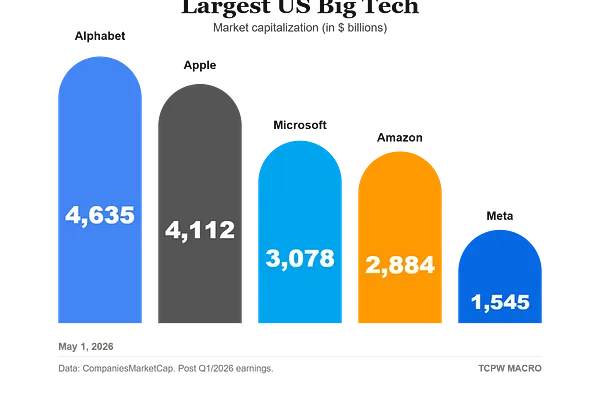
Top 10 companies in S&P500 contribute up to ~35% of total market cap - the highest ratio in over 50 years.
→ Some stocks are leading the entire market, especially the tech stock group.
Not to mention the impact of the recent meme stock frenzy, with some surging nearly 250% in just 3 days.
→ Easy money from meme stock investors seeking quick profits raises concerns that the market is being pushed unsustainably high!
Latent volatility risk makes investors worry about a Volmageddon recurrence.
However, in reality, the current VIX is not as 'silent' as the period before Volmageddon.
Before Volmageddon, the market had no moves over 1% for 93 straight days.
While this year, the longest recorded streak is only 15 days.
CONCLUSION
The 2018 Volmageddon event is a warning about the risky financial markets facing sudden volatility. Risk managers need to balance between strategies of using leverage vs hedging risks, especially when the market has high concentration and high volatility.
Currently, there are concerns that investors are becoming overly “complacent” that no negative factors are imminent, inadvertently masking unusual fluctuations. This could lead to sudden market disruptions, similar to the Volmageddon event in 2018—when the VIX surged too abruptly, significantly disrupting the market.
However, history seems unlikely to repeat itself. The difference in the VIX index shows that the market “subdued but not overly subdued” like the period before Volmageddon 2018. What experts are more concerned about is that investors are becoming overly confident in the market. Unexpected events related to the economy, AI, Fed policy, or geopolitical risks could have serious impacts, requiring investors to always remain vigilant and well-prepared.


Comments (0)
No comments yet
Be the first to comment
Login to comment