October job openings drop to lowest level in over 2 years
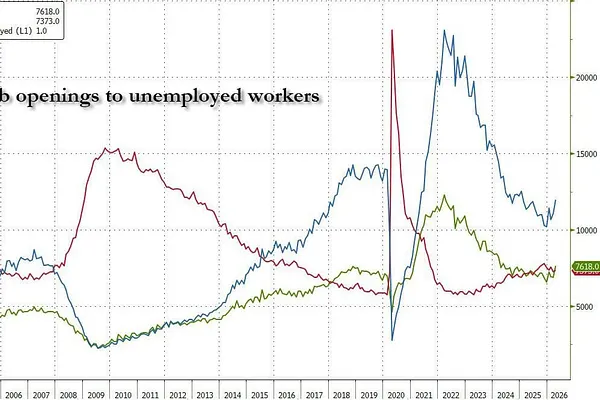
October job openings at 8.7 million, the lowest since the economy reopened in Q1 2021.
JOLTS new hiring rate has decreased -0.9bps over the past 6 months, not as sharply as in previous months, but still faster than historically.
New hiring rate = Number of new job openings / total current jobs.
According to BLS, the sector with the largest job decline is:
Health care and social assistance (-236,000)
Finance and insurance (-168,000)
Real estate and rental (-49,000).
Job openings increased thanks to the information technology sector (+39,000).
The decline in October job openings caused the gap: number of job openings - number of unemployed workers to drop to 2.227 million - the lowest gap since July 2021.
Similarly, the ratio job openings / number of unemployed also dropped to just 1.34 - the lowest since August 2021.
This figure is almost back to the pre-pandemic 1.3 level, a sharp drop from the record 2.0 reached in early 2022.
Quits - an indicator closely tied to labor market strength, also fell -18,000 to 3.628 million, the second lowest since March 2021.
Quits rate remained at 2.3% in October, the fourth consecutive month unchanged
October hires also fell -20,000 to 5.886 million.
November Services PMI rebounds
S&P Global November Services PMI rose to 50.8 from 50.6 in October (unchanged from preliminary data).
ISM Services PMI higher than expected, up from 51.8 in October to 52.7.
Of which:
Employment increased less than expected
New orders unchanged
Prices Paid decreased.
While both S&P and ISM Manufacturing PMIs show contraction, the Services sector shows demand for services remains strong…
— the main reason why services inflation may persist.
Behind the impressive US stock rally: 350 billion USD liquidity injected into the market in November
According to Goldman Sachs, up to +350 billion USD liquidity was added to the market in November/2023
First, reserves at US commercial banks declined, accompanied by the market rally indicating that this money may have been pumped by banks into free market liquidity.
The Fed adding 60 billion USD for the third consecutive week (via RRP and TGA) plus USD weakness as the main drivers.
While BoJ continues to add liquidity through bond purchases, the increase in bond account balances over the past 20 days has net drained JPY liquidity.
However, US and Eurozone loan growth and money supply indicators remain weak:
Lending activity by commercial banks in the US and Eurozone remains quite weak, indicating reduced borrowing demand — a direct consequence of high interest rates in both regions.
Everyone investing in money market funds MMF due to high interest rates also contributes to overall liquidity increase, but reduces deposits at banks.
Other news
Moody's confirms downgrade of China's rating to A1, lowers the country's outlook from "stable" to "negative".
Chinese stocks have fallen to the lowest level in 5 years.
Fed's balance sheet is at the lowest level since April 2021, down 1.17 trillion USD from the peak in April 2022.
Saudi Arabia's Energy Minister said today that OPEC+'s oil production cuts could "completely" continue through Q1/2024 if needed.
Vladimir Putin will visit UAE and Saudi Arabia this week, presidential aide Yury Ushakov told the media.
German 10-year government bonds fall to the lowest level since June.
Consumer giant Procter & Gamble Co. is expected to spend >2 billion USD on restructuring and resolving Gillette's losses - the company that P&G acquired in 2005.


Comments (0)
No comments yet
Be the first to comment
Login to comment